Types of Grey Marble: Complete Guide to Luxury Varieties for 2026 Design
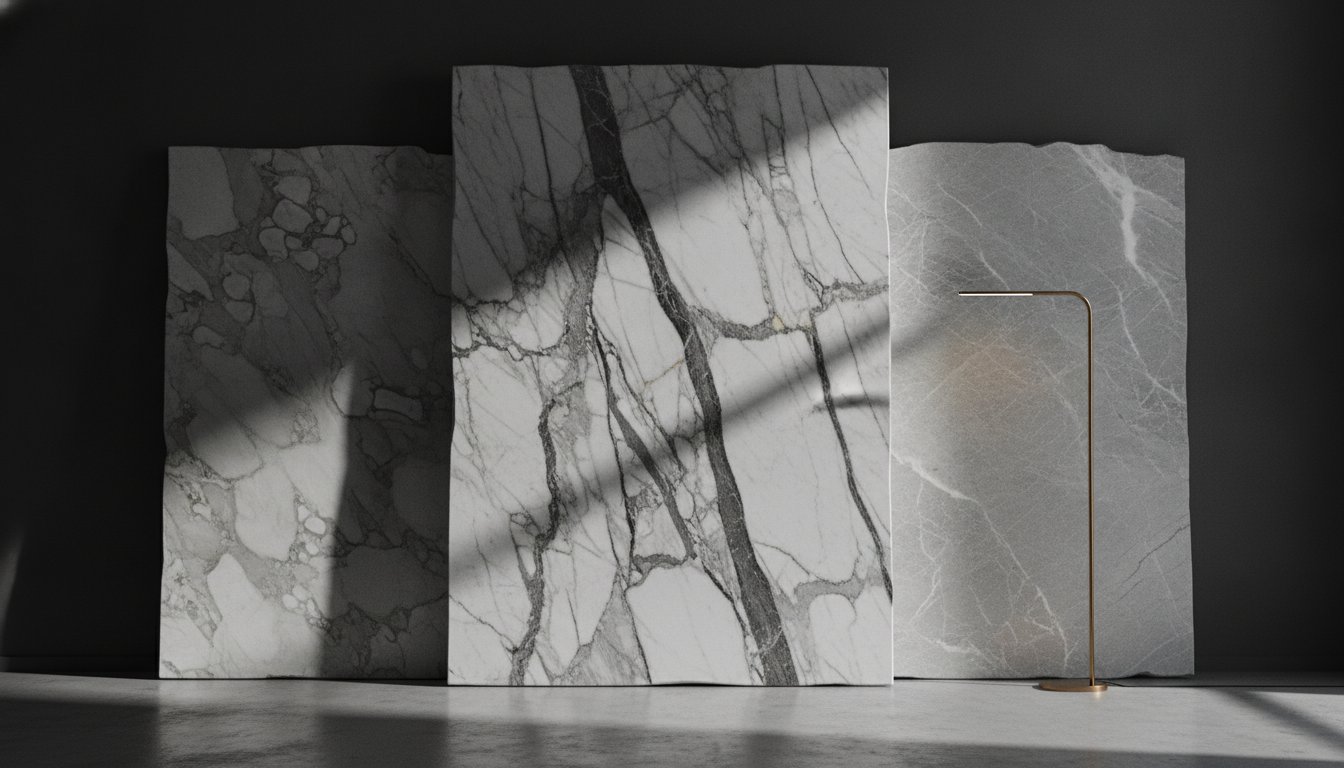
Why Grey Marble is Becoming the Structural Core of Ambitious 2026 Architectural Projects
Choosing the ideal natural stone requires a sensitivity that goes beyond a mere aesthetic glance. We know how complex it can be to distinguish between the various types of grey marble available on the market, especially when the difference between a Bardiglio and a Grigio Carnico lies in millimeter-level details that radically change the soul of a luxury environment.
This comprehensive guide will accompany you in discovering the most exclusive varieties, offering the clarity needed to transform any technical uncertainty into a conscious, high-profile design choice. We promise to unveil the secrets of the most sought-after veins, providing the tools to evaluate the quality of a slab and ensuring compliance with the new GWP environmental regulations required by the sector. Together, we will explore the depths of Fior di Bosco and the warm nuances of Tundra Gray, analyzing color pairings and ideal applications for surfaces that demand prestige, character, and an unmistakable aesthetic signature.
Key Points
- Discover why grey marble has become the essential element for luxury minimalism in 2026, offering unparalleled chromatic versatility in architectural projects.
- Learn to distinguish the main types of grey marble, from the cerulean shades of Bardiglio to the resolute character of Grigio Carnico, to select the perfect variety for every environment.
- Understand how the choice of surface finish can radically transform the visual perception of the veins and the chromatic depth of the natural slab.
- Evaluate the best technical applications, from durable high-traffic flooring to scenographic vertical wall coverings for high-profile hotels and residences.
- Acquire professional criteria for inspecting slab quality prior to purchase, ensuring the aesthetic excellence and technical compliance of your investment.
Table of Contents
- The Aesthetics of Grey Marble: Versatility and Prestige in Design
- The Main Types of Grey Marble: A Technical Overview
- Visual Characteristics: Veins and Slab Finishes
- Applications in Interior Design and Architecture
- Sourcing Guide: Choosing MARMISAVAS as a Partner
The Aesthetics of Grey Marble: Versatility and Prestige in Design
Grey marble no longer represents a simple zone of shadow between black and white. In 2026, it has established itself as the cornerstone of luxury minimalism thanks to its ability to offer dynamic neutrality. This stone does not merely occupy space; it defines it through a chromatic psychology that evokes solidity, balance, and a whispered sophistication. Architects choose these tones to create environments that convey calm without appearing static. Grey marble has the unique power to act as a visual bridge, enhancing both the purity of white veins and the strength of black details present within the stone's own structure.
Exploring the different types of grey marble means immersing oneself in a palette that responds to the demands of the most sophisticated contemporary design. The current trend sees a shift from cold, purely industrial greys toward more welcoming shades with taupe and beige undertones. This evolution makes it possible to maintain the intrinsic elegance of grey while adding a warmth that makes residential spaces much more inviting. The versatility of this material makes it perfect for dialoguing with noble metals like brass or with precious woods, creating high-level material contrasts that endure over time.
Why Choose Grey Marble Instead of Synthetic Materials?
Opting for natural stone is a value-driven choice that transcends momentary aesthetics. Each slab of marble is an unrepeatable geological document, characterized by a visual depth that industrial products cannot match. While porcelain stoneware prints a two-dimensional pattern on the surface, natural stone lives in every single millimeter. Light interacts with internal minerals, creating plays of refraction that give a soul to the surface. In a real estate market increasingly attentive to construction quality, the use of authentic grey marble represents a tangible investment, increasing the prestige and resale value of any luxury property.
The Chromatic Range: From Pearl to Anthracite
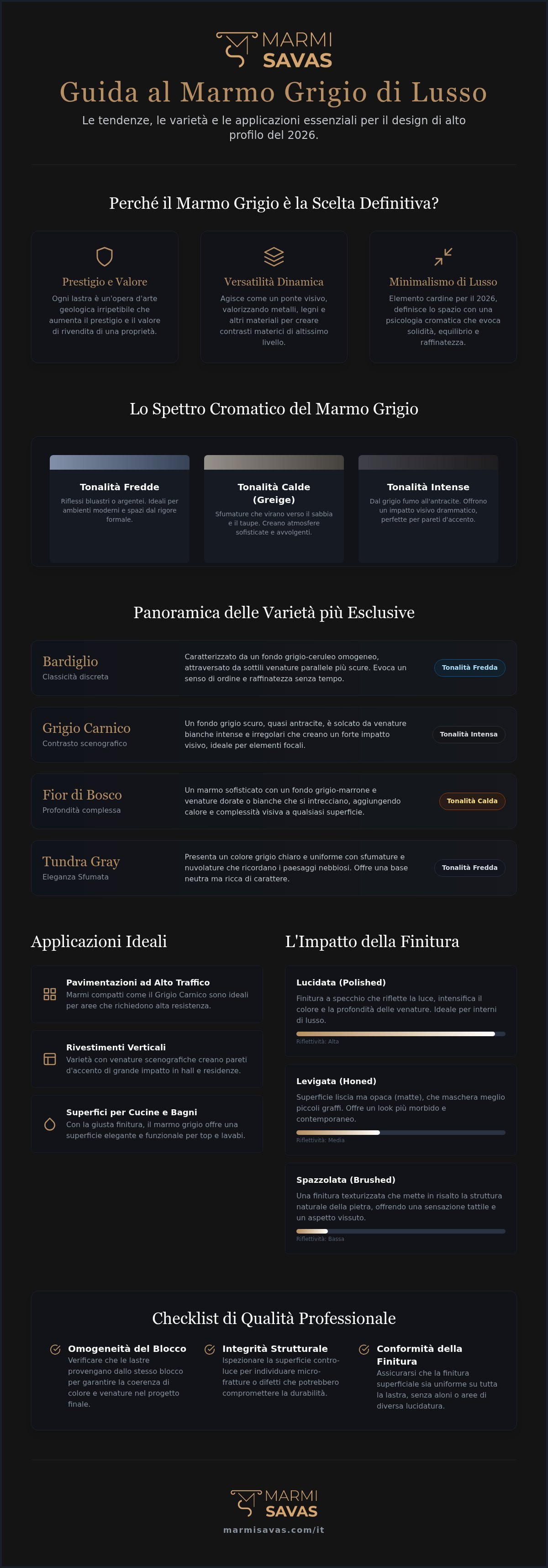
The classification of grey tones is vast and allows for extreme project customization. We can distinguish varieties based on their visual temperature:
- Cold Tones: Varieties with bluish or silvery reflections, ideal for modern environments, corporate offices, and spaces of formal rigor.
- Warm Tones (Greige): Marbles with shades shifting toward sand, perfect for creating sophisticated, intimate, and enveloping atmospheres.
- Intense Tones: From smoke grey to deep anthracite, these stones offer a dramatic visual impact, excelling in the creation of accent walls or sculptural elements.
The perception of these shades is closely tied to the natural light present in the environment. A pearl grey surface can appear almost white under the midday sun, only to reveal its full chromatic complexity with evening shadows. This mutability is what makes marble a living material, capable of transforming the sensory experience of a space throughout the day.
The Main Types of Grey Marble: A Technical Overview
Material selection is the crucial moment when architectural vision turns into tangible reality. Understanding the technical nuances of the various types of grey marble is essential to calibrating a project's atmosphere with millimeter precision. Each variety possesses a mineral density and petrographic pattern that determine not only its aesthetics but also its ideal destination of use within high-profile residential or commercial contexts.
Bardiglio Marble represents one of the most authentic expressions of national quarrying tradition. Its parallel veins and cerulean shades create an orderly visual effect, ideal for those seeking discreet, timeless classicism. For projects requiring a bolder character, Grigio Carnico is often the choice of preference. Its dark grey, almost anthracite background is furrowed by intense, irregular white veins that generate a scenographic color contrast, perfect for elements that must serve as a focal point in the room.
Among the classic stones dominating contemporary design, Pietra Grey holds a place of honor. Its uniform background and subtle veins make it a favored material for minimalist furnishings and continuous flooring. Other varieties, such as Grigio Billiemi, stand out for their exceptional compactness, making them ideal for large-scale surfaces subject to heavy foot traffic. For those seeking movement and dynamism, Grigio Versilia offers a sophisticated alternative, with cloud-like patterns that seem to shift under natural light.
Italian Grey Marbles: Excellence and Tradition
Italy preserves grey varieties of rare beauty that perfectly complement the most celebrated white marble collections. The historical bond between monumental architecture and the use of grey natural stones testifies to the durability and prestige of these materials. Relying on excellent Italian sourcing means accessing quarrying expertise that guarantees the structural integrity of the slabs, a determining factor for the success of large-scale projects requiring uniformity and consistent quality.
Trending International Varieties
The global landscape offers fascinating options that integrate harmoniously with domestic stones. Tundra Grey has become a benchmark for its delicate cloud-like softness, capable of illuminating open, modern spaces without the coldness of pure white. Silver Shadow, with its nearly pearlescent light grey tone, is the ideal choice for environments requiring subdued luminosity and whispered elegance.
When selecting material, it is useful to consider the following technical parameters:
- Porosity: Denser varieties tend to be less absorbent and easier to maintain.
- Polishability: Mineral composition influences the final brilliance of the surface.
- Mechanical Resistance: An essential parameter for defining durability in high-traffic contexts.
Choosing the perfect slab requires an expert eye that knows how to read beyond the surface of the stone. If you wish to delve into the technical characteristics of a specific variety for your next project, you can contact our consultants for dedicated, personalized support.
Visual Characteristics: Veins and Slab Finishes
The aesthetics of grey marble types depend not only on their geological origin, but also on the complex architecture of their veins. Each extracted block reveals a unique pattern that can be classified into four main categories: brecciated, linear, cloudy, or dotted. Brecciated veins feature mineral fragments that appear embedded in a natural cementitious matrix, creating a three-dimensional depth effect. Conversely, linear veins offer a geometric rigor that visually lengthens spaces, ideal for corridors or grand halls. Cloudy varieties soften tones into subtle chromatic shifts, while dotted ones recall the granular texture of ancient, solid stones.
A crucial technical aspect for designers is the average density of these stones. Grey marbles tend to have a higher hardness compared to some softer white varieties. This makes them excellent for applications requiring greater mechanical resistance while retaining the elegance of natural stone. The final aesthetic rendering is also determined by the choice of installation layout. The open-mappa or bookmatch technique is particularly effective with veined grey marbles. By placing two mirror-image slabs side by side, symmetrical patterns are obtained that transform a simple wall into a natural work of art, emphasizing the continuity of mineral lines.
The Impact of Polishing vs. Honing
Surface finishing is not just a tactile detail; it is a chromatic filter that transforms the hue of grey. A polished finish acts as a magnifying glass: it darkens the stone's background and accentuates contrast with the white veins, conferring a regal, mirror-like appearance. If you seek a more contemporary and discreet effect, a honed finish offers a silky, matte surface. This choice softens tones, making the marble less reflective and better suited to contexts with diffused lighting. For vertical coverings of great sensory impact, brushed or sandblasted finishes create tactile textures that add a material dimension to interior design.
Evaluating Vein Quality
Knowing how to read a slab is a fundamental skill to ensure project success. It is necessary to distinguish between desired mineral intrusions, which impart character, and structural defects that could compromise the material's integrity. The cutting direction determines whether the pattern will appear linear or cloudy, influencing not only aesthetics but also budget management. For a detailed overview of the costs associated with slab selection, you can consult our guide on marble prices per square meter. Choosing the correct orientation allows you to optimize the visual yield of every single slab, enhancing your investment in premium materials and ensuring an outcome of excellence.
Applications in Interior Design and Architecture
The choice of grey marble defines the visual hierarchy of an architectural space. In residential and commercial flooring, these stones offer a pragmatic advantage: their chromatic complexity masks daily wear and tear much better than absolute whites. Durability is an absolute priority for high-traffic areas such as entrances or large living zones. For a technical deep dive into the stones best suited for these surfaces, you can explore our guide on marble for flooring.
Vertical wall coverings represent the most scenographic use of the material. In luxury hotels, an accent wall made of grey marble slabs laid out in an open-book (bookmatch) pattern creates a focal point that immediately communicates prestige and solidity. The kitchen environment also benefits from the sobriety of grey. The use of slabs for countertops and backsplashes allows for the creation of a continuous surface that resists time and trends. In the bathroom, Bardiglio Marble is the undisputed protagonist. Its cerulean tones and subtle veins evoke an aquatic serenity, ideal for transforming a high-end suite into a true private spa.
Color and Material Pairings
The secret to successful design lies in the dialogue between materials. The different types of grey marble pair exceptionally well with natural wood. The warmth of Canaletto walnut or the texture of brushed oak balances the natural coldness of the stone. Metals also play a fundamental role. Satin brass adds a touch of vintage luxury to the grey veins, while stainless steel reinforces a clean, rigorous industrial-chic aesthetic.
Contract Projects and Large Works
Managing large-scale projects requires a supplier capable of guaranteeing chromatic continuity across thousands of square meters. For hotel lobbies or executive offices, the use of grey marble tiles represents an efficient solution that does not sacrifice elegance. Consistency in block selection is vital to avoid unpleasant visual breaks between different areas of the building. Although marble is predominantly an indoor material, certain particularly dense grey varieties can be evaluated for protected exterior cladding, provided appropriate finishes are used to withstand weathering.
If your project requires a custom selection of slabs or consulting on the best formats for your specific needs, our team is ready to support your creative vision with competence and passion.
Sourcing Guide: Choosing MARMISAVAS as a Partner
Moving from design vision to material realization requires a partner who speaks the same language as architects and interior designers. Choosing among the various types of grey marble is only the first step in a complex process involving selection, logistics, and technical consulting. MARMISAVAS positions itself as a global curator, capable of interpreting the aesthetic needs of professionals and transforming them into supplies of excellence, ensuring that every slab meets the quality standards required by the luxury market in 2026.
Slab inspection is a critical phase that allows no approximations. Before purchase, our experts verify the structural integrity of the material, analyzing the presence of natural micro-fractures or mineral intrusions that could affect processing. We meticulously check the chromatic continuity between blocks, a determining factor when covering large surfaces. Our technical consulting aims to optimize cutting, reducing waste and ensuring that the vein pattern is maximized, avoiding unexpected costs during installation.
Logistics management represents another pillar of our service. Shipping precious stone materials throughout Italy requires rigorous planning and the use of specific packaging to prevent any damage. MARMISAVAS coordinates every phase of transport, ensuring that the slabs arrive at the construction site or workshop on schedule, ready to be transformed by our clients' trusted stone artisans.
Supply Customization
Every project has unique needs in terms of format and finish. We accompany designers from block selection directly in the quarry all the way to the production of custom tiles for complex flooring. Our support includes budget analysis, suggesting the varieties that offer the best balance between aesthetics and investment. If a project requires a warmer atmosphere than grey tones, we propose sophisticated alternatives such as brown marble, perfect for creating enveloping material contrasts.
Contact Our Experts
For architecture studios requiring physical samples for their moodboards, we offer a rapid sample shipping service. We also support professionals in drafting specifications for natural stones, providing detailed technical data sheets and updated environmental certifications. We are convinced that direct collaboration is the key to the success of every great architectural work. We invite you to contact MARMISAVAS to discuss the details of your next project and discover how our expertise can make a difference in selecting the most exclusive materials.
Defining the Future of Design with Natural Stone
Choosing among the different types of grey marble means investing in a material that unites the immutability of geology with the modernity of 2026 trends. We have analyzed how pattern variety and the choice of the correct finish can radically transform the chromatic yield of a slab, making it the protagonist of durable flooring or high-profile scenographic wall coverings. The technical complexity of these stones requires a vision that goes beyond a simple catalog, focusing on mineral quality and sourcing precision to ensure excellent results.
MARMISAVAS places decades of experience in sourcing Italian and international natural stones at your disposal. As a specialized supplier for architects and designers, we ensure a wide availability of high-quality slabs selected to meet the challenges of the most ambitious and complex projects. We are ready to become your strategic partner, offering technical and logistics consulting of excellence to enhance every space with the authentic elegance of marble. Contact our experts to discover our exclusive selection of grey marble. We are enthusiastic about contributing to the realization of your creative vision.
Frequently Asked Questions About Grey Marble
Which grey marbles are the most resistant for high-foot-traffic flooring?
Grigio Carnico and Grigio Billiemi are among the most robust options for flooring subject to frequent wear. Their high mineral density guarantees superior mechanical resistance compared to softer varieties. These materials maintain structural integrity even in prestigious commercial contexts. It is essential to select the correct finish, such as honed or brushed, to minimize the visibility of any surface scratches over time.
Is grey marble suitable for kitchen countertops, or does it tend to stain?
Application in the kitchen is possible and highly sought after for the sophisticated aesthetic it offers. However, being a natural calcareous stone, grey marble is sensitive to acidic substances like lemon or vinegar. To preserve the slabs, applying professional water- and oil-repellent protective treatments is indispensable. Constant maintenance and the use of cutting boards prevent direct contact with staining agents, keeping the beauty of the natural veins unaltered.
What is the main difference between Bardiglio marble and Grigio Carnico marble?
The distinction lies primarily in chromatic intensity and mineral pattern. Bardiglio is characterized by a cerulean grey background with subtle, parallel veins, offering a calm and uniform appearance. Grigio Carnico, on the other hand, features a dark grey, almost anthracite background furrowed by bold, fragmented white veins. This aesthetic difference makes Bardiglio ideal for spa environments, while Carnico excels as a characterful architectural accent element.
How can I clean and maintain the brilliance of polished grey marble?
Maintenance requires the exclusive use of pH-neutral detergents specific for natural stones. Absolutely avoid aggressive products, descalers, or acidic home remedies that could corrode the surface polish. To preserve the mirror-like brilliance of the various types of grey marble, we recommend regular cleaning with soft microfiber cloths. Periodically, it is appropriate to renew the surface sealing treatment to protect the natural porosity of the material from liquid absorption.
Can grey marble be used for exterior cladding?
Outdoor use is limited to specific varieties and depends heavily on local climatic conditions. Only grey marbles with low porosity and high frost resistance are suitable. In these cases, a polished finish is discouraged because weathering would quickly dull the surface. Sandblasted, bush-hammered, or flamed finishes are preferred, as they also guarantee anti-slip properties essential for the safety of outdoor flooring in residential or public contexts.
Is it possible to order grey marble slabs with an open-book (bookmatch) vein pattern?
Certainly, bookmatch installation is one of the most frequent requests for luxury projects. This technique involves cutting consecutive slabs from the same block to achieve a mirror-image, symmetrical pattern. Varieties with bold veins are the most suitable for this purpose. MARMISAVAS selects specific blocks to ensure that pattern continuity is perfect, creating accent walls that look like true natural works of art inside lobbies or living zones.
What factors influence the price of grey marble per square meter?
The value of a slab depends on the rarity of the variety, the purity of the background, and the continuity of the veins. Slab size plays a crucial role: large pieces without structural defects command higher prices. Other factors include quarry yield in a given period and the complexity of the required finish. The quality of the selection made by the supplier ensures that the investment corresponds to a material free of unpleasant impurities.
Are there varieties of grey marble with warm tones similar to taupe?
Tundra Grey and certain selections of Fior di Bosco offer splendid tones that lean toward greige or taupe. These types of grey marble are highly appreciated for their ability to warm up an environment, moving away from the rigor of cold greys. They pair perfectly with natural materials like oak wood, creating an enveloping chromatic balance. These varieties represent the ideal choice for anyone seeking sophisticated yet welcoming neutrality in contemporary design.