Calacatta vs Carrara: A Guide to Choosing Between the Finest White Marbles
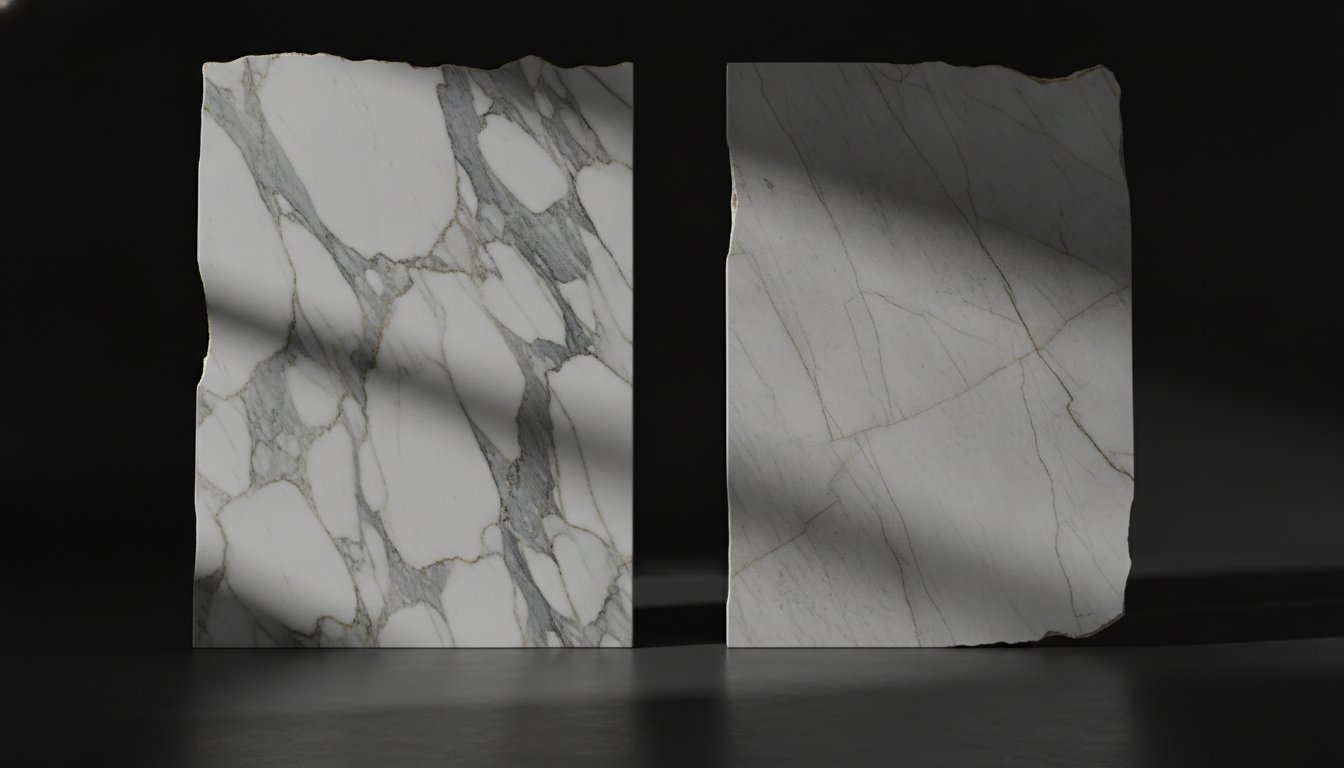
What would happen if the prestige of your next interior design project depended on a slightly more pronounced vein or a just slightly milkier background? In the clash of Calacatta vs. Carrara, the distinction lies not only in commercial value, but in the very soul of the stone that will define the identity of an exclusive space. Many professionals feel the pressure to consider industrial imitations, yet they fear that a lack of authenticity could compromise the visual impact and longevity of the work.
At MARMISAVAS, we share your pursuit of perfection and understand how complex it is to source premium-choice slabs that guarantee aesthetic consistency across large surfaces. In this guide, you will discover how to precisely distinguish between these two excellences from prestigious Italian quarries to select the ideal raw material for your standards. We will examine the technical characteristics, the hierarchy of value, and the objective criteria for recognizing superior-quality natural marble—an investment that saw national luxury marble exports grow by 12.3% to reach 805 million euros, testifying to an appeal that knows no crisis.
Key Takeaways
- Identify common roots in the Apuan Alps and the structural differences that make each slab an unrepeatable piece of Italian geological history.
- Analyze the chromatic contrast in the Calacatta vs. Carrara comparison to choose between the discreet elegance of a gray background and the bold luxury of dramatic veining.
- Evaluate the competitive advantages of natural marble over imitations, focusing on the luminous depth and intrinsic value that only authentic stone can offer.
- Learn technical criteria for professional selection, from inspecting micro-fissures to designing bookmatched layouts for high-impact scenic surfaces.
Index
- The Legacy of White Marble: Origins of Calacatta and Carrara
- Aesthetic Analysis: Visual Differences Between Carrara and Calacatta
- Natural Marble vs. Imitations: Why Authenticity is an Investment
- Applications and Design: Which Marble to Choose for Your Project?
- Professional Sourcing: The MARMISAVAS Approach to Premium Slabs
1. The Legacy of White Marble: Origins of Calacatta and Carrara
The beating heart of Italian natural stone lies among the peaks of the Apuan Alps, a territory where geology has met art for millennia. In this setting, nature took geological eras to distill what we consider today to be the pinnacle of architectural elegance. In the Calacatta vs. Carrara debate, it is fundamental to understand that we are not just talking about aesthetic variants, but distinct geological identities born from the same mining basin. In a global market where the Carrara district generated an export value of 805 million euros, distinguishing between these varieties becomes a decisive economic and design factor for every professional in the sector.
Bianco Carrara Marble represents the global icon of classical sculpture and architecture. It is the most extracted and widely known variety in the world, characterized by a light gray base and subtle veins that blend softly into the background. The history of Carrara marble dates back to the Roman era, establishing itself as the gold standard for those seeking continuity and tradition. Conversely, Calacatta is synonymous with extreme rarity. Extracted in limited quantities, this marble stands out for its incredibly pure milky white background and bold veining, ranging from dark gray to gold, making it a niche choice for ultra-high-profile projects.
Geology and Formation: Why They Are Not the Same Marble
Although both come from the same Tuscan region, their formation reflects crucial differences in the metamorphic pressure undergone by the limestone sediments. Carrara features a fine and uniform crystalline structure that absorbs light in a soft, homogeneous way. Calacatta, thanks to a higher concentration of calcium carbonate and more selective geological processes, offers superior translucency. This mineral purity allows light to penetrate deeper into the crystal, giving the slabs a vitality that industrial imitations simply cannot replicate. The limited availability of Calacatta stems from the fact that only a few veins within the quarries produce this degree of whiteness and dramatic veining, making every block a precious discovery.
Marble as a Status Symbol in Contemporary Design
Today, choosing between these materials defines the character and prestige of an environment. White marble is no longer a simple covering; it is a design language. In minimalist projects, Carrara offers a relaxing and sophisticated texture for extensive flooring or timeless bathrooms. Architects often look to premium Calacatta Marble selections to create high-impact focal points, such as backlit walls, monumental fireplaces, or kitchen islands that dominate the space. Choosing natural stone means investing in an asset that gains value over time, defying trends with the power of its historical heritage.
2. Aesthetic Analysis: Visual Differences Between Carrara and Calacatta
Recognizing the differences in the Calacatta vs. Carrara comparison at a glance is a skill that transforms a simple supplier into an aesthetic consultant. Although both belong to the Apuan white family, their visual personalities diverge drastically. The background color is the first indicator. Carrara presents itself with an ethereal gray tone, often defined as "clouded" (nuvolato), which provides a visual softness ideal for spaces requiring continuity. On the contrary, Calacatta boasts a vibrant, luminous milky white background that acts as the perfect canvas for much more decisive veining.
Identikit of Bianco Carrara Marble
Bianco Carrara marble is famous for its thin, grayish, and branched veins distributed uniformly across the surface. In the professional sector, the classification is mainly divided into C and CD grades. Grade C features a lighter background and more defined veins, while CD tends toward a darker, deeper gray. This stone is the preferred choice for large-scale flooring and classic claddings, where the natural repetition of the pattern creates a sense of calm and solidity. Its aesthetic is intrinsically linked to a discreet refinement that never tires the eye.
Identikit of Calacatta Marble
If Carrara is whispered, Calacatta is a shout of elegance. Its most sought-after varieties, such as Calacatta Oro (Gold), Borghini, or Vagli, showcase bold and often "ovoidal" veins that create unparalleled visual drama. The shades range from the warm tones of gold and beige to deep grays, making each slab a work of art in its own right. This variety is ideal for focal points where the stone must be the protagonist, such as monumental kitchen islands, accent walls, or luxury master bathrooms. The structure of the veins also allows for spectacular bookmatched (macchia aperta) installations, where the natural patterns mirror each other with millimeter precision.
Technical Note: An often underestimated technical element is the crystalline "sparkle." Under natural light, the surface of the marble reveals its mineral structure. Quarrying and geology directly influence this translucency. Calacatta tends to have a coarser grain that reflects light more sharply compared to the fine grain of Carrara. This interaction with ambient lighting can radically change the perception of the space, making the environment feel warmer or cooler depending on the variety chosen.
3. Natural Marble vs. Imitations: Why Authenticity is an Investment
Choosing between Calacatta and Carrara means investing in a living material capable of interacting with space through a depth that no industrial product can emulate. Many porcelain stoneware manufacturers promote their slabs as indistinguishable alternative options to stone. The technical reality tells a different story. Natural marble possesses a three-dimensional crystalline structure. Light does not stop at the surface; it penetrates the first few millimeters of the calcium carbonate, refracting among the crystals. This creates an internal vitality that flat, matte digital printing on porcelain can never replicate.
Uniqueness represents the second pillar of economic value. In a luxury project, repetition is the enemy of exclusivity. While industrial machines print patterns that inevitably repeat every few meters, every single slab of Calacatta or Carrara is a one-of-a-kind piece in the universe. This rarity directly impacts property valuation. A kitchen clad in authentic white marble is a safe-haven asset that maintains the property's prestige over time, distinguishing itself from synthetic finishes subject to rapid obsolescence.
Beyond Aesthetics: The Tactile Sensation of Stone
Physical contact offers an unparalleled sensory experience. Marble has a thermal mass that keeps it cool to the touch, gradually adapting to the room's ambient temperature. This natural texture, free of the plastic resins typical of engineered materials, conveys solidity and hygiene. Over decades, the stone develops a noble patina that adds charm rather than diminishing it. Furthermore, it is a sustainable choice: a material born from the earth that does not emit volatile organic compounds (VOCs) inside the home.
Professional Maintenance: Myths and Reality
There is a myth that marble is too delicate for daily use. On the contrary, natural stone is one of the most resilient materials available. If a porcelain slab chips, the damage is permanent because it exposes the underlying ceramic substrate. Marble, however, can be restored indefinitely. A scratch or a stain can be removed through professional honing or polishing. The surface returns to its original splendor even after fifty years of use. It is a life cycle that industrial materials simply cannot sustain.
- Protection: Use modern water-repellent treatments that protect the stone's breathability without altering its color.
- Cleaning: Clean daily with pH-neutral detergents to preserve the brilliance of the crystals.
- Appreciation: Consider the marks of time as tangible proof of the material's authenticity.

4. Applications and Design: Which Marble to Choose for Your Project?
The intended use is the ultimate deciding factor in the Calacatta vs. Carrara comparison. If the goal is to create an architectural feature that commands attention, Calacatta is unsurpassable. Its veined structure lends itself magnificently to the art of bookmatching. This technique consists of placing two or more slabs cut consecutively from the same block side by side, creating a mirrored pattern reminiscent of butterfly wings. This is a high-level design solution often used for monumental shower walls or headboards that become genuine natural works of art.
When it comes to color pairings, the purity of white blends elegantly with warm materials like oak wood or metallic finishes like brass and bronze. Looking for a sharper, more rigorous contrast? Pairing it with black marble creates a timeless aesthetic typical of luxury entryways and prestigious hotel suites. Planning the slab layout is a critical step to minimize waste, especially with such rare materials. Accurate veining mapping prior to installation ensures that the design flows seamlessly through the space, optimizing your investment in the raw material.
Calacatta in the Kitchen and Bathroom
In the kitchen, a monolithic island in Calacatta Oro becomes the visual anchor of the home. Its warm veins elevate the environment from purely functional to a statement space. If you desire even greater dynamism, Arabescato offers tighter, more complex ovoid patterns, perfect for those seeking constant visual movement. In the bathroom, full-height wall claddings transform the space into a private spa. The translucency of the stone envelops the user in an embrace of natural light and material warmth, elevating daily well-being.
Carrara for Wide-Open Flooring
When the project involves extensive square footage, such as the living areas of a villa or the lobbies of a residential complex, Carrara is the most balanced choice. Its chromatic uniformity allows it to cover large surfaces without abrupt visual breaks, guaranteeing a cohesion that is difficult to achieve with stones featuring overly bold veining. The constant availability of homogeneous lots makes Carrara ideal for the contract sector and large-scale real estate developments.
5. Sourcing Professional: The MARMISAVAS Approach to Premium Slabs
Our mission begins where the earth opens, in the heart of the Apuan quarries. Choosing between Calacatta and Carrara requires a vision that goes beyond simple surface aesthetics. For an architect or a contractor, the quality of a slab is measured by its structural integrity and lot continuity. MARMISAVAS selects material directly at the quarry, evaluating each block before it is even processed into slabs. This approach ensures that only premium-choice marble, free of excessive impurities or structural defects, becomes part of our exclusive collection reserved for luxury projects.
Technical inspection is a rigorous step in our protocol. Each slab is examined to identify micro-fissures or natural frailties that could compromise fabrication or installation. For professionals working remotely, we provide high-definition photographic documentation. This service allows you to map veins and approve lots from afar, ensuring that the design vision aligns perfectly with material reality. Once the stone is selected, our national logistics team handles transport using specialized vehicles, ensuring that the marble's beauty arrives intact at the job site.
From Quarry to Project: The Supplier's Role
Deep knowledge of each individual lot is what allows design coherence to be maintained across large surfaces. We do not just supply the material; we guide architectural firms in choosing the most suitable thickness. While 2cm slabs are the standard for interior claddings and floors, we often recommend 3cm for monumental kitchen countertops or structural elements that require a more commanding physical presence. We constantly collaborate with top local fabricators to ensure that cutting and finishing respect the unique characteristics of each white marble variety.
Frequently Asked Questions About White Marble Selection
What is the main price difference between Calacatta and Carrara?
Calacatta marble has a significantly higher market value compared to Bianco Carrara due to its extreme scarcity. While Carrara is available in large volumes, high-quality Calacatta veins are limited and concentrated in a few specific quarries. This scarcity, combined with the purity of its white background and the drama of its veining, positions Calacatta as an elite material for ultra-luxury projects.
Is Carrara marble more durable than Calacatta marble?
Both varieties share similar technical characteristics, as they are both metamorphic marbles extracted from the same Apuan basin. However, Bianco Carrara usually features a finer, more compact grain, whereas Calacatta can have a slightly more open crystalline structure. In terms of wear and stain resistance, both require proper protective treatments and careful maintenance using professional sealants to preserve their aesthetic integrity over time.
Why is Calacatta marble considered more luxurious?
The prestige of Calacatta comes from its unique scenic impact and limited production, which guarantees exclusivity. Its milky white background, free of the grayish undertones typical of Carrara, offers a stark contrast to bold veins that can include golden or dark gray tones. In the Calacatta vs. Carrara comparison, the former is chosen when a surface needs to be transformed into a focal, unrepeatable work of architectural art.
Can I use white marble for a kitchen countertop?
Yes, white marble is a classic choice for luxury kitchens, provided you accept its porous and reactive nature. It is essential to apply professional water- and oil-repellent treatments to protect the surface from acidic substances like lemon or wine. Many chefs and designers appreciate the natural patina that marble acquires over the years, viewing it as a mark of authenticity that adds character and history to the home.
What does 'bookmatched' or 'macchia aperta' mean in marble?
Bookmatching consists of placing two consecutive marble slabs cut from the same block side by side, like the open pages of a book. This process creates a mirrored, symmetrical pattern of veins across the final surface. It is a highly effective technique with heavily veined varieties, as it emphasizes the drama of natural patterns on accent walls or large kitchen islands.
How can I tell real marble apart from porcelain imitations?
Real marble is distinguished by the three-dimensional depth of its crystals, which reflect light naturally, unlike the flat digital printing found on porcelain stoneware. To the touch, natural stone maintains a cool temperature and a unique texture that evolves over time. Furthermore, marble can be restored through professional honing and polishing, whereas damage to a ceramic surface is permanent and cannot be repaired without replacing the entire slab.
Which finish is recommended for a white marble floor?
For white marble floors subject to frequent foot traffic, a honed (honed/matte) finish is often preferred over a polished (glossy) one. Honing offers a velvety, matte surface that better masks scratches or everyday signs of wear. If you are looking for maximum splendor in reception spaces, a polished finish enhances the brilliance of the crystals but requires more consistent maintenance to keep its original reflectivity intact.
Does MARMISAVAS provide samples for architectural firms?
MARMISAVAS actively collaborates with architecture studios and contractors by providing physical samples for creating professional mood boards and client presentations. We understand that evaluating the exact grain and tone of the stone is fundamental to the success of a luxury project. In addition to samples, we offer high-definition photographic documentation of the lots currently available in our warehouse to facilitate the selection of the best slabs for each specific design need.