2026 Guide to Italian Marble Export
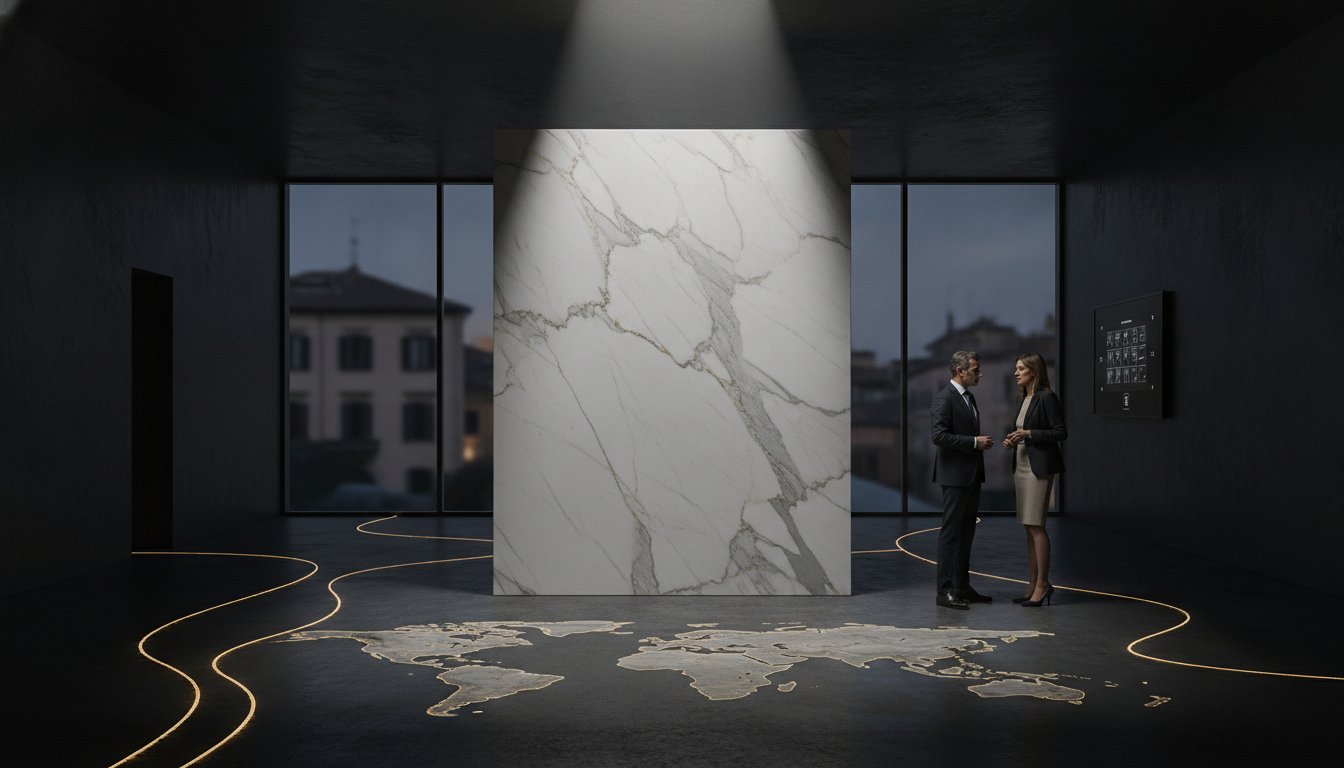
Italian marble export approaches 2026 with a focus on profitability per square meter and diversification in non-EU markets. Let's analyze real sector data and financial protection strategies for stone producers: which sales channel to choose, how to protect margins against exchange rates, and where to place slabs and processed materials without eroding the value of precious natural stone.
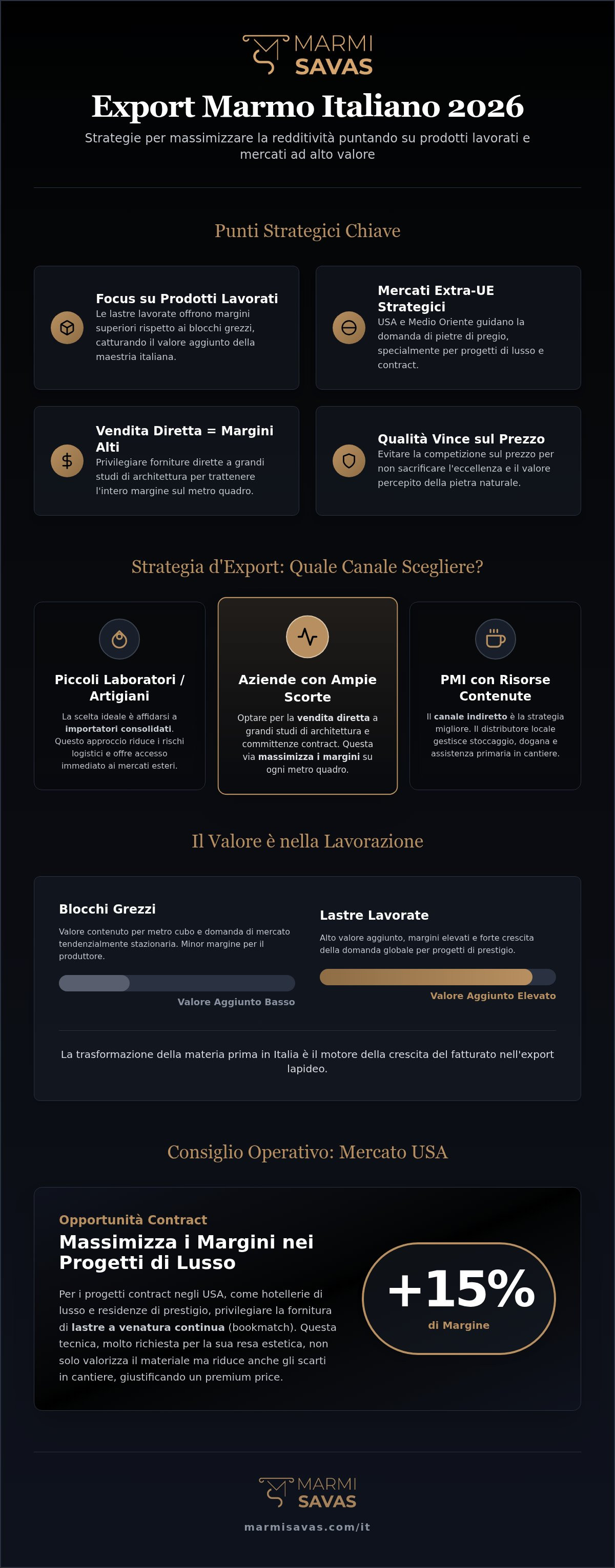
Key Points
- Turnover grows thanks to processed slabs that offer a higher margin compared to raw blocks.
- Avoid competing on price against cheap foreign materials unless you want to sacrifice excellence.
- Favor direct supplies for large architectural firms if you have ample warehouse inventory.
- The operational advice for the US market suggests continuous veins to increase margins by 15%.
Index
- Export strategy: when a distributor is better and when direct supply is better
- Stone export: turnover grows with processed slabs
- USA and Middle East: the markets that absorb precious Italian stones
- Cover exchange risk before starting foreign supply
- Do not compete on price: which weak alternatives to discard
- 2026 Tenders: non-repayable funds for fairs and digital catalogs
- Slab logistics: five steps to protect stone and construction site timelines
Export Strategy: When a Distributor is Better and When Direct Supply is Better
The size of your business determines whether to proceed with local distributors or manage direct supplies to construction sites. Three recurring situations guide the choice with data already known from the sector:
Business Channel Distribution
- Art carpentry or small-scale workshop: Rely on established importers. Reduce logistical risks and get immediate access to foreign markets without setting up your own network.
- Company with ample warehouse inventory: Choose direct sales to large architectural firms and contract commissions, so you deal with the entire margin per square meter.
- SME with limited resources: Favor the indirect channel; the local distributor absorbs storage, customs, and first-level assistance at the construction site.
Operational Insights and Planning
With clients, we observe that small art carpentry workshops derive concrete benefit from relying on established importers precisely because the complexity of slab transport does not weigh on the internal budget. Large-format slabs still require structured logistics, even when the channel is indirect: planning remains the operational constraint, not the volume itself. To evaluate the material before shipping, you can consult the slab guide, where you will find technical inspection criteria for natural stone. The choice of channel is aligned with inventory and service capacity, protects your margins over time, and prepares the ground for the valuable numbers discussed in the next section.
Stone Export: Turnover Grows with Processed Slabs
The export of the Italian stone sector records clear growth in terms of economic value. The increase in turnover is driven by the demand for processed products compared to raw blocks: the transformation of raw material creates a higher profit margin per exported square meter. From workshops, we see the same pattern repeat in different commissions.
Case Analysis
- Situation: The foreign client asks for a raw block to work on site and compresses the price.
- Action: Instead, the already processed slab is proposed, with a polished finish or special treatments.
- Outcome: The added value of Italian artisanal and industrial mastery is captured, while the demand for large-format slabs grows compared to raw material.
An example of high-precious processed stone is Verde Alpi marble, a variety with a deep tone and scenic veins, suitable for cladding where the surface design must remain legible from a distance.
Export Impact Table Overview
- Raw blocks: Low value / Stationary demand
- Processed slabs: High added value / Strong global growth
- Precious materials: High margin / Increasing demand
The sale of processed stones enhances every exported square meter. Quality and vein design make the Italian product a reference for international architecture, especially in the destination markets discussed below.
USA and Middle East: The Markets That Absorb Precious Italian Stones
The United States represents the top foreign market for Italian stone exports, driven by growing demand in luxury hospitality. American developers demand precious materials for vertical wall cladding and prestigious flooring.
Luxury Hospitality Scenario
- Situation: A hotel lobby or a contract master bathroom in the USA must convey visual continuity over large surfaces.
- Action: Continuous-vein slabs are selected and, where the project allows, the bookmatch effect, with stones having a luminous background.
- Outcome: Construction site waste is reduced and a higher margin can be achieved, as in the operational advice below.
Calacatta Luna, coming from selected Italian quarries, stands out for a soft, rounded fibrous texture on a white base, accentuated by a network of light gray veins: it transforms lobbies into exclusive spaces. If serving contract-level options, the Carrara, Calacatta, and Arabescato selection offers slabs suitable for international projects.
Commercial Considerations and Geopolitical Factors
Something few think about: visual continuity between various surfaces reduces construction site waste in commercial buildings. The use of large-format slabs enhances the natural design of the veins without interrupting the graphic pattern. The geometric balance obtained with the bookmatch effect supports the scenography of master bathrooms; stones with a luminous background increase the perception of space in large hospitality.
European Union trade restrictions influence export routes toward Eastern Europe, as confirmed by the European Commission's import and export ban regulations in 2024. This guides producers toward North American and Middle Eastern markets. MARMISAVAS responds to these routes with superior quality blocks extracted directly from the most renowned quarries.
Strategic Advice
- Advice: Favor slabs with continuous veins for contract projects in the USA to secure margins higher by 15%.
Cover Exchange Risk Before Collecting Foreign Supply
Contracts for natural stone exports stipulated in foreign currency require hedging financial instruments to lock in profit margins. Dollar fluctuations put the profitability of stone SMEs at risk when collection takes place months after shipment.
Key Situation and Action Steps
- Situation: You have shipped slabs for a construction site paid in foreign currency, and collection will arrive several months later.
- Action: You fix the exchange rate with forward contracts (hedging) at the time of order confirmation.
- Outcome: The sales value remains locked, and volatility does not erode the operating margin. Based on daily fieldwork, fixing the exchange rate through forward contracts is the reasonable choice to protect margins in sales outside the EU: it acts as revenue insurance. International payments should not turn into a currency gamble. Hedging is indispensable especially when supplying gray marble slabs and complex architectural projects regulated in foreign currency.
Estimation and Quotes
For an estimate aligned with volumes and destination, you can request a quote on the lot to be exported.
Do Not Compete on Price: Which Weak Alternatives to Discard
Competing on price against cheap foreign materials undermines the profitability of natural stone supplies. Chasing the lowest costs is a dead end for those working with precious materials: Italian stone expresses an aesthetic value that mere price-cutting does not replicate.
Market Trends and Alternatives
In many international projects, there is a trend to replace Italian slabs with less expensive alternatives. A historical reference is Proconnesian marble, extracted on the island of Marmara and widespread in Roman and Byzantine antiquity for its availability, not as a substitute for Italian marble. The operational advice for the US market suggests continuous veins to increase margins by 15%.
Value and Quotation
Trying to beat this option by reducing margins debases the excellence of the vein design. The use of large-format Italian slabs sustains prestige and visual continuity on walls and floors in luxury contexts. For a comparison on your project's lot, ask for a personalized quote based on format and finish.
2026 Tenders: Non-Repayable Funds for Fairs and Digital Catalogs
Public tenders for international fairs and B2B digitalization finance the foreign expansion of stone companies. Non-repayable grants cover expenses for exhibition spaces and digital platforms.
Digital Contributions and Catalogs
Digital contributions reduce the costs of showing the slab selection to architects and buyers far from the warehouse. A structured digital catalog makes it possible to quickly share the technical details of natural surfaces, including translucent slabs and precious blocks, without multiplying physical sample shipments.
Public Funding and Budgeting
Public funding turns fair participation into a measurable investment for distributors and also supports virtual galleries to present Premium elements and large-format slabs to international clients. Check open tenders and integrate the "internationalization" item into the year's budget.
Slab Logistics: Five Steps to Protect Stone and Construction Site Timelines
Planning the transport of large-format slabs requires a rigorous sequence to protect the stone and respect construction site timelines. Managing marble blocks like Bianco Carrara or luminous Calacatta requires the same attention reserved for a traveling work of art: a sudden jolt can compromise the integrity of the material. Direct observation in high-end construction sites shows that careful packaging avoids superficial micro-cracks on marble slabs.
The Five Steps
- 1. Selection of crates: use treated and reinforced wooden cages to contain natural stones.
- 2. Edge protection: protect the corners of each slab with high-density rubber profiles.
- 3. Resin application: perform a specific resin treatment before shipment to increase structural resistance without altering aesthetics.
- 4. Fixing and racking: position the slabs on A-frame racks maintaining the optimal loading angle.
- 5. Delivery planning: coordinate unloading with appropriate grids directly at the operating sites.
Operational Control and Requests
This sequential control avoids costly delays and breakage during unloading. If logistics seem to be the weak point of the foreign contract, anticipate packaging, resin, and crane slots already upon order confirmation: it is the operational lever that holds margin and installation date together. Details and request: MARMISAVAS.
Frequently Asked Questions
Local Distributor or Direct Sale: What Suits My SME?
It depends on volumes, inventory, and the ability to follow the foreign construction site. Art workshops and carpentry reduce logistical risk with consolidated importers; those with ample warehouse and structured service can directly serve architecture and contract studios. The indirect channel remains suitable for SMEs with limited resources.
How Much Did Italian Stone Export Turnover Reach in the First 8 Months of 2025?
The export of Italian marble generated a significant economic value in the first eight months of the year, confirming the sector's prominent global position. For sales figures on your slab mix and material costs, you can request a personalized quote. Foreign demand continues to reward processing and quality of natural stone.
How Do I Protect Margins If the Contract is in Dollars or Another Currency?
Fix the exchange rate with hedging instruments (forward contracts) at the time of order, especially when collection arrives months after shipment. Thus, revenue is not exposed solely to dollar fluctuation, and the operating margin remains aligned with the agreed price list.
What Is the Average Price of Exported Materials?
The quotation of stones varies based on stone rarity, format, thickness, and surface finishes. Exclusive selections require a specific evaluation per architectural project. Contact us for a quote calibrated to your export needs.
What Are the Main Destination Markets for Processed Products?
Finished products and mirror-effect surfaces are mainly destined for mature markets such as North America and Western Europe, attentive to processing precision and Premium finishes for luxury interiors. Demand in Gulf countries is also growing, consistent with the extra-EU push of 2026.
Solutions for Exceptional Projects
The export of Italian marble brings architectural value to private residences and high-profile commercial spaces when channel, exchange, and logistics are aligned with profitability per square meter. In 2026, the MARMISAVAS selection includes precious slabs extracted from the most renowned quarries and, among international comparison materials, also references such as Volakas marble of certified origin. Consultants accompany architects and designers in choosing the slabs suited to each design vision: every natural stone offers unique chromatic nuances to durable luxury cladding. To consult the large-format slab catalog and organize international supplies, request an overseas quote on the official website.