Black Marble Slabs: A Guide to Choosing for Your Project
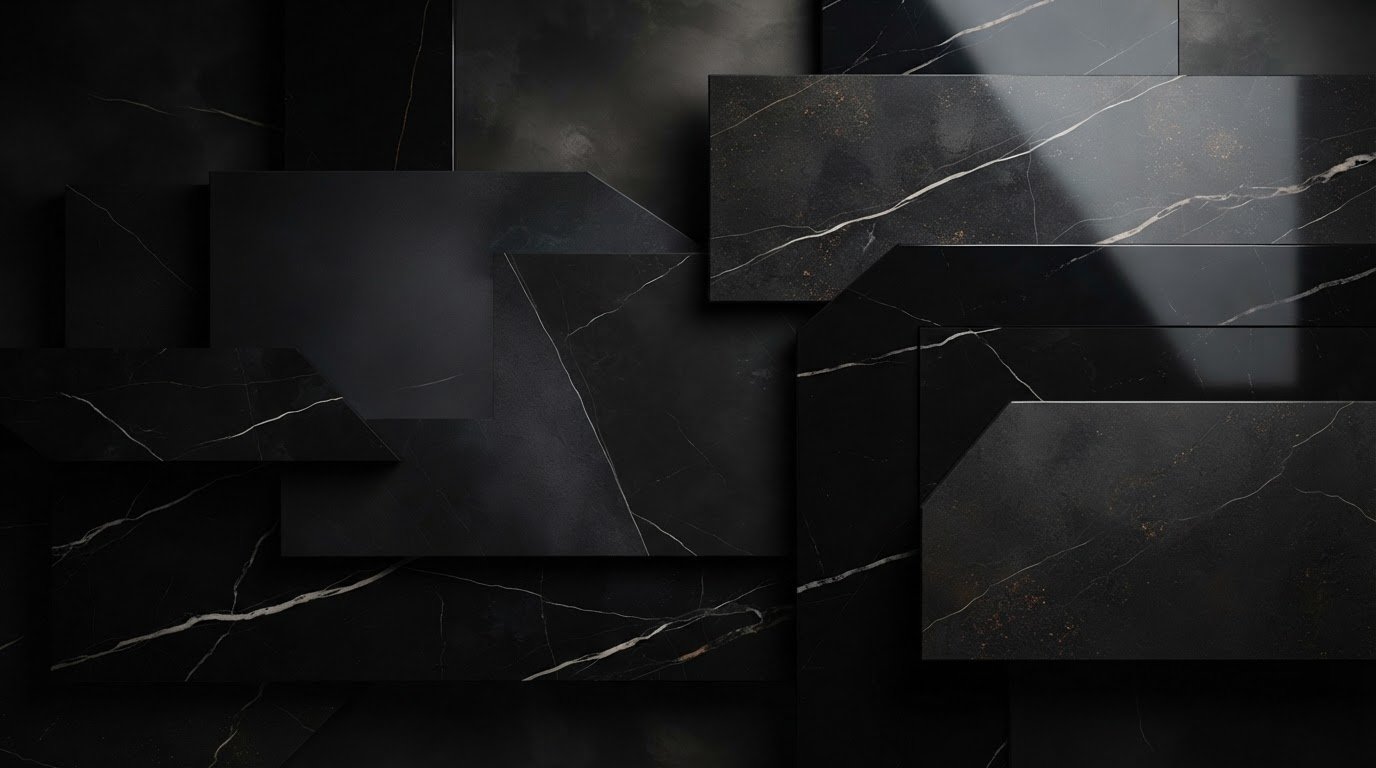
The choice of black marble is not limited to colour alone: it requires observing the individual slab. Similar materials in photographs may look different in reality: the background may be more uniform or mottled, while the veining varies in intensity, direction and pattern. Observing these elements helps you choose a material that is consistent with the intended atmosphere and composition, rather than simply achieving a dark tone.
Photographs provide an initial aesthetic reference, but they do not always accurately convey the relationship between the background and the veining or the stone’s overall appearance. To choose black marble slabs, evaluate the slab intended for the project rather than relying solely on a representative image. Start by observing the background, follow the natural pattern and consider how the surface relates to the other materials in the setting.
Key Points
- To choose black marble slabs, observe the background and veining of the individual slab: natural variations contribute to the character of the project.
- Compare polished, honed and brushed finishes, evaluating how each interacts with light and enhances the marble’s design.
- Assess the continuity of the veining and the effect of the material by examining a sample or observing the slabs in relation to the desired effect.
- Define the intended use, format, finish and quantity: these details help turn an initial idea into a precise quotation request.
- MARMISAVAS customises formats and finishes and prepares estimates based on measurements for small and large orders intended for residential, commercial and architectural projects.
Index
- Black Marble Slabs: What to Observe in the Colour and Veining
- Finishes and Applications of Black Marble Slabs
- How to Compare and Select Black Marble Slabs
- From Selection to Quotation: Preparing a Request for Black Slabs
- Choosing Black Marble Slabs with MARMISAVAS
Black Marble Slabs: What to Observe in the Colour and Veining
Black marble naturally has a dark background that may feature grey or white veining, varying from one slab to another. The black may appear uniform or be animated by light-coloured lines; the intensity and distribution of colour variations also change. Observing these elements helps you choose a material that suits the intended atmosphere and composition, rather than simply introducing a dark tone.
Photographs offer an initial aesthetic reference, but they do not always accurately reproduce the relationship between the background and the veining or the stone’s overall appearance. To choose black marble slabs, evaluate the slab intended for the project without relying solely on a representative image. Begin by observing the background, follow the natural pattern and consider how the surface relates to the other materials in the setting.
Dark Background and Marble Veining: Reading the Natural Pattern
The background determines the visual perception of the material, while the lines and colour variations define its rhythm. Thin, widely spaced veins allow the black to remain dominant; a dense or contrasting pattern attracts more attention. Direction also matters: horizontal, vertical or diagonal lines suggest different movements and interact differently with the geometry of the space. The term marble veining refers precisely to the natural pattern of the veins in marble.
During observation, follow the path of a vein from one end to the other and note where it stops, becomes thinner or changes direction. Consider the contrast with the background and the distribution of the pattern across the entire surface. To learn more about a specific variety, the marble Nero Marguina page provides detailed information; however, do not assume that every black marble has the same appearance.
Is Natural Variation a Defect?
No. Differences in tone or pattern are characteristics of natural marble and, on their own, are not a reason to reject a slab. The assessment depends on the project: pronounced contrast can become a visual accent, while a more discreet pattern may complement a restrained composition. The objective is not to find an absolutely perfect slab, but to establish how much variation is consistent with the desired result.
If the project involves several slabs and requires visual continuity, observing them together makes it possible to compare the background, the intensity and the direction of the veining. This helps you assess how the patterns interact and whether the differences are too pronounced for the intended effect. Pay particular attention to:
- the background tone and its uniformity;
- the contrast, density and direction of the veining;
- the consistency of the pattern across the selected slabs.
These criteria help identify the material’s character and choose the one that best supports the composition, without seeking uniformity that is contrary to the natural character of the stone.
Finishes and Applications of Black Marble Slabs
The finish changes how black marble interacts with light and how it is perceived in a space. It does not alter the stone’s natural pattern, but it can emphasise contrast or create a more discreet visual effect. MARMISAVAS offers polished, honed and brushed finishes that can be customised according to the project. When choosing, consider the veining, the intended use of the surface and the atmosphere you want to create.
Polished, Honed or Brushed: Which Effect Should You Choose?
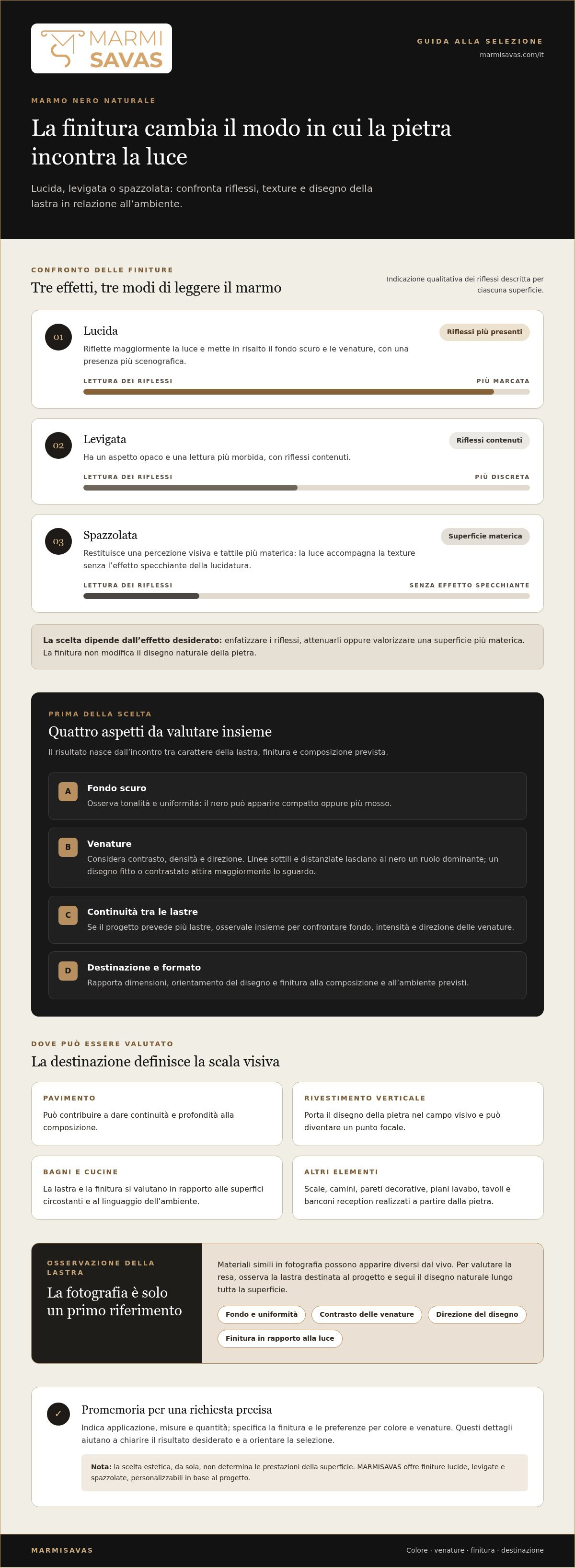
Polished finishes reflect more light and enhance the contrast between the dark background and the veining, which gains a more dramatic presence. Honed marble has a matte appearance and a softer visual reading, with restrained reflections. Brushed marble offers a visual and tactile perception that is more material in character: light follows the texture without the mirror-like effect of polishing. In short, choose polished marble to emphasise reflections, honed marble for a more understated appearance and brushed marble for a textured effect.
Assess the finish in the context of the setting. In a bright space, a polished surface may make the relationship between light and veining more dynamic; a matte finish gives black a more intimate presence. To explore how different varieties may have specific geological characteristics and a role in the history of ornamental stone, the IUGS describes the geological characteristics of the black marbles of Belgium.
From Flooring to Cladding: Matching the Slab to the Setting
The intended use helps define the scale of the visual outcome. On a floor, black marble can create continuity and depth in the composition; on a vertical wall, the stone’s pattern becomes more prominent and can act as a focal point. In bathrooms and kitchens, relate the slab and finish to the surrounding surfaces and the language of the space. The aesthetic choice alone does not determine the technical performance of the surface.
Slabs can also be assessed for stairs, fireplaces and decorative walls, as well as for vanity tops, tables or reception counters made from stone. In these cases, the format and orientation of the pattern contribute to the overall result. Black marble varieties have different appearances: evaluating the material and finish in relation to the application helps define a consistent choice. To put the decision into practice, you can share the project requirements with MARMISAVAS and request a customised assessment.
How to Compare and Select Black Marble Slabs
An accurate selection compares the slabs using the actual requirements of the project, not just an inspirational image. For black marble slabs, use the same criteria for each sample and record the differences. This method keeps the comparison tied to the desired result, whether it involves a discreet surface or a composition with a more pronounced pattern.
The following checklist helps organise the assessment:
- Background: observe the tonal uniformity and how uniform the surface appears.
- Veining: assess the contrast, density and direction of the natural pattern.
- Continuity: follow the lines and consider how they might relate across the planned slabs.
- Finish: compare the surface response to light and the atmosphere of the setting.
- Application: relate the format and appearance to the scale of the planned surface.
To remember the main aspects to observe, consider colour, continuity of the veining, surface texture and visible defects, always in relation to the intended application.
Technical Criteria for Slab Inspection
The expression technical slab inspection indicates practical criteria for observing and comparing a slab, not a certification or standard attributed to the supplier. Examine the colour at several points, check whether the veins maintain continuity consistent with the expected pattern and consider the thickness specified for the particular slab. Also observe any visible defects, assessing their location and relevance to the intended use.
The assessment should consider both individual details and the overall composition. A sample is useful for evaluating tone, surface and finish, but it represents only one portion of the marble and does not, by itself, show the full progression of the veining. If continuity is important, for example on a large wall, comparing the selected slabs provides a more complete understanding. Slab quality inspection, understood as a visual assessment of integrity, veining and defects, refers to the material actually examined and does not replace technical checks specific to the intended application.
Visual Coherence, Composition and Bookmatching Techniques
On large surfaces, the relationship between slabs can significantly affect the result. The bookmatching technique involves arranging consecutive slabs like mirror images so that the patterns form a symmetrical composition. The effect depends on the veining present: before choosing this solution, decide whether you want discreet continuity or a more pronounced central pattern, and assess the slabs in pairs.
To make the comparison clearer, communicate the intended use, required format, finish and expected visual result. MARMISAVAS supplies natural marble slabs and customises formats and finishes according to the project. You can send your project details to receive a tailored proposal.
From Selection to Quotation: Preparing a Request for Black Slabs
A well-structured request turns an aesthetic intention into concrete information for the supplier. For black marble slabs, indicating the colour alone is not enough: the intended use, finish, format and expected quantity help define a proposal suited to the project. Clearly describing the desired result makes it easier to assess the characteristics of the slab and the requirements of the composition.
Before requesting a quotation, gather the essential information and indicate your priorities. For example, a feature wall may require particular attention to the arrangement of the veining; a surface in a residential setting may guide the choice towards a specific finish and format. You do not need to have every technical detail already defined: share what has been established and what still needs to be assessed.
What Details Should Be Included in a Supply Request?
Indicate the intended use, such as flooring, cladding or a decorative surface, and describe the desired visual effect: a more uniform background, prominent veining or a pattern coordinated across several slabs. Add your preferred finish, the required dimensions and the expected quantity. If several surfaces are involved, describe how they should relate to one another: the assessment can then consider the overall result rather than each element in isolation.
- Intended use: specify the setting and the planned application.
- Aesthetic effect: describe the tone, veining intensity and desired continuity.
- Finish and format: indicate the preferred surface treatment and project dimensions.
- Quantity: communicate the required volume, even if it is only an estimate.
This information provides a clear basis for personalised advice and a proposal consistent with the project’s characteristics.
Customised Formats and Made-to-Measure Quotations
MARMISAVAS customises formats and finishes to meet project requirements and manages orders of different sizes. Quotes are not based on a fixed price applicable to every slab; each proposal is prepared individually, taking into account the selected material, format, finish and requested quantity. The proposal considers the specific supply requirements rather than relying on standard figures that may not represent the project.
To prepare your request, have the measurements, application details and a visual reference for the desired effect ready. Even a preliminary indication is a useful starting point: aspects that have not yet been finalised can be discussed during the consultation, connecting practical needs with aesthetic choices. A made-to-measure quotation helps you assess the supply in relation to the actual characteristics of the project.
To receive a personalised proposal, submit your supply request, indicating the intended use, finish, format and expected quantity.
Choosing Black Marble Slabs with MARMISAVAS
Choosing a natural marble slab means evaluating its background, veining, finish and intended use together. Colour alone does not determine the final effect: the relationship with surrounding surfaces, the scale of the space and the role of the stone in the composition also matter. Choosing black marble slabs therefore means defining a concrete part of the project’s visual identity, rather than simply selecting an item from a catalogue.
MARMISAVAS specialises in supplying natural marble slabs for residential, commercial and architectural projects. Comparing project requirements with the material’s characteristics helps guide the selection while respecting the natural differences between individual slabs.
A Selection Tailored to the Project
Every project begins with different priorities. A wall covering may require a striking visual presence, while a surface integrated into a more complex composition may call for a more discreet pattern. Personalised consultation connects the application, format and finish with the desired effect. Marble is a natural stone: veins, shades and variations make every slab distinctive and should be considered when selecting the material, rather than treating them as defects.
- Define the objective: indicate the role the marble will play in the setting and the atmosphere you want to create.
- Describe the application: specify the surface, the required dimensions and, if already defined, the format.
- Share your preferences: communicate the finish and the character of the veining that best suits the project.
- Consider the whole composition: indicate whether several elements need to be coordinated and whether visual continuity is important.
These details provide a basis for consultation between architects, interior designers, stone professionals and private clients, keeping the selection connected to the actual needs of the project.
Start a Personalised Request
MARMISAVAS supplies natural marble slabs in Italy and abroad and supports the selection process with personalised consultation. Formats and finishes can be adapted to project requirements; for both small and large orders, a made-to-measure quotation is prepared. The proposal takes into account the material and the specifications agreed for the individual project.
To begin the comparison, prepare a concise description of the project, indicate the intended application, the required dimensions or format, the finish and the estimated quantity. A visual reference can help communicate the aesthetic intention, alongside an assessment of the characteristics of the selected natural marble slab. If some details are still being defined, indicate this in your request: it will be possible to clarify them and evaluate the proposal in relation to your project.
Share your requirements and contact MARMISAVAS to start the project.
From Form to the Vision of Your Project
A slab can become the starting point for defining the language of a space. Before making a selection, imagine how the marble will interact with the surrounding colours, materials and volumes. Clarifying this relationship helps maintain a coherent intention from the first sketch to the final decisions. Black marble slabs are not merely a colour choice, but a presence that contributes to the visual balance of the space.
For a residential, commercial or architectural project, you can consult MARMISAVAS to identify a proposal that aligns with your vision. Share your idea, even if it is still taking shape, and begin a discussion about selecting natural marble.
Contact MARMISAVAS about your project and turn your idea into an informed material choice.
Frequently Asked Questions About Black Marble Slabs
What Does Natural Black Marble Mean?
The term indicates natural marble selected for its dark background, not a single material with a standardised appearance. Colour alone does not identify a specific variety or describe every detail of the surface. In a project, it is useful to distinguish the general colour category from the specific slab: the selection should match the material and pattern you want to evaluate, especially when it must coordinate with other surfaces.
What Finishes Are Available for Black Marble Slabs?
Available finishes include polished, honed and brushed surfaces. To compare them, evaluate the surface under the lighting that will characterise the setting: natural and artificial light can change the perception of reflections. When specifying the finish in your request, also indicate whether it needs to coordinate with other stone surfaces. This reference helps assess the slab within the overall palette rather than as an isolated sample.
Which Settings Can Use Black Marble Slabs?
They can be considered for residential and commercial settings, depending on the project requirements. In addition to choosing the surface, plan how it will coordinate with adjacent elements: assess where the finishes end and how the colour relates to the surrounding walls and materials. A plan or design drawing can help communicate these relationships and assess the stone as part of the overall composition.
How Is the Quality of a Black Marble Slab Assessed?
Observe the material in relation to its intended use and the project requirements, without relying on colour alone. If you have a technical drawing, compare the required dimensions and identify the most important visible characteristics. You can record differences between the slabs examined and indicate which ones affect the expected result. This project-based assessment helps you make an informed choice and does not replace any necessary technical checks.
Does MARMISAVAS Offer Customised Formats and Finishes?
Yes. MARMISAVAS customises formats and finishes according to the project. To make your request clear, indicate whether the measurements come from a finalised drawing or are still approximate. If the slab needs to coordinate with several elements, describe this requirement as well: it will help establish the role of the format in the composition. Personalised consultation connects these details with the selection of natural marble.
Is There a Minimum Quantity for Ordering Black Marble Slabs?
MARMISAVAS handles orders of different sizes and prepares made-to-measure quotations according to supply requirements. When describing your needs, distinguish the different applications within the project so that the request clearly specifies the materials and quantities required for each part. Even a preliminary estimate helps structure the comparison and prepare a proposal suited to the specific situation.
How Can I Request a Quotation for Black Marble Slabs?
Present your project and provide the information already defined, distinguishing it from details that are still undecided. You can attach measurements or drawings, specify the intended use of the stone and communicate the expected quantity. If you have a preference for the pattern or overall appearance, describe it in simple terms or provide a visual reference. These details help MARMISAVAS prepare a made-to-measure assessment.