Natural Stone Supplier USA with Showroom and Inventory

Natural Stone Suppliers in the USA: Showrooms, Selection and Quality
In the United States, finding a natural stone supplier means navigating different types of businesses and identifying where materials can be viewed in person. The choice is not limited to color: veining, finish and slab quality contribute to the project outcome.
It is natural to want to see the stone before choosing it. In a showroom, viewing slabs in person helps identify shades and patterns that a photograph can only partially reproduce. Comparing retailers also makes it possible to learn more about the material's origin and characteristics.
In this guide, you will discover how to navigate showrooms and retailers in the United States, what types of natural stone you can find, and which criteria to consider when selecting and inspecting slabs. You will also learn how to evaluate veining, tone and finish according to the intended use, so you can choose materials more confidently for an architectural or interior design project.
Key Points
- Discover how to navigate showrooms and retailers in the United States to view colors, veining and finishes in person.
- Learn which aspects to consider when selecting slabs, from pattern continuity to the presence of visible defects.
- Understand how the supplier network is distributed across the territory and why businesses may differ in size and specialization.
- Compare the aesthetic characteristics of marble, granite, quartzite and travertine to identify materials that suit the project.
- Learn how MARMISAVAS can support the selection of white marble, Calacatta, Bianco Carrara and Arabescato for architectural and interior design projects.
Index
- Showrooms and retailer networks in the United States
- Slab selection and quality control
- Who are the main natural stone suppliers in the United States?
Showrooms and Retailer Networks in the United States
The American network includes showrooms, warehouses, importers and retailers with different roles. A commercial location alone does not indicate which slabs are on display or whether the supplier sells retail or wholesale. To orient yourself, distinguish between the point of sale, where materials are viewed, the warehouse, which may manage batches and stock, and the specialized retailer, often focused on specific stones or applications.
A showroom allows you to view marble, granite and other stones in person, evaluating their colors, veining and finishes under different lighting conditions. For example, a white background with gray veins may appear warmer or cooler depending on the lighting. Comparing entire slabs helps you understand pattern continuity and imagine the effect on a wall or in a kitchen. A small sample indicates the general appearance but does not always show variations across the entire slab.
Samples, custom cutting and wholesale sales are distinct commercial arrangements, defined by each supplier's procedures. A sample offers an initial indication of color and surface; custom cutting concerns agreed dimensions and processing; wholesale sales take quantities and lot selection into account. For a commercial project, these differences affect material comparison and supply planning. An effective request specifies the material, planned dimensions, intended destination and indicative quantity.
For import, acceptance and safety, evaluation includes several aspects: material identification, shipping documents and slab handling. The commercial name does not replace the description of the stone and its origin. Packaging, weight and loading methods are central elements in transport planning. Procedures depend on the product and commercial route; documents must correspond to the material actually shipped.
The cost of importing into Italy depends on volume, weight, packaging, distance, transport method, insurance and applicable shipping charges. Duties and VAT should be included in the overall calculation, together with transport, rather than considered separately. Timing also depends on slab availability, loading preparation, transit and customs operations. An estimate therefore requires a quotation referring to the actual material and destination.
The main quarries and extraction areas cannot be inferred from the retailer's location. Origin must be associated with the individual stone and its extraction quarry, distinguishing it from the supplier's commercial location. During selection, a clear record connects the variety, origin and lot. This step is useful for comparing similar materials from different areas and understanding the slab's history.
To purchase or ship stone from the United States to Italy, the process begins with slab selection and quantity definition. This is followed by confirmation of specifications, preparation of commercial documents, transport organization and import management. Coordinating these steps helps keep material, order, shipment and documentation aligned. For a final selection, images of complete slabs and lot references connect the selected material to the delivered product.
Slab Selection and Quality Control
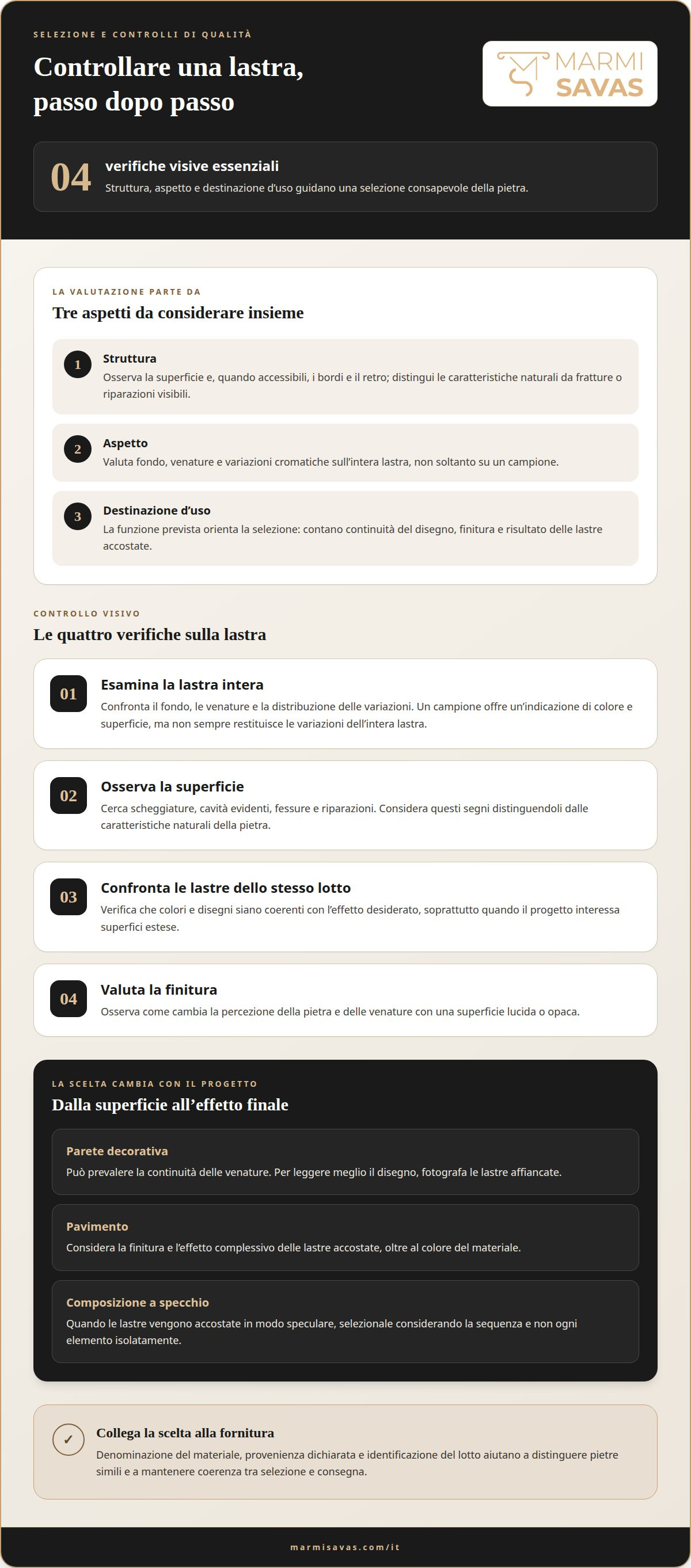
The quality of a slab is evaluated by considering structure, appearance and intended use together. A white marble with pronounced veins, for example, should be examined differently from a granite with a more granular pattern. Before selection, inspect the surface, edges and back, when accessible, to identify fractures, visible repairs or color variations. Inspection does not eliminate natural differences, but helps understand how to integrate the material into the project.
Selection starts with the intended function. For a decorative wall, vein continuity may be the priority; for flooring, the finish and overall effect of adjacent slabs also matter. Natural quartzite and marble, for example, should not be evaluated solely by color: structure, finish and required maintenance contribute to the choice. Defining the application first makes comparisons between materials and different collections more focused.
A structured visual inspection can follow these steps:
- Examine the entire slab: compare background, veins and distribution of variations without relying only on a sample.
- Inspect the surface: look for chips, visible cavities, cracks and repairs, distinguishing them from the stone's natural characteristics.
- Compare slabs from the same lot: check whether colors and patterns are consistent with the desired effect, especially for large surfaces.
- Evaluate the finish: observe how a polished or matte surface changes reflections, tone and the perception of veins.
For bookmatched compositions, slabs are placed together in a mirrored arrangement: selection must consider the sequence, not each element individually. If the project includes a large wall, photographing adjacent slabs provides a more faithful reading of the final pattern. This clarifies how veins develop and where color variations are concentrated.
Documentation also helps connect selection with supply. The material name, declared origin and lot identification are useful references for distinguishing similar stones and maintaining consistency between selection and delivery. In a project with multiple rooms, associating each slab with its intended location reduces exchanges during planning. Photographs of the complete surface complement comparisons with notes on finish and application.
To define the criteria suitable for a project, you can share the selection details, indicating the desired material, finish and intended use. A precise description helps focus comparisons on the characteristics that truly matter, from vein movement to consistency between slabs.
Who Are the Main Natural Stone Suppliers in the United States?
In the United States, there is no single dominant category of supplier: distributors, importers, warehouses and companies connected to extraction address different needs. A sector list includes 2,943 suppliers, but the data describes registered activities rather than a ranking of quality or assortment. To identify relevant operators, start with the requested material and the project's specific requirements.
Company size is one element for understanding the market. Among the registered companies, 1,128 have between 1 and 10 employees and 1,033 have between 1 and 50. Smaller businesses may focus on a local market or specific processing; more structured companies may serve commercial networks and large projects. The number of employees, however, does not by itself measure slab quality or selection breadth.
There are 22 companies with 201–500 employees, while 12 fall within the 501–1,000 range. These figures show that registered operators vary in size. For an architectural project, the distinction is not only company size: it is important to understand whether it manages slabs, blocks, processing or distribution, and whether it handles the requested material.
A practical evaluation can follow three steps:
- Define the necessary category: a distributor is relevant for comparing slabs; a quarry matters when origin and extracted material are important.
- Match the stone to its use: marble for a dramatic wall, granite for a granular pattern, travertine for a textured surface.
- Compare commercial information: examine the name, declared origin, available format and sales terms.
Specialization helps narrow the search. Some operators handle several stone families, while others focus on specific materials or origins. A broad catalog facilitates comparison between alternatives; a focused offer may be more relevant when the project requires a particular stone. In both cases, the match between the proposed material and its intended use remains essential.
For an Italian buyer, evaluation should also include international shipping and document consistency. For example, for a marble wall, compare complete slabs and vein continuity; for flooring, consider finish and uniformity between elements. These criteria help distinguish a simple list of companies from a selection relevant to the project.
The most suitable suppliers are those that respond to the specific requirement: stone type, finish, format and destination. The registered company data describe the variety of businesses but do not replace material evaluation. For architects, businesses and owners, precisely defining the application and desired characteristics makes comparison between operators and offers more effective.
For those following the supplier sector, Natural Stone Principles is scheduled for December 10, 2026: this date may be considered when planning consultations about available information.
What types of natural stone are available from US suppliers?
US catalogs offer different stone families, each with its own colors, veining, and applications. Marble, granite, quartzite, and travertine are useful categories for starting a comparison; onyx and limestone expand the possibilities. The assortment varies among suppliers and warehouses, so selection should be evaluated in relation to the project, not only by commercial name.
Marble features natural patterns ranging from subtle veins to broad, contrasting lines. A light background can bring brightness to a space, while gray or dark veins create a more striking effect. When comparing slabs, examine the relationship between background color, vein movement, and variations across the surface rather than relying on a sample alone.
Granite often has a granular texture, with crystals and variations distributed throughout the material. Over the past 20 years, its appearance has evolved beyond traditional surfaces with small black specks. Today, comparisons may include more intricate patterns and different color palettes. In a kitchen or commercial space, evaluating the entire slab helps understand how the pattern will repeat across the surface.
Natural quartzite features veins and color variations that may resemble marble, but each stone has its own characteristics. To make an informed selection, examine its structure and obtain information about appropriate maintenance. Perceived hardness alone does not determine stain resistance: porosity and surface care also affect everyday use.
Travertine has characteristic cavities and irregularities, and its appearance varies according to finish and processing. Warm beige tones can complement floors and wall coverings with a textured character. Onyx, meanwhile, is appreciated for its color variations and decorative presence; for an accent wall, examining the complete slab is particularly important.
To narrow down the options, associate each stone family with the desired result:
- Dramatic veining: Compare marble and quartzite, examining the background and pattern.
- Granular texture: Evaluate granite, including its contribution to the overall surface.
- Warm, textured character: Consider travertine and its natural cavities.
- Decorative accent: Examine onyx as a distinctive visual element.
The finish changes reflectivity, tone, and color perception: a polished surface enhances reflections, while a matte finish creates a softer effect. For a coherent project, define the application first, then compare slabs, finishes, and tonalities. This sequence helps determine which material best meets aesthetic and practical requirements.
Choosing between a matte or polished finish can change the overall visual result; regarding maintenance, some quartzites are more porous than granite, so both stones require appropriate care and sealing. Among the natural stone suppliers listed in the United States, the average is 8.2 contacts per company. Houston is the US city with the most registered natural stone supplier companies, with 60 records; Miami is the second city by number of natural stone suppliers, with 36 registered companies. Anaheim has 31 registered natural stone supplier companies. In the sector, the Natural Stone Foundation awarded $150,000 in grants during its 2026 funding cycle to support initiatives in the natural stone industry.
Which US suppliers sell marble, granite, quartzite, and travertine?
In the United States, the availability of marble, granite, quartzite, and travertine depends on each operator's catalog. Slab distributors and importers may handle several stone families; quarries and specialized retailers often focus their offerings on specific materials or origins. To find a suitable supplier, search by stone type and project destination rather than relying on a generic commercial category.
A multi-material distributor may be practical when a project combines different surfaces. For example, an architect might consider marble for a wall, granite for a work area, and travertine for flooring. An operator focused on a single family may instead offer a more limited and specialized selection. Evaluate the difference based on the proposed slabs and their stated origin.
To compare proposals, prepare a request with four elements: material, application, desired finish, and indicative quantity. Specifying “marble for vertical cladding” is more useful than a generic stone request; indicating “quartzite for a residential project” further narrows relevant alternatives without confusing appearance with commercial name.
Evaluation varies according to the stone. In marble, background and vein movement matter; in granite, crystal and grain distribution; in quartzite, pattern and material characteristics; in travertine, cavities and appearance after finishing. A supplier handling these categories should describe the proposed stone using appropriate terminology, without presenting different materials as equivalent.
For a purchase from the United States intended for Italy, commercial selection is only part of the decision. Connect the selected slab to the lot, material description, and planned shipment. If the project requires multiple matching slabs, for example, sequence and visual consistency are as important as the stone family. Documenting the selection facilitates coordination between choice, ordering, and transportation.
In practice, the research process may follow these steps:
- Identify the family: marble, granite, quartzite, or travertine, according to the desired effect and application.
- Define the appearance: background, tonality, veining, grain, or characteristic cavities.
- Compare the offer: examine slabs, finish, origin, and sales terms.
- Plan the supply: connect the selection to the lot and shipping requirements to Italy.
If the project requires a selection of Italian white marble, describe the material and application to initiate a targeted comparison of suitable slabs.
Slab distributors and importers are suitable candidates for searching across several stone families. Availability should be evaluated according to each operator's catalog.
MARMISAVAS
MARMISAVAS is a reference for those wishing to evaluate natural marble slabs for an architectural or interior design project. The selection includes Calacatta, Bianco Carrara, Arabescato, and white marble, materials with distinctive veining and tonalities. Calacatta often features a light background and more pronounced patterns; Bianco Carrara is appreciated for its brightness and delicate veining. Arabescato offers an intricate pattern suited to visually impactful compositions.
Architects, designers, and property owners can guide their selection by starting with the desired effect, application, and finish. If the project requires white marble with precise characteristics, MARMISAVAS helps identify the material family most consistent with the design vision. To compare options and discuss your project, contact MARMISAVAS.
Turn the selection into a design decision
Stone selection becomes valuable when connected to the overall vision of the spaces. Color, veining, and finish interact with light, volume, and the project's other materials. Before defining the selection, it is useful to establish the atmosphere you want to create and the role the slab will play in the environment.
Anyone evaluating a natural stone supplier in the United States can apply the same criteria to proposals for materials selected in Italy. MARMISAVAS offers Calacatta marble, Bianco Carrara, and Arabescato: stones with distinctive patterns suited to different aesthetic interpretations. Calacatta features more dramatic veining, Bianco Carrara offers delicate brightness, while Arabescato provides an articulated pattern.
Defining the application and desired effect makes it easier to begin a concrete comparison of slabs for your project. Contact MARMISAVAS to discuss your selection and create a coherent environment aligned with your idea of beauty.
Frequently asked questions
How can you verify the quality, origin, and certifications of natural stone?
To evaluate the stone, combine the material inspection with documentation referring to the slab or lot. Check that the commercial name, declared origin, and identifiers match the sales documents and technical sheets. If a certification is presented, verify the issuing organization, scope, and material it refers to: a generic certificate does not automatically prove the origin of an individual slab. Photographs alone do not establish origin or structural integrity.
What risks should be considered when choosing a natural stone supplier in the USA?
The main risks concern differences between the selected material and the delivered product, damage during transportation, and costs excluded from the quotation. Before ordering, define in writing the slab identification, quantity, packaging, transportation responsibility, and procedure for reporting possible damage. For a shipment to Italy, also clarify currency, payment terms, and required commercial documents. Precise terms make comparisons between offers more transparent and reduce operational ambiguity.