Calacatta Marble Slabs for Kitchens, Bathrooms and Interiors

Calacatta Marble: Characteristics, Varieties and Applications
In Calacatta marble, the character of the slab emerges above all from its veining: on a light background, veins can be broad and pronounced, with contrasts that distinguish Calacatta slabs from Carrara, which is generally softer and greyer. Calacatta varieties also feature different colours and patterns, from the golden shades of Calacatta Gold to the violet tones of Calacatta Viola.
This visual richness makes the choice fascinating, but not always straightforward. A strong vein can become the focal point of an island or a wall; a more delicate pattern accompanies the space with greater discretion.
Discover how to recognize Calacatta, Carrara and Statuario, which characteristics distinguish certain Calacatta varieties and how to evaluate slabs for kitchens, bathrooms and interiors. We will also explore the aesthetic aspects to consider when identifying the material best suited to the project and creating continuity between colour, veining and space.
Key Points
- Compare the background and veining pattern to distinguish the character of Calacatta from Carrara and Statuario.
- Evaluate slabs according to the desired visual continuity and the effect you want to achieve in the space.
- Match marble to kitchens, bathrooms, walls or floors, considering the role colour and veining will play in the space.
- Discover how Calacatta varieties differ in shades and patterns, from golden reflections to violet veining.
- Explore MARMISAVAS selections in Calacatta, Bianco Carrara, Arabescato and white marble to guide your material choice.
Index
- Origin of Calacatta marble and comparison with Carrara
- Availability of Calacatta and Statuario slabs
- Applications in kitchens, bathrooms, walls and floors
- Quarries and variety names
- Visual characteristics of different Calacatta varieties
- MARMISAVAS: Calacatta Marble
Origin of Calacatta Marble and Comparison with Carrara
In Italy, Calacatta mainly comes from the Carrara area in Tuscany and the Apuan Alps. To compare it with Carrara, observe above all the background, contrast and direction of the veining.
Origin and Comparison with Carrara
The quarries of the Apuan Alps produce marbles also used in prestigious interiors and architectural projects. Calacatta is often distinguished by its light background and more pronounced, broad and dramatic veins. Carrara is more widespread and tends to have a softer, greyish appearance. In a kitchen, for example, the contrast of Calacatta can become the visual focal point, while the more delicate pattern of Carrara accompanies the furnishing with discretion.
Calacatta varieties do not all have the same pattern. Calacatta Borghini, for example, features high-contrast veins with warm and cool tones. This is why it is important to evaluate the entire slab, not just a small sample. Consider how the lines cross the surface and where the cuts will fall, so that you can choose a pattern consistent with the project.
Authenticity of Calacatta
To evaluate authenticity, start with the declared origin and commercial denomination, then observe the entire slab. Natural marble presents variations in tone and veins that are not perfectly repetitive; comparing several areas helps you understand the overall pattern. Calacatta Borghini should also be evaluated according to its visible characteristics: similarity in tone alone does not prove that it belongs to this variety.
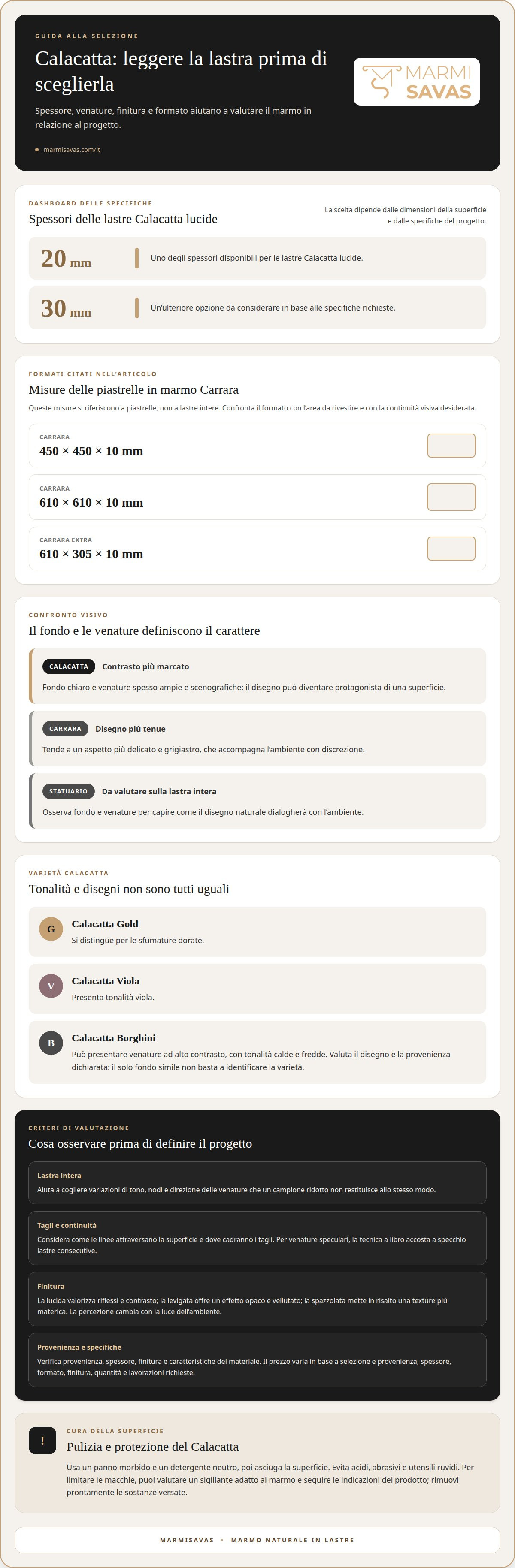
The format affects both the reading of the material and cut planning. Among the Carrara marble tile formats listed are 450 × 450 × 10 mm and 610 × 610 × 10 mm; for Carrara Extra, 610 × 305 × 10 mm. These are tile measurements, not full slab dimensions. Before defining the design, compare the format dimensions with the area to be covered and the desired visual continuity.
What are the risks of choosing Calacatta? As a natural material, marble requires attention in use and maintenance to preserve its appearance. Natural veins are not repetitive: consider the appearance you want and the care the surface will require.
To clean and protect Calacatta, use a soft cloth and a neutral detergent, then dry the surface. Avoid acids, abrasives and harsh tools; to prevent stains, evaluate a suitable marble sealant and follow the product instructions. Sealant does not eliminate the need to promptly remove spilled substances.
The Apuan Alps host marble quarries known for producing materials intended for prestigious interiors and architectural works. Borghini Quarry has been managed by the Borghini family for three generations.
Availability of Calacatta and Statuario Slabs
The choice between Calacatta and Statuario depends on the desired pattern, project dimensions and selected slabs. Before purchasing, compare thickness, finish, background and vein continuity: these details help evaluate the visual effect and suitability of the material for its intended use.
Calacatta slabs are available in 20 mm and 30 mm thicknesses. To choose, consider the surface dimensions and the project specifications. Statuario should also be examined for its background and veining across the entire slab, so you can evaluate how the natural pattern will harmonize with the space.
In Italy, choose a supplier who clearly describes the origin, thickness, finish and characteristics of the material. Observing the entire slab allows you to identify variations in tone, knots and the direction of the veins, details that a small sample does not reproduce in the same way. If the project includes several surfaces, consider the slabs together to coordinate the overall appearance.
Slab selection makes it possible to identify the natural pattern best suited to the project. Examine each slab and evaluate which sections are best suited to the different planned surfaces. This way, you can create a coherent composition without expecting natural veins to repeat uniformly. For example, a floor and a nearby island may require careful colour harmony.
If the project includes mirrored veining, evaluate the bookmatched arrangement, also called “a libro”: consecutive slabs are placed like a mirror, and the effect can create visual continuity on a wall or island. The result depends on the sequence of slabs and the orientation of the pattern, so it is useful to consider the composition as a whole before cutting and installing the surfaces.
The price is determined through a quotation and varies according to selection and origin, thickness, format, finish, quantity and required processing. When comparing several proposals, verify that they concern materials with equivalent characteristics: the variety name or the appearance of a sample alone is not enough.
Which finishes should be considered? Polished finish enhances reflections and contrast; honed finish creates a matte, soft effect, while brushed finish gives the surface a more textured appearance. The finish changes the perception of colour and veins: compare samples with the lighting planned for the space.
For a kitchen or bathroom countertop, choose the slab based on measurements, openings and desired pattern. Share these elements with the professional managing the project so they can define the material specifications and necessary processing. Also evaluate thickness and finish in relation to the final appearance.
To compare the options for your project, you can describe the characteristics of the desired slab, indicating the room, dimensions and finish.
Applications in Kitchens, Bathrooms, Walls and Floors
Calacatta can become the protagonist of a surface or accompany the project through carefully selected details. In a kitchen, bathroom, wall or floor, consider dimensions, light and the role of veining to define the desired effect.
Applications for Countertops and Walls
On a kitchen countertop, a light background and pronounced veins attract attention and characterize the island or worktop. To evaluate the effect, identify the most visible area and consider where edges, openings and joints will fall. The natural pattern varies from slab to slab, so the composition must be studied using the selected material.
As a vertical covering, a slab can create a focal point behind the worktop or around a fireplace. A large wall enhances extended veins, while a smaller strip introduces marble without dominating the entire space. Observe the surface under the actual light of the room: lateral light can highlight colour variations more strongly.
To coordinate countertop and wall, visually compare adjacent slabs. In a kitchen with simple lines, for example, broad veins add movement; alongside finishes already rich in detail, a more balanced pattern keeps the composition legible. Visual continuity also depends on the position of joints and cuts.
Applications for Bathrooms and Floors
In a bathroom, Calacatta can characterize walls, niches or vanity tops, creating an aesthetic thread between different surfaces. A niche, for example, can repeat the tone of the main covering without reproducing every vein. Define the proportions of the areas and evaluate how cuts divide the pattern in the most visible points.
For flooring, relate the scale of the veining to the dimensions of the room. In a large entrance, pronounced lines can accompany the scale of the space; in a compact bathroom, a more discreet pattern avoids weighing down the whole composition. The finish modifies the perception of light and the tactile sensation: compare samples with the expected lighting.
Natural stone offers compositional possibilities even at transitions between floor and wall. For example, aligning a joint with the edge of a niche creates visual order; a carefully planned arrangement, on the other hand, reduces the impression of random cuts. Evaluate these details on the floor plan and in the project elevations, together with the surrounding colours.
In every room, start with a dimensioned plan and mark fixed elements such as taps, sinks, doors and sockets. Then identify the portions of the slab to enhance in the most visible areas. This method helps coordinate function, veining and architecture, considering marble as an integral part of the interior design.
Marble pieces are supplied without sealant. Before applying a suitable product, clean them and allow them to dry completely.
Quarries and Variety Names
Calacatta identifies a light-colored marble appreciated for its pronounced veining, but the name alone does not indicate a specific quarry. Variety names help describe origin and appearance, elements to consider together when choosing a slab for a project.
Where is Calacatta marble extracted in Italy? Its main origin is the Carrara area, in the Apuan Alps. The quarries in the area are known for marble intended for interiors and architectural works; to determine the specific origin, also consider the commercial name of the variety.
The name does not automatically indicate the place of extraction. Calacatta Lincoln, for example, is extracted in Colorado, United States. This case shows why it is useful to distinguish the variety name from the declared origin of the material, without deducing it solely from the word “Calacatta”.
Some names directly refer to appearance. Macchia Vecchia means “old stain” and recalls the aged impression of its veins. On a slab of this variety, observe how the lines are distributed across the background: the same name can correspond to different visual effects, to be evaluated on the complete surface before defining the final design.
To compare varieties and origins, proceed step by step:
- Read the name indicated for the marble and separate it from the geographical indication.
- Ask for the origin to be described separately from the commercial name.
- Examine the entire slab, checking the background, contrast and continuity of the veins.
- Compare the material with its intended use, for example a feature wall or a countertop.
These steps help avoid comparisons based only on the name. Two slabs called Calacatta may have different patterns and shades; the final effect also depends on the portions cut and placed together. For a wall, evaluate the overall pattern; for a countertop, also consider the position of edges and openings.
Calacatta Gold, Calacatta Monet and Calacatta Viola are names that guide the interpretation of color: gold, ivory with colored accents and purple veins characterize these varieties respectively. Visual verification remains essential because it allows you to compare the name with the material actually selected.
During purchase and installation, keep the name and origin data associated with the selected slab. Architects, marble workers and clients can thus refer to the same material during design, processing and installation, reducing ambiguity between varieties with similar names.
Visual Characteristics of the Different Calacatta Varieties
Calacatta varieties are distinguished mainly by color and vein patterns. Comparing these elements across the entire slab helps choose a marble consistent with the desired atmosphere, from an exclusive accent to a more elaborate design.
Calacatta Gold combines golden veins with taupe and gray shades. The overall effect creates a warm contrast, but not a uniform one: evaluate the balance between shades across the complete surface. In a neutral-colored setting, gold can become a luminous detail; alongside warm woods, taupe shades create a visual connection between materials.
Calacatta Monet features an ivory-cream background crossed by plum, lavender, rust and gold veins. The presence of warm and cool colors makes it useful to place the slab alongside samples of the planned finishes. This allows you to evaluate whether the shades harmonize with the space or create a dominant contrast.
Calacatta Vagli is recognized by its intricate, net-like veins. This pattern may be suitable for bookmatched installation, in which slabs placed mirror-like create visual continuity. Before choosing, check the sequence of slabs and the point where the pattern is reflected: symmetry depends on their actual arrangement.
Calacatta Viola stands out for its intense veins in shades of purple, burgundy and eggplant. Compared with golden varieties, it offers a stronger chromatic contrast and can guide an interior color palette. Before defining the project, pair it with the colors of walls, furnishings and metals.
To compare the varieties, consider these visual characteristics:
- Calacatta Gold: gold, taupe and gray for a warm, nuanced composition.
- Macchia Vecchia: gold, rust and gray with cloud-like patterns.
- Monet: ivory-cream background and plum, lavender, rust and gold accents.
- Vagli: a lattice-like pattern, suitable for carefully planned mirror compositions.
- Viola: purple, burgundy and eggplant veins, with intense contrast.
The choice does not depend only on the main color. Compare the density and direction of the veins and the amount of visible background. Then imagine which portion will be highlighted: a narrow strip selects only a few lines, while a wide surface shows more variations. The same variety can therefore produce different effects depending on the cut.
To evaluate a variety for your project, share the desired aesthetic characteristics and the intended environment.
MARMISAVAS: Calacatta Marble
MARMISAVAS offers Calacatta slabs for projects in which the light background and expressive veins define the identity of the space. The choice can start from the desired effect: from the marked contrast of Calacatta to the more delicate pattern of Bianco Carrara, through the designs of Arabescato and the shades of white marble.
To evaluate the material, consider the intended environment, the surface to be covered and the visual role of the slab. Architects, designers and owners can thus compare aesthetic characteristics with project requirements, maintaining consistency between stone, light and surrounding finishes.
To discuss your project and the most suitable Calacatta slabs, contact MARMISAVAS.
Turn Marble Selection into a Design Direction
The right slab does not simply complete a surface: it helps define the visual rhythm of the environment. Before proceeding, clarify the role you want it to play, from a prominent feature to a more discreet presence, and consider how it will interact with light, furnishings and surrounding materials. Thus, the choice of Calacatta marble slabs comes from an overall vision, not just from a sample observed outside its context.
Move your project forward by defining the environment, surface and aesthetic preferences: these references make the discussion about the material more concrete. Contact MARMISAVAS to discuss your project and identify the direction best suited to your ideas.
Frequently Asked Questions
What are the standard dimensions and thicknesses of Calacatta slabs?
For polished Calacatta, slabs with thicknesses of 20 mm and 30 mm are available. Length and width should be evaluated in relation to the selected slab and the project: for example, a countertop with openings requires different cut planning from a continuous wall. Before defining the design, compare the area measurements, joints and vein sections to be highlighted.
How much does a Calacatta marble slab cost per square meter in Italy?
The cost is determined by the selected slab and project characteristics, not by a universal rate per square meter. The figure per square foot is only a surface reference, not a price valid for every Calacatta slab: 1 square meter = 10.764 square feet. International references may differ in currency, slab description and included items. The quotation should be requested for the desired material and selection.
What factors affect the price of Calacatta, such as veining, quality and finish?
The evaluation depends on slab selection, vein contrast and continuity, thickness, format and finish. The quantity of material and required processing also affect the price. When comparing two quotations, verify that they concern comparable slabs and finishes. Material, processing, transport, cutting and installation are separate items: attribute to the price only the costs explicitly indicated in the quotation.
What are the differences between Calacatta, Carrara and Statuario?
Calacatta tends to have a light background with pronounced and contrasting veins, while Carrara often features a more delicate and grayish pattern. Statuario is appreciated for its luminous background and prominent veins. Characteristics vary from one natural slab to another: to choose, compare the entire material and evaluate contrast, vein distribution and the result in the intended environment.
What are the risks of choosing Calacatta marble compared with porcelain stoneware or quartz?
Natural marble may require careful maintenance; check with the professional which care procedures are suitable for the selected slab. Consider the necessary maintenance and natural variations in the veins before choosing it.
How is a Calacatta slab installed for a kitchen or bathroom countertop?
Share measurements, openings and the desired pattern with the professional, so they can define the slab specifications and necessary processing. Also evaluate thickness and finish according to the final effect.