Arabescato Price per Square Meter and Slab Characteristics

The price of Arabescato marble cannot be evaluated by separating the cost from the slab: thickness, dimensions, and material characteristics affect the selection and quotation. The most common thicknesses are 20 and 30 mm, while the format determines how much surface area can be obtained and how the veining pattern can be showcased. It is natural to want to compare the price per square meter, but two slabs of the same variety may have different visual effects. Background, veining intensity, and continuity contribute to defining the project's result. For this reason, the evaluation starts from the intended use and desired appearance, not only from the surface measurement.
In this guide, you will discover how to understand Arabescato pricing in relation to slab thicknesses and dimensions and which elements to consider when comparing options. You will also see how to observe the background and veining to appreciate differences between slabs and guide the selection for a wall covering, flooring, or decorative detail.
Key Points
- Compare slabs by considering thickness, dimensions, and usable surface area for the project together.
- Evaluate the quotation according to the variety, selection, and characteristics of the slab, not only the cost per square meter.
- Consider how format and thickness influence the appearance of the veining and material planning.
- Observe the background, veining pattern, and finish to recognize differences between Arabescato varieties.
- Define the desired effect and application first: it will be easier to identify the suitable slab and compare options.
Index
- Slab thicknesses and dimensions
- Arabescato price per square meter
- Which factors affect the price of Arabescato marble?
- How to recognize authentic Arabescato marble and evaluate its quality?
- MARMISAVAS: Calacatta Marble
Slab thicknesses and dimensions
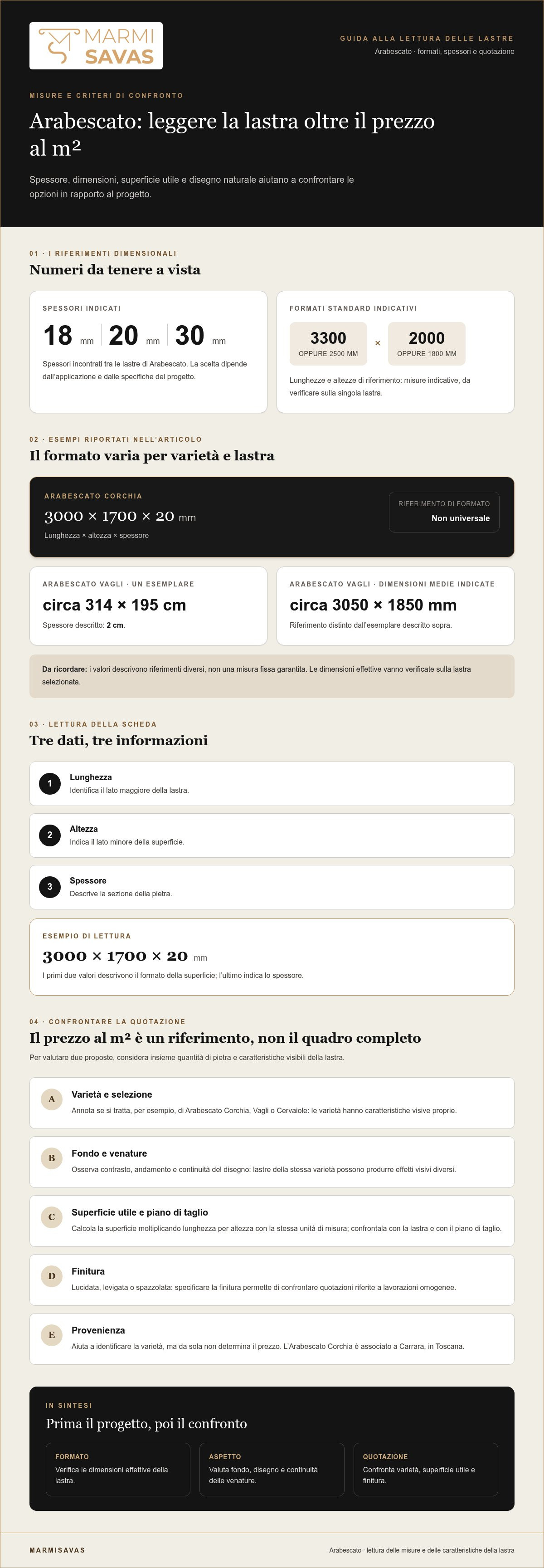
Arabescato slabs do not have a single universal format. Measurements vary according to the variety, extracted block, and available cutting. Among the standard formats indicated are lengths of 3300 or 2500 mm and heights of 2000 or 1800 mm. These are indicative dimensions to guide the project, not measurements to automatically assign to every slab. Before defining the design of a space, it is therefore necessary to evaluate the actual dimensions of the selected material.
For Arabescato Corchia, a format of 3000 × 1700 × 20 mm is also reported. The measurement includes length, height, and thickness. This format makes it possible to consider the available surface and the visual continuity of the veining. A larger slab may help reduce interruptions in the pattern on a wall or floor, but the composition also depends on the geometry of the space and the planned cutting. Actual measurements must be read from the individual slab.
Arabescato slabs are available in thicknesses of 18, 20, and 30 mm. For Arabescato Corchia, 20 and 30 mm are mainly indicated; for Arabescato Vagli, 20 or 30 mm. The choice depends on the intended application and the project's specifications. Thickness does not only affect the visible cross-section before defining cuts and joints.
The measurements published for Arabescato Vagli show why it is important to distinguish between a variety and an individual slab. One specimen is described as approximately 314 × 195 cm, with a thickness of 2 cm. For the same variety, average dimensions of approximately 3050 × 1850 mm are indicated. The values are not perfectly identical: they describe different references, not a fixed measurement guaranteed for every piece. The Arabescato Corchia slab must therefore be evaluated according to its actual dimensions.
To read a dimensional specification without confusing the data, consider three elements. Length identifies the longer side; height indicates the shorter side; thickness describes the stone's cross-section. For example, in 3000 × 1700 × 20 mm, the first two values define the surface format, while the last indicates a 20 mm slab. This distinction helps compare different formats and communicate project requirements precisely.
- Identify the variety, such as Corchia or Vagli, before comparing measurements.
- Read length, height, and thickness separately in the slab specification.
- Evaluate the continuity of the veining in relation to the surface to be covered.
- Define thickness in relation to the application and planned cuts.
A large format can enhance the natural pattern, especially when the veining forms evident arabesques. To arrange multiple slabs together, observe the background and the path of the gray lines. The final effect also depends on how the cut intersects the pattern, not only on the available measurements. The standard measurement is therefore an initial reference: the actual evaluation starts from the selected slab and the surface to be created.
In the project, record dimensions with the unit of measurement and thickness, without mixing millimeters and centimeters. For example, 314 × 195 cm corresponds to a format described in centimeters, while 3050 × 1850 mm is expressed in millimeters. Recording the data in the same system makes comparisons between specifications more immediate and facilitates cut planning. An accurate reading of measurements therefore helps connect the available slab to the aesthetic and dimensional requirements of the space.
Arabescato price per square meter
A quotation per square meter is a reference, but it does not describe every slab on its own. To compare two proposals, consider surface area, variety, selection, and finish together. Arabescato Corchia and Arabescato Vagli may feature different patterns even when the project requires similar surfaces. The evaluation therefore concerns both the quantity of stone and the visible characteristics of the material.
The natural pattern affects the selection: background, contrast, and the direction of the veining distinguish one slab from another. A specimen with evident arabesques may have a different appearance from one with a more discreet pattern. In projects requiring a coordinated composition, the continuity of the pattern between slabs also matters. The name Arabescato alone is therefore not enough to describe what is being compared.
Provenance helps identify the variety, but does not determine the price on its own. Arabescato Corchia is an Italian marble associated with Carrara, in Tuscany. Arabescato Vagli and Arabescato Cervaiolo are other varieties, each with its own visual characteristics. When comparing proposals, record the variety name and provenance together with the characteristics of the slab, instead of treating all types as equivalent.
The required surface area is another essential element. To calculate it, multiply the length by the height of the panel, using the same unit of measurement. Then compare the result with the slab's surface area and the cutting plan. A covering composed of multiple elements requires careful arrangement, especially if you want to preserve the continuity of the veining. Therefore, read the price per square meter in relation to the quantity actually useful for the project.
Include the finish in the comparison as well. A polished, honed, or brushed surface produces different reflections and sensations, changing the stone's final appearance. Specifying the desired finish helps compare quotations referring to homogeneous processing. According to the European Commission, the ex-works price includes the value of the materials used and other production costs. This criterion helps distinguish the material's value from the production stages included in the quotation.
Before comparing offers, prepare a consistent description of the project. Indicate the variety, surface area, required dimensions, and finish. Add a note about the desired pattern, for example pronounced veining or a more uniform motif. These details clarify how closely the proposal corresponds to the project's requirements. The Arabescato Corchia selection offers a concrete reference for evaluating a specific variety.
- Compare the same variety and not only the designation Arabescato.
- Verify that the surfaces considered correspond to the planned cutting.
- Record finish and thickness in the same comparison sheet.
- Evaluate the veining pattern in relation to the overall composition.
For your project, the price depends on variety, selection, format, finish, and quantity: the exact figure is indicated in a quotation referring to the specific case. A complete request with measurements and preferences makes it possible to evaluate the proposal using consistent criteria. To share the details and begin the comparison, you can send the project information.
Each slab is distinguished by unique elements such as background color, contrast, and veining orientation.
The price of Arabescato marble slab material is indicated between Euro 450 up to Euro 880 per square meter, without custom cutting or other processing. These figures are not directly interchangeable: FOB, VAT, and inclusion of processing describe different conditions. Request a quotation referring to the same product type and clarify which stages are included, so the comparison remains linked to the actual supply and cutting plan.
Which factors affect the price of Arabescato marble?
The value of a slab depends on several characteristics, not only its commercial name. For Arabescato, variety, natural appearance, selection, and processing all contribute to the evaluation. A Corchia slab with a dense pattern, for example, has a different visual effect from a surface with more sparse veining. Understanding these elements helps compare proposals referring to genuinely similar materials.
Visual selection is one of the central criteria. Background, contrast, and the arrangement of veins vary from one extracted block to another. In Arabescato Corchia, the predominantly white background may feature gray, black, and, more rarely, golden lines. In Vagli, gray and greenish veins can also be observed. These natural characteristics influence the overall effect and the possibility of coordinating several slabs in the same space.
The continuity of the pattern also requires attention. If the project includes adjacent panels, the correspondence of the veins can become an important criterion. A bookmatched composition, for example, requires evaluating the slabs and the cutting plan together. The material must have a pattern suitable for the intended composition. It is not enough to consider each piece separately: the combinations define the visual result.
Surface quality is another element to examine. Observe the background and the veins, then identify any visible discontinuities or defects. Also consider the uniformity of the finish and the consistency of the appearance with the intended use. A feature wall, for example, highlights the pattern across a large surface, while a smaller element focuses attention on a specific portion of the stone.
Processing matters because it transforms the block into selected material ready for subsequent stages. Cutting, edge finishing, and surface finishing require different production operations. The European Commission indicates that the ex-works price includes the value of the materials used and other production costs. This reference clarifies why evaluating the material alone does not necessarily describe all the items included in a proposal.
Quantity and the cutting plan also affect material management. A project with regular shapes allows cuts to be organized differently from a composition with shaped elements. A rectangular wall, for example, requires planning different from a design that must follow niches and openings. Consider together the purchased surface and the surface actually usable: cutting determines how the slab adapts to the required dimensions.
To compare two proposals correctly, prepare a sheet using the same criteria for each slab:
- Variety and origin: distinguish Corchia, Vagli, and Cervaiole.
- Appearance: describe the background, color, and direction of the veins.
- Selection: note pattern continuity and visible defects.
- Processing: indicate the required cutting, edges, and finish.
- Destination: specify the planned panels, coverings, or other elements.
A sheet organized this way makes the comparison more transparent and clarifies which differences depend on the stone and which on processing. Two slabs of the same variety, for example, may require different selections if a composition demands coordinated veins. Evaluating the material, pattern, and transformations together makes it possible to read the proposal in relation to the project, without reducing Arabescato to a generic description.
How to recognize authentic Arabescato marble and evaluate its quality?
Arabescato marble is recognized mainly by the contrast between its light background and intricate veins. Its appearance varies according to the variety and the original block. Therefore, observe the entire slab, not just an enlarged detail: a small sample may show the color, but not the continuity of the pattern across the whole surface. Evaluation begins with identifying the variety and continues with an orderly visual examination.
The background of Arabescato may vary, as may the color and direction of the veins. Arabescato Corchia generally has a white background, with light ovals and gray or black lines; golden veins are rare. Arabescato Vagli, on the other hand, has a white background and gray or greenish veins. These characteristics help distinguish specimens with different effects without reducing every slab to a single color scheme.
Arabescato Cervaiole, also called Arabescato Faniello, has a specific visual identity: its white background is crossed by intertwined light-gray veins. Comparing it with Corchia and Vagli shows how color and pattern vary between types. To evaluate the consistency of the designation, verify that the variety name corresponds to the material description and observe whether the visible pattern reflects its characteristics.
Aesthetic quality is evaluated in relation to the intended use. For a large wall, consider the distribution of veins across the entire slab. For a smaller element, observe which part of the pattern will remain visible after cutting. In Corchia, for example, white ovals and dark lines can create a pronounced graphic effect. A well-planned cutting layout enhances the natural pattern instead of concentrating it in a less representative area.
For an initial examination, proceed using simple and comparable criteria:
- Identify the variety: note whether it is Corchia, Vagli, or Cervaiole.
- Observe the background: check the white tone and its distribution across the slab.
- Follow the veins: observe color, direction, and continuity from one end to the other.
- Examine the surface: look for visible discontinuities or defects without confusing them with the natural pattern.
- Connect the appearance to the project: evaluate how cutting selects and arranges the pattern.
The Arabescato Corchia specification indicates water absorption below 0.5%. This is a figure referring to that variety, not a characteristic that should automatically be attributed to every Arabescato marble. This distinction is important: the general name includes different types. When comparing materials, associate each technical figure with the specific variety to which it refers, rather than extending it to the entire family.
Origin completes the understanding of the material. Arabescato Corchia is an Italian marble originating from Carrara, in Tuscany; the Vagli variety is also presented as Italian marble. Consider this information together with the appearance and identification of the slab. A thorough check combines the name, declared origin, background, veins, and surface, without relying on a single visual clue.
To guide the selection, compare the characteristics of the slab with the desired pattern and the surface to be covered. If the project requires an evaluation of Arabescato slabs, share the project details to begin comparing the most suitable material.
Arabescato Cervaiole, also called Arabescato Faniello, has a white background with intertwined light-gray veins. Comparing the slab with this description helps verify the consistency of the commercial name without assuming undocumented characteristics.
MARMISAVAS: Calacatta Marble
MARMISAVAS is the next step for comparing Arabescato slabs and evaluating an alternative with a different character. The supply includes Arabescato marble, Calacatta, Bianco Carrara, and white marble for residential and commercial projects. Calacatta stands out for its light background and often broad, dramatic veins; Bianco Carrara is appreciated for its delicate veining and brightness.
Considering these characteristics together helps identify the material consistent with the requested atmosphere and design. To guide the selection, prepare the project measurements and indicate the effect you want to achieve, from pronounced veining to a more discreet appearance.
To compare slabs and share the project requirements, contact MARMISAVAS.
Define the next step of your project
The choice of slab can give direction to the entire space. Before deciding, clarify what role the stone should have: become a focal point, complement existing materials, or create continuity between surfaces. Also consider the lighting of the space and the project palette. These priorities turn an aesthetic preference into concrete criteria for selecting the material.
To evaluate the price of Arabescato marble, relate the proposal to the specific requirements of the project: variety, selection, and finish all contribute to the evaluation. The price is defined through a personalized quotation. Clearly presenting the intended application and desired effect makes the comparison between slabs more targeted.
Once you have defined these priorities, you can continue the discussion with MARMISAVAS and evaluate the material in relation to your project vision. Contact MARMISAVAS for information and move forward with the selection, paying attention to the character and balance of the space.
Frequently asked questions
How is the cost of Arabescato in Italy evaluated?
In Italy, the cost is evaluated according to the specific supply, not only the name of the stone. To read a proposal, distinguish the quotation per square meter from the one referring to the entire slab. Also consider which materials and processing are included. When comparing two offers, standardize the unit of measurement and the contents: the difference between the figures will be more understandable and the comparison more precise.
What is the price of Arabescato Corchia, Vagli, and Carrara?
There is no single figure valid for Corchia, Vagli, and Carrara: the evaluation depends on the variety and the selected slab. To avoid ambiguity, use the full designation reported in the proposal and distinguish the variety name from the geographical reference. If you compare materials for the same space, evaluate each option according to the aesthetic result and the required quantity, without considering the different names interchangeable.
How much do Arabescato slabs and tiles cost in Italian stores?
Slabs and tiles may be sold using different units of measurement, so read the figure together with the quantity to which it refers. To compare two proposals, bring the total to the same unit and distinguish the cost of an individual element from that of the overall surface. Also note the sales format and the characteristics indicated in the specification: this will help you avoid comparing offers referring to different supplies.