Italian Marble Importer in the USA: Origin and Duties

For an Italian marble importer in the USA, customs codes and product processing are key elements: classification depends on the form and degree of processing of the marble. Documentation may include invoices, packing lists, certificates of origin, and quality reports.
For those looking for an Italian marble importer in the United States, the beauty of the stone and its origin are important, but describing the material precisely also matters. Customs classification does not depend solely on the commercial name: form and processing help identify the relevant code and assess applicable duties.
In this guide, you will discover how to document Italian origin, distinguish the main HS categories, and describe the product clearly for customs declarations. We will also look at how to navigate duties and which information facilitates the process from slab selection to shipment to the United States.
Key Points
- Describe marble according to its processing and form: rough blocks, slabs, and cut pieces may fall into different customs categories.
- Prepare consistent documentation, including invoices, packing lists, and documents useful for proving Italian origin.
- Use the HS code relevant to the stone and its processing to navigate classification and assess applicable duties.
- Make the product description precise: material, form, and degree of processing help correctly distinguish goods.
- Compare veining, color, and availability of different varieties to identify the marble most suitable for the project.
Index
- Importation and distribution of natural stone
- Italian origin and customs documentation
- HS codes and customs duties
- Importers, suppliers, and product descriptions
- Which types of marble are imported most often into the USA?
- MARMISAVAS: Calacatta Marble
Importation and Distribution of Natural Stone
Maritime routes from Italy to the United States take approximately 9 to 35 days, depending on the route and ports of call. Marble arrives through various US ports; the choice depends on the final destination and the available service, whether direct or with intermediate stops.
To plan the arrival of marble and other natural stones, consider the form of the goods, volume, and subsequent route together. Slabs, blocks, and processed products require descriptions and handling appropriate to their type. Maritime transport takes place in 20- or 40-foot containers, selected according to the cargo volume.
The port of entry is a stage in distribution, not the final destination of the material. After customs clearance, the stone may continue to a warehouse, a specialized storage facility, or directly to a construction site. Defining in advance who will receive the goods helps coordinate unloading and subsequent delivery.
Practical planning starts with these steps:
- Determine whether slabs, rough blocks, or processed marble are being purchased, because the form affects the description and cargo handling.
- Estimate the total volume to choose between 20- or 40-foot containers.
- Identify the port according to the destination and the planned distribution route.
- Coordinate arrival with the warehouse or construction site that will receive the stone after customs clearance.
Recent shipment dates and weights show the variety of cargo reaching the United States. A shipment of slabs weighing 8,155 kg arrived on August 17, 2026; on July 21, a marble shipment weighed 21,554 kg. These examples help explain why volume, packaging, and receiving arrangements must be organized before departure.
Distribution does not end with the ship's arrival. A shipment intended for a warehouse may require different handling from a direct delivery to a construction site. Specifying the receiving location and stone type helps organize subsequent operations. For each shipment, distinguishing raw material from finished product clarifies the route from the quarry to the commercial destination.
In the stone trade, origin and destination are only part of the plan. The importer coordinates volume, containers, port, and final delivery while keeping product information consistent. The sequence must be defined before departure: identify the goods, organize maritime transport, and prepare distribution after arrival in the United States. This preparation connects stone selection with the project's actual requirements and receiving arrangements.
Italian Origin and Customs Documentation
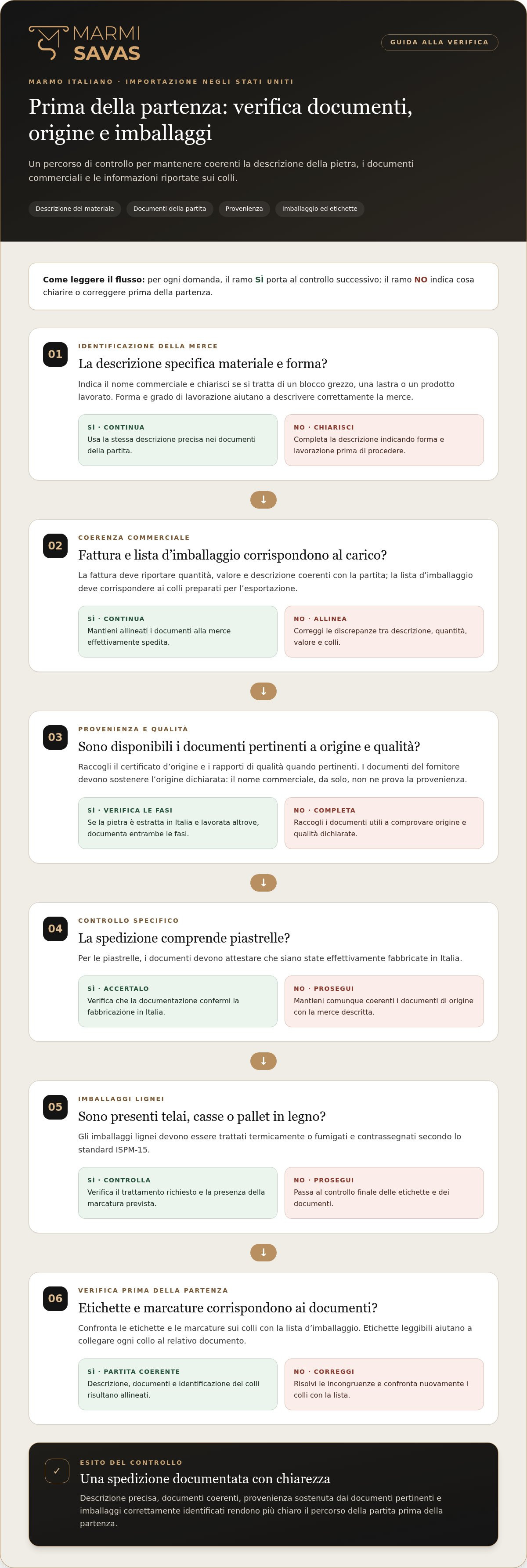
To document Italian origin, collect invoices, packing lists, certificates of origin, and quality reports, where relevant. Supplier documents must support the declared origin of the product. For tiles, they must also confirm that they were actually manufactured in Italy. The commercial name alone does not prove origin.
The comparison between Italian marble, local marble, and quartz cannot be resolved through a universal ranking of price or quality. In natural marble, grade, color, veining, and availability influence the assessment; aesthetic judgment also depends on the actual selection and intended use. Quartz is a distinct material, so the comparison must begin with the characteristics required by the project.
The main risks concern discrepancies between documents and goods, aesthetic variations between slabs, and damage during transport or handling. An inaccurate description may complicate customs clearance, while an unverified selection may differ from the expected result. Aligning documentation, photographs, and package identification helps identify inconsistencies before departure.
Organize the information in a clear sequence:
- Describe the material using its commercial name and form: block, slab, or processed product.
- Include quantities, value, and a description consistent with the shipped lot in the invoice.
- Align the packing list with the packages actually prepared for export.
- Collect the certificate of origin and quality reports associated with the material.
- Compare documents with labels and markings on the packages before departure.
Commercial provenance must distinguish the origin of the material from the place of processing. If the stone is extracted in Italy and processed elsewhere, the documents must correctly describe both stages. This distinction makes the origin declaration clearer for those purchasing, importing, and receiving the shipment, without confusing the variety name with proof of origin.
Before export, slabs undergo quality checks, are packed in wooden crates, and are properly labeled. Wooden packaging, including frames, crates, and pallets, must be heat-treated or fumigated and marked according to the ISPM-15 standard. Legible labels help connect each package to its corresponding packing list.
For a selection intended for a design project, keep photographs of the slabs together with their descriptions and commercial documents. Comparing images with the received material helps assess shades and veining, which naturally vary from one slab to another. Organized documentation thus facilitates origin traceability and quality management throughout the commercial route.
To discuss the requirements of an Italian marble selection, you can [contact us] for the material characteristics and information useful for supply.
HS Codes and Customs Duties
To classify marble destined for the United States, first consider its form and degree of processing. The customs classification of processed marble depends on its form and degree of processing, including slabs and pieces cut to size. Rough or merely squared blocks, on the other hand, fall under HS heading 2515. The distinction between processed material and blocks is not merely commercial: it determines the customs classification of the cargo.
US import statistics distinguish various categories of finished products. HS code 6802910500 identifies marble slabs, while 6802911500 identifies marble other than slabs. For marble and alabaster worked for monuments or construction, simply cut or sawn, code 6802215000 is indicated. Each identifier corresponds to a specific description and should not be selected solely based on the commercial name.
Other processed stones, including limestone and other calcareous stones, fall under HS codes 6802.92 and 6802.99. Classification therefore depends on the material and type of processing, not merely the surface appearance. When preparing a description for an import activity, clearly indicate whether the goods are marble, travertine, alabaster, or another stone.
To guide classification checks, compare these elements:
- Form: rough block, slab, or piece cut to size.
- Processing: material that has merely been squared, simply sawn, or further processed.
- Composition: marble, travertine, alabaster, limestone, or another stone.
- Declared use: for example, construction or monuments, when relevant to the heading considered.
The HS code helps identify the tariff classification but does not determine the amount of duties on its own. The treatment depends on the relevant heading and the trade measures applicable to the goods. To calculate it, the product classification must therefore be distinguished from any measures associated with its origin.
As of July 24, 2026, Italian stone falls within the Section 301 measure applied to goods from the European Union. Tariff treatment may vary depending on the product classification and applicable measures, so it is advisable to verify how these affect the ordinary duty. An automatic total should therefore not be assumed: the applicable classification and treatment provided for the goods determine the tariff outcome.
A useful procedure is to describe the material using specific terms, compare the description with the candidate heading, and verify that the form and processing are consistent. A slab, a merely squared block, and a sawn piece have different characteristics. Including these distinctions in commercial documentation helps make the customs declaration more precise.
Before finalizing the procedure, check that the commercial description, HS code, and shipping documents identify the same product. For example, a slab should not be described as a rough block. This check makes import management more orderly and helps the business assess the classification and relevant tariff measures more precisely.
Importers, Suppliers, and Product Descriptions
An effective commercial description connects the selected variety, the appearance of the slab, and its processing. When comparing Italian suppliers, US importers can start with recognizable names such as Carrara, Calacatta, and Arabescato.
Types of Marble Imported
There is no universally verifiable ranking of the varieties imported most frequently into the United States. Carrara, Calacatta, and Arabescato are distinctive examples of Italian marble: Bianco Carrara is known for its bright background and delicate veining; Calacatta often features more pronounced veins; Arabescato displays flowing and contrasting patterns. The choice depends on the desired visual effect and the specific selection.
To compare slabs intended for the same project, observe the background tone, the intensity of the veining, and the differences between individual pieces. The name of the variety does not describe every slab: a comprehensive photograph of the selection helps evaluate the expected result for the surfaces. If the project requires a symmetrical pattern, consider the sequence of slabs during selection.
Suppliers and Product Descriptions
A supplier should describe the stone using precise terms, distinguishing the variety, declared origin, form, and processing. For example, “white Carrara marble slab” communicates more than “light-colored stone.” If the material comes from a quarry in the Carrara area but is processed elsewhere, describing extraction and processing separately avoids ambiguity for the importer.
When comparing offers from suppliers, request consistent descriptions for each selection: commercial name, quantity, available size, and finish. These elements allow equivalent materials to be compared instead of combining a polished slab with another having a different finish without specifying it. Images must also correspond to the proposed batch, so that veining and tones are useful for evaluation.
Before defining the order, organize the comparison into practical steps:
- Group proposals by variety, such as Carrara, Calacatta, or Arabescato.
- Compare images of the slabs actually selected, not only indicative photographs.
- Record form, finish, and quantity using the same criteria for each offer.
- Align the commercial description with the documents and labels of the shipment.
Commercial provenance must be expressed accurately. “Italian marble” indicates a national origin; “Carrara marble” narrows the reference to an area known for extraction. In the Carrara area, extraction activity involves more than 650 sites, so the geographic indication does not automatically identify a specific quarry. An accurate description distinguishes the name of the stone from the documented place of extraction.
For an importer, supplier clarity also facilitates communication with designers and recipients in the United States. A specification that names the variety, specifies the finish, and links photographs to the selection reduces divergent interpretations during purchase and receipt. In this way, the natural identity of the stone remains clear throughout the commercial journey, from Italian quarries to the final project.
Which Types of Italian Marble Are Imported Most Often into the USA?
Italian varieties to consider include Bianco Carrara, Calacatta, and Arabescato. There is no single choice suitable for every project: background, veining, color, and processing determine the effect of the stone in interiors and its consistency with the architectural design.
Bianco Carrara is distinguished by its light background and generally delicate, gray or bluish veining. Its appearance makes it suitable for projects seeking brightness and a restrained pattern. Calacatta often features a white background and more pronounced veins, with strong contrasts that can become the focal point of a wall or surface.
Arabescato offers another expression of white marble: more pronounced veins create a rich pattern, also recognizable on large slabs. During selection, observe the relationship between light areas and dark lines, as well as the continuity of the pattern across slabs intended for the same environment. The appearance naturally varies from one slab to another.
To guide the selection, compare these criteria:
- Background: assess how uniform the white is or whether it is crossed by shades.
- Veining: compare the intensity, direction, and density of the natural pattern.
- Combination: consider how the marble interacts with wood, metal, and the palette of the environment.
- Format: select slabs consistent with the surfaces and joints planned for the project.
- Finish: choose according to the desired appearance and the intended use of the surface.
Other varieties also deserve attention. Black marble can create contrast with light walls, while gray and brown tones pair with warm materials and understated palettes. These categories do not indicate a single vein or shade: evaluate the actual slabs, considering the color and pattern of each piece.
For a project in the United States, the name of the variety helps begin the comparison, but it is not enough to describe the selected material. Photographs of the slabs, indications of the finish, and references to provenance make the selection clearer for designers and importers. For example, a Calacatta slab with broad veins produces a different visual result from a more discreet selection within the same family.
The most effective selection therefore arises from the meeting between the identity of the stone and the project's objective. Bianco Carrara, Calacatta, and Arabescato offer distinct expressions, while black, gray, and brown marble expand the color possibilities. Speak with the marble selection team to identify the varieties and slabs most consistent with your project.
MARMISAVAS: Calacatta Marble
MARMISAVAS can help you identify the Italian marble most suitable for your project, starting from the desired effect and the characteristics of the slabs. Calacatta is distinguished by its light background and broad, dramatic veining; Bianco Carrara offers a more delicate pattern, while Arabescato creates complex contrasts.
For an importer or designer, comparing these varieties means considering tones, the direction of the veining, and consistency among the selected slabs. MARMISAVAS offers Calacatta, Bianco Carrara, Arabescato, and white marble, providing a starting point for evaluating materials intended for residential and commercial projects.
To discuss the selection best suited to your project, contact MARMISAVAS.
Turn the Selection into a Concrete Project
The choice of stone can become the starting point for defining the palette, light, and rhythm of the spaces. For those importing Italian marble into the United States, the next step is to transform aesthetic preferences into a clear selection shared with designers and commercial interlocutors. Recording the desired effect, the surfaces involved, and visual priorities helps maintain project consistency.
MARMISAVAS offers Calacatta, Bianco Carrara, and Arabescato, varieties suited to different expressions, from dramatic veining to more delicate patterns. Comparing slabs can guide the choice toward a stone that aligns with the identity of the environment and the project's intentions.
When you want to develop the selection for your project, contact MARMISAVAS to discuss it. A focused conversation can help shape an informed choice and a result with authentic character.
Frequently Asked Questions
Who are the main importers of Italian marble in the United States?
Importers to consider are companies that manage purchasing, entry documentation, and stone distribution in the United States. To compare them, evaluate the accuracy of descriptions, traceability of provenance, and ability to connect slab selection with project requirements. MARMISAVAS supplies natural marble for projects in Italy and abroad; the selection can start with Calacatta, Bianco Carrara, or Arabescato.
From which Italian quarries and regions does marble imported into the United States originate?
Imported marble may come from different Italian extraction areas; Carrara is a reference origin for white marble. The area includes more than 650 extraction sites, so the geographic name alone does not identify a specific quarry. For a project, distinguish the commercial variety, the clearly identified extraction area, and the place of processing: these are different pieces of information that help describe the selected stone precisely.
What costs affect the importation of Italian marble into the United States?
The total cost depends on the value of the stone, the volume and type of shipment, the destination, and customs management. Tariff classification and any applicable trade measures also have an impact. A slab and a rough block involve different logistical requirements. To compare quotations, separate the cost of the material from transport, handling, customs clearance, and inland delivery: this makes it possible to identify the elements that determine the total.
Which US duties and customs rules apply to marble imported from Italy?
Classification and trade measures depend on the form and processing of the product. As of July 24, 2026, the Section 301 measure applied to goods from the European Union includes Italian stone and slabs, bringing the ordinary duty up to an established level rather than adding it to that level. To evaluate a shipment, the description of the goods must correspond to its tariff category and commercial documents.
How can you find and verify a reliable supplier or importer of Italian marble?
Compare consistency between the sample, photographs, commercial description, and shipment documents. For example, if the project calls for Bianco Carrara slabs, verify that the photographed selection corresponds to the proposed material and that finish and quantity are clearly described. A reliable supplier makes the provenance and characteristics of the stone legible, without confusing the commercial name with the extraction area or place of processing.
Where can you purchase imported Italian marble in major US cities?
Availability depends on the distribution network and the destination of the shipment: marble may reach a depot, a specialized warehouse, or a construction site. To choose the purchasing channel, first identify the material and the desired slab selection, then consider how the goods will reach the project. MARMISAVAS supplies natural marble for projects in Italy and abroad, with varieties such as Calacatta, Bianco Carrara, and Arabescato.