Bianco Carrara Marble Slabs: Finishes, Thickness and Weight

The choice of Bianco Carrara marble slabs does not depend only on color: thickness directly affects weight, while the finish and processing define the appearance of the surface and its consistency with the project. For Bianco Carrara C, a 20 mm slab weighs approximately 54 kg per m².
The light background and delicate veining make Bianco Carrara marble slabs recognizable, but each slab features a different natural pattern. It is therefore useful to carefully evaluate both the aesthetic result and the practical aspects, especially when the material is intended for flooring, wall cladding, or architectural elements.
In this guide, you will discover how to interpret differences in color and veining, which characteristics to consider, and how thickness, finishes, and processing influence the choice. We will also explain how to interpret weight in relation to the surface area, allowing you to evaluate the material more confidently from the earliest project stages.
Key Points
- Evaluate thickness in relation to the intended use and project dimensions: it affects the overall weight of the material.
- Consider finishes and processing together with the stone's natural pattern to achieve a result consistent with the environment.
- Bianco Carrara is appreciated for its luminous background and veining, which vary from one slab to another.
- Consider the characteristics of marble when selecting its application and planning daily surface care.
- Discover how color and natural impurities contribute to the visual differences between varieties.
Index
- Available Thicknesses
- Characteristics of Bianco Carrara Marble
- Slab Thickness and Weight
- Bianco Carrara Marble Slabs
- Which Bianco Carrara Variants Exist and How Do They Differ in Veining and Color?
- MARMISAVAS: Bianco Carrara Marble
Available Thicknesses
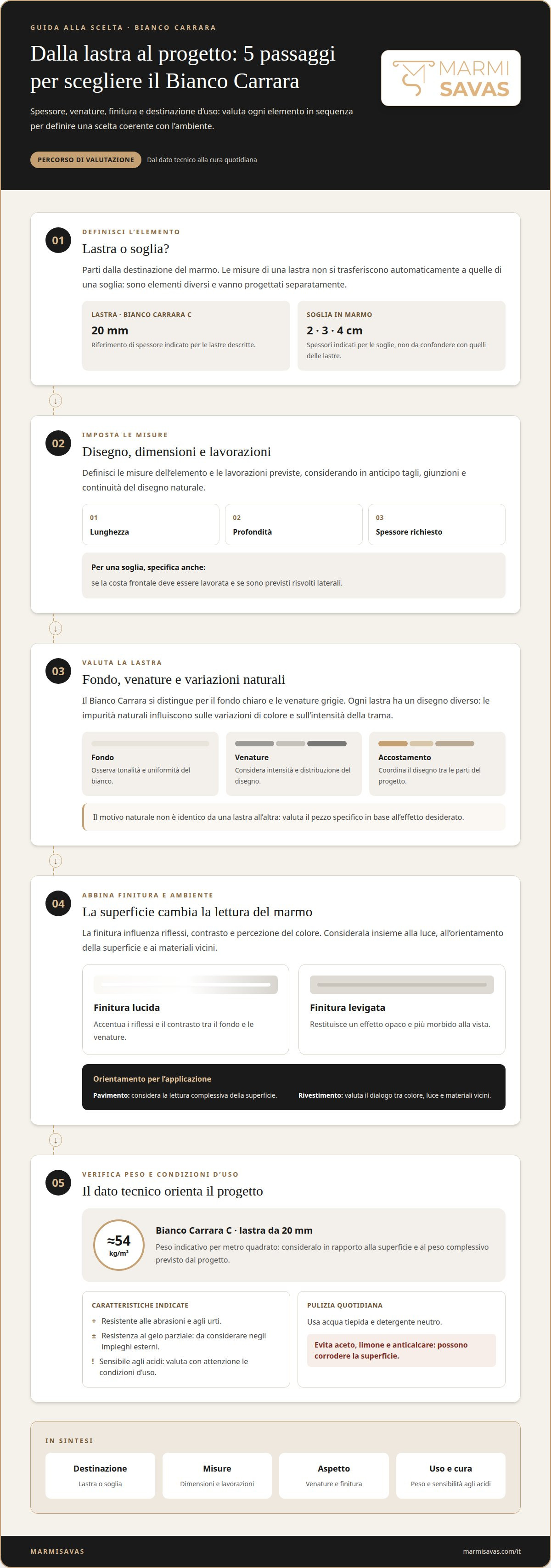
Thickness should be selected according to the element to be produced, project dimensions, and the weight that the structure must support. For Bianco Carrara C slabs described on the Italian market, the available reference is 20 mm. This is useful information for planning the project, but it should not be confused with the thicknesses indicated for thresholds: these are different elements, and their measurements cannot automatically be transferred from one type of processing to another.
For Bianco Carrara marble thresholds, thicknesses of 2, 3, and 4 cm are indicated. The choice depends on the planned configuration, the size of the piece, and the architectural design. A threshold can be custom-made and include only cutting or also front-edge processing. If the project includes lateral returns, these must be considered when defining the piece.
To make an orderly choice, start with the intended use and then define the processing requirements:
- Establish whether the element is a slab or a threshold, avoiding confusion between their respective measurements.
- Indicate the required length, width, and thickness of the element in the drawing.
- Specify whether the front edge must be processed and whether lateral returns are required.
- Consider the surface finish together with the color and veining of Bianco Carrara.
The format should also be considered separately from the final result: continuous cladding, a countertop, or a threshold require different cutting plans. The format depends on the dimensions of the element, the arrangement of the veining, and the number of joints planned. For example, a long threshold should be designed by considering the cut and the edge in advance, while a large surface requires coordination of the pattern between the individual pieces. Bianco Carrara marble has natural veining, so visual matching deserves attention already during the design phase.
Texture concerns both the stone's natural pattern and the appearance of the processed surface. A polished finish enhances reflections and contrast between the background and the veining; a honed finish provides a matte, softer appearance. Color perception changes with light and finish, so it is useful to evaluate the slab, environment, and surface orientation together. In Bianco Carrara, the light background and gray veins create a different result from one slab to another.
Characteristics of Bianco Carrara Marble
Bianco Carrara combines a light background with natural veining, with visible differences between individual slabs. To choose carefully, evaluate color, finish, and intended use together, also considering sensitivity to acids.
Variations in Veining and Color
The varieties differ in the tone of the background and the pattern of the veins. The type and quantity of impurities present in the marble determine color variations: some slabs appear more uniform, while others show more pronounced gray patterns. Observing the entire surface helps determine whether the pattern complements the environment or becomes the dominant element.
When comparing it with other white marbles, evaluate the slab's background, veining intensity, and distribution. Bianco Carrara retains the character of natural stone; however, chromatic variability requires selecting the piece according to the desired effect, without expecting an identical pattern on every slab.
Choosing According to Finish and Use
To select a slab, match the veining pattern with the finish and intended use. A polished surface enhances reflections and contrast, while a matte finish provides a more understated appearance. For flooring, consider the overall reading of the surface; for cladding, evaluate how the color interacts with light and nearby materials.
Compared with porcelain stoneware and quartz, marble's distinctive feature is its natural and non-repeating pattern. There is no absolute superiority: the choice depends on aesthetics and the project's characteristics. Marble's sensitivity to acids must also be considered, especially for surfaces exposed to acidic substances.
Applications and Risks
Bianco Carrara is suitable for indoor environments and, partially, for outdoor environments. It can be selected for kitchens, bathrooms, and floors, taking the conditions of use into account: marble is resistant to abrasion and impacts, but not to acids. It also has partial frost resistance, an aspect to consider in outdoor applications.
Daily cleaning requires lukewarm water and a neutral detergent; vinegar, lemon, and descaling products should be avoided because they can corrode the surface. In the kitchen, caution mainly concerns contact with acidic substances; in the bathroom, the use of descaling products should be excluded. To evaluate Bianco Carrara for your project, you can share the details of its intended use.
Another element for understanding the material is its composition: marble is composed of approximately 50% carbonates. This describes a general characteristic of the stone and can support the observation of its background and veining, without replacing the evaluation of the individual slab. In Bianco Carrara, composition should therefore be considered together with the visible appearance and intended function, in order to maintain consistency between the material data and the desired aesthetic result.
Marble composed predominantly of calcium carbonate and magnesium carbonate is white. This relationship between composition and color helps explain the light background, but does not independently define the pattern of every slab. To choose, examine the specific piece and relate it to the environment in which it will be installed: evaluating the surface and conditions of use completes the general information about composition.
Slab Thickness and Weight
For Bianco Carrara C, the available reference describes slabs with a thickness of 20 mm and a weight of approximately 54 kg per m². This connects a precise measurement to an indicative weight, useful for estimating the mass of the planned material. It does not represent the total weight of a finished element: processing, supports, and additional components belong to separate calculations.
The total surface area is the first element to define. Start with the project dimensions, calculate the area, and apply the reference of 54 kg per m² for 20 mm slabs. This provides an estimate of the marble's weight, not a valid measurement for different thicknesses. The result helps organize handling stages and communicate essential information to those following the project.
For a clear estimate, collect the following information:
- Thickness indicated in the project, distinguishing the 20 mm reference from other measurements.
- Total surface area, calculated from the actual dimensions of the elements.
- Number and format of pieces, to organize cutting and handling.
- Any additional components, to be considered separately from the slab weight.
Weight has practical consequences throughout the entire work sequence. First, the dimensions and arrangement of the slabs are defined; then, how to transfer or position them in the project is evaluated. For 20 mm slabs, the value of approximately 54 kg per m² provides a concrete basis for this planning. The area and number of pieces make it possible to move from a unit reference to the total quantity of material.
Thickness should be evaluated together with the intended application, rather than considered a purely aesthetic choice. A 20 mm slab has a specific weight per surface area that affects planning: the requirements of the element and its project dimensions define the context for the data. Weight alone does not establish which thickness is suitable for every application; it helps understand a practical consequence of the selected measurement.
It is also important not to automatically transfer slab measurements to thresholds. For the latter, thicknesses of 2, 3, or 4 cm are indicated, but these involve different processing from the 20 mm slab reference. A custom threshold may require cutting, a processed front edge, or lateral returns. The final shape and processing affect the amount of marble used, so weight must be evaluated for the specific element.
In summary, the practical reference for Bianco Carrara C slabs is 20 mm, equal to approximately 54 kg per m². To use this value correctly, define the area and number of pieces and separate slabs from processed elements. This makes the material estimate a concrete figure for project planning, without confusing measurements, intended uses, and different components.
Bianco Carrara Marble Slabs
In Italy, Bianco Carrara marble slabs are purchased through suppliers specializing in marble and natural stone. To compare offers, consider origin, dimensions, thickness, and finish, as well as the possibility of selecting slabs according to the veining pattern.
The choice is not exhausted by the name of the material. Each slab is a natural element, with a background and veining that may vary. For a project involving multiple surfaces, a consistent selection helps coordinate the overall effect. Evaluating the slab is particularly useful when the stone's pattern must characterize a cladding or a floor.
Before purchasing, define the project elements and collect the essential information:
- Intended use, for example flooring, wall cladding, thresholds, or floors.
- Required measurements and cutting layout, to plan the surface.
- Thickness and finish required for the element to be produced.
- Color and veining pattern, evaluated on the slab and not only through a description.
- Handling and transportation methods, in relation to weight and format.
To evaluate slabs, compare dimensions and thickness with the elements planned for the project. Observe the background, tonal variations, and continuity of the veining directly on the material, checking that the selection suits the desired design. For cladding, flooring, or an individual element, the characteristics to consider may vary according to the surfaces and measurements required.
The finish contributes to the appearance of the surface and should be selected in relation to the desired result. Thickness and dimensions are also important elements when comparing slabs. To evaluate offers, consider these characteristics together with the marble's tonal variations and the natural pattern of the veining, without relying solely on the material's name.
Careful planning also considers the pattern between adjacent pieces. If several slabs form a continuous surface, comparing them in advance can help evaluate the direction of the veining; for custom cuts, the layout must consider the final shape. These steps coordinate the choice of material and processing.
To select slabs for a project in Italy, start with the intended use and dimensions, then evaluate thickness, finish, and natural pattern. The characteristics to consider must be defined according to the application: a threshold, a wall, and a floor require different evaluations.
To complete the assessment, consider the price together with the required quantity and the characteristics already defined for the project.
When comparing offers, consider the total quantity to be ordered and check that the quotation clearly reports the material, thickness, required surfaces, and economic conditions. The indicated thresholds may help evaluate which offer correspond to the project, but they do not replace verification of measurements and slab patterns. Before confirming, ensure that the conditions applicable to the order are clearly stated and compare offers formulated on the same basis.
Which Bianco Carrara Variants Exist and How Do They Differ in Veining and Color?
Bianco Carrara does not have an identical appearance in every slab: the background and veining vary naturally. The type and quantity of impurities present in the marble determine color variations. To recognize them, observe the background tone, the contrast of the veining, and how the pattern is distributed across the surface.
The evaluation starts with the background. A slab may appear brighter or show a grayer tone; the veins may also be subtle, widespread, or more pronounced. These differences describe the visible appearance of the material, not an artificial variation in the design. For a large cladding, consider the overall effect of the surface; for a smaller element, evaluate the detail that will remain most visible.
An orderly evaluation can follow these steps:
- Observe the background and identify the color variations present on the slab.
- Follow the veins from one end to the other, noting their direction and continuity.
- Evaluate the contrast between the gray lines and the light background.
- Imagine the slab's orientation in its final position, for example on a wall or floor.
- If the project includes several elements, compare the patterns of the slabs to be combined.
In the case of Bianco Carrara C, the slab identifies the material being considered, but each surface retains its natural characteristics. The name alone does not allow the exact pattern of the veining to be predicted. The aesthetic choice should refer to the specific slab and the visible portion after cutting: a prominent line may occupy the center or be interpreted by the format of the element.
Light also modifies color perception. A surface in a bright environment may appear different from the same slab placed next to darker materials. For a consistent comparison, observe the slabs under the same lighting conditions and consider the walls, flooring, and furniture planned. This way, you can evaluate the background and the contrast of the veining in the actual project context.
In practice, choose according to the desired visual effect, without expecting repeated patterns between natural slabs. For a more uniform result, select surfaces with similar backgrounds and patterns; for a scenographic accent, evaluate more pronounced veins and their arrangement. The decision should consider the overall appearance of the project.
To identify whether Bianco Carrara is suitable for the project's design, share your request.
MARMISAVAS: Bianco Carrara Marble
MARMISAVAS offers Bianco Carrara marble slabs for projects in which brightness, a light background, and natural veining define the character of the space. After evaluating thickness, weight, finish, and pattern, you can orient the choice according to the intended use and desired aesthetic effect.
To compare white materials, also consider Calacatta marble, Arabescato, and other varieties of white marble. Evaluating tones and veining patterns helps coordinate the material with the project's architectural language, from residential interiors to commercial spaces.
If you have already defined dimensions, application, and finish, contact MARMISAVAS to evaluate the Bianco Carrara marble slabs best suited to your project.
Turn the Project Idea into a Concrete Choice
The next step is to define the role of the stone in the project: discreet presence, luminous surface, or central visual element. Briefly describing the environment and the desired effect helps guide the selection of Bianco Carrara marble slabs toward a choice consistent with the overall design.
MARMISAVAS offers Bianco Carrara marble, Calacatta marble, and Arabescato marble. These materials have distinct visual characteristics and should be evaluated in relation to colors, proportions, and the style of the space. Sharing project details makes it possible to start a targeted comparison of the most suitable material, keeping the aesthetic choice and the requirements of the environment together.
To discuss the selection or your project, contact MARMISAVAS. Every informed choice can create a personal, balanced space capable of enhancing the natural beauty of stone.
Frequently Asked Questions
What is Bianco Carrara marble and what are its characteristics?
Bianco Carrara is an Italian natural marble, recognizable by its light background and gray veining. Each slab has its own pattern: tones and veining intensity vary according to the impurities present in the stone. A surface with pronounced veins, for example, creates a different visual effect from a more uniform slab. This uniqueness makes it important to evaluate the material in relation to the composition of the environment.
What formats and thicknesses are available for Bianco Carrara slabs?
The format can be defined according to the project, with customized dimensions for the intended applications. For the Bianco Carrara C slabs described, the thickness is 20 mm; thresholds are distinct elements and have different thickness references. When defining the format, consider the cutting pattern and the arrangement of pieces: careful planning helps coordinate veining and joints on the final surface.
What finishes are available for Bianco Carrara and how much do they affect the price?
Available finishes include polished, honed, and brushed. The choice changes the perception of the surface and should be considered together with the format and slab selection. The price is defined through a quotation based on the selection, format, and finish. Processing, transportation, cutting, and installation are separate items unless the quotation explicitly includes them.