Grey marble slabs with veining and finishes for interiors

Grey is not a neutral choice: in grey marble slabs, also known as grey marble slabs, tones, veining and finish define the character of the space. Pietra Grey, for example, pairs a dark background with sparse white veining, while Bardiglio presents soft, cloudy shadings.
Colour is only the starting point. A polished finish reflects light and highlights the pattern; a honed one offers a more discreet effect. Wood, metals and surrounding tints also influence the rendering of grey slabs and the balance of the palette.
You will discover how to distinguish tones and veining, compare finishes and guide the choice for floors and wall coverings. You will also see how to evaluate grey marble slabs in relation to light and combinations, to give interiors a coherent and personal character.
Key points
- Compare light and dark grey backgrounds, fine or marked veining and cloudy patterns to define the desired character.
- Choose the finish according to the visual result: the polished surface reflects light more, while the matt one offers a softer effect.
- Consider the intended use and the style of the space to identify where the slabs best enhance residential and commercial spaces.
- Consider the natural variations in colour and veining: every slab has a distinctive pattern, to be harmonized with the surrounding materials and palettes.
- Explore the origin and characteristics of the different stones to guide the selection towards the marble most consistent with the project.
Index
- Types of marble with grey veining or tones
- Polished, satin and matt finishes
- Residential and commercial uses
- Colour and veining
- Which Italian quarries and areas produce grey marble?
- MARMISAVAS: Calacatta Marble
Types of marble with grey veining or tones
Grey slabs range from anthracite backgrounds to pearly shadings, with linear or cloudy patterns. To orient yourself, compare the base colour, the texture and the intended use.
Pietra Grey combines dark grey and brown tones, fine grain and sparse white veining, often elongated. The measured contrast is suited to projects that require an intense background without too dense a pattern. Grey Pearl brings together seven natural shades of grey, coffee brown, black and white: a more varied composition, suited to surfaces rich in shadings.
Bardiglio presents a grey base crossed by light, soft veining, similar to clouds. In choosing the destination of Bardiglio, it is useful to consider the characteristics of the material. Grey marble can be used for floors, wall coverings and interior details. The result depends on the pattern of the individual slab and on the relationship with light and surrounding materials.
Aesthetic characteristics and uses
In a bathroom, a light grey background with diffuse veining creates visual continuity; in a living room, a dark slab can define an accent wall. For floors and wall coverings, observe how the pattern is distributed and changes with natural light. Grey marble pairs with warm wood, metals and neutral palettes; marked veining, on the other hand, requires more sober pairings.
Slab selection
Examine the whole slab, not just a sample: compare background, veining, variations and continuity of the pattern. For a large surface, evaluate the pairing of the slabs and the position of the joints. Consider format, destination and colour rendering in the space. A prominent vein can become the visual fulcrum, while a uniform motif discreetly accompanies the other elements.
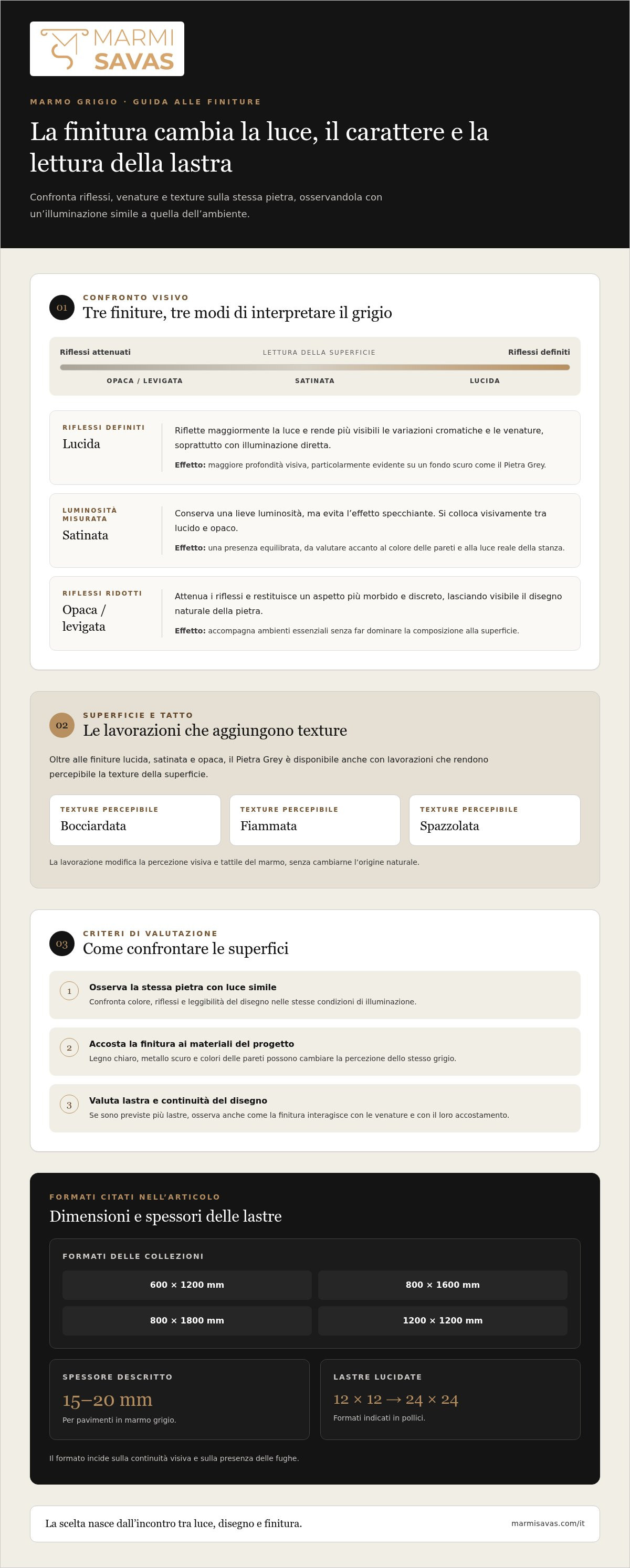
What dimensions and thicknesses are available? Grey slab collections include formats such as 600×1200 mm, 800×1600 mm, 800×1800 mm and 1200×1200 mm. For grey marble floors, thicknesses from 15 to 20 millimetres are described.
Where to buy grey marble slabs in Italy? You can contact suppliers specialized in slabs and compare variety, format and visible selection. Before defining the pairings, evaluate the whole slabs and the natural pattern of the material, so as to choose a composition consistent with the project.
How to clean and protect slabs from stains and scratches? Remove dust and residues with a soft cloth and a neutral detergent, then dry the surface. To limit stains and scratches, clean up spills immediately and avoid abrasive sponges and aggressive products.
Polished, satin and matt finishes
The finish changes the way a grey slab reflects light and highlights the veining. Pietra Grey marble is available polished, matt, bush-hammered, flamed or brushed: the choice depends on the visual effect and the intended use. To compare surfaces, observe the same stone under similar lighting and evaluate colour, reflections and legibility of the pattern.
The polished finish creates defined reflections and makes the chromatic variations of the marble more visible. In an entrance or on a vertical wall covering, it can give depth to a dark background like that of Pietra Grey. Grey slabs with an intense polish are also offered in formats from 12×12 to 24×24 inches. The format affects visual continuity and the presence of joints.
The matt surface, obtained with a honed finish, softens the reflections and offers a softer appearance. It can accompany essential spaces, where the natural pattern remains visible without dominating the composition. The satin finish sits visually between polished and matt: it retains a slight luminosity but avoids the mirror effect. Compare it with the colour of the walls and with the real light of the room.
- Polished: enhances contrasts and veining, especially with direct lighting.
- Satin: maintains a measured luminosity, suited to balanced palettes.
- Matt or honed: reduces reflections and offers a more discreet image.
- Bush-hammered, flamed or brushed: introduces a perceptible texture on the surface.
The treatment does not change the natural origin of the marble, but modifies its tactile and visual perception. For this reason, evaluate the sample next to the project’s materials: a polished grey near light wood appears different from the same matt marble placed next to dark metal. If the composition includes several slabs, also observe how the finish interacts with the continuity of the veining.
To decide, start from the space and the light: consider whether the surface will be observed up close, lit from the side or crossed by reflections. Then compare finish and format on the chosen stone, without relying only on the commercial name. The comparison between finishes can go alongside that between the prices of the available materials. These data make it possible to distinguish the cost of a sample from that referring to the surface of the slab, without confusing the different units of sale. To evaluate the solutions available in relation to your project, you can talk to the team.
In the comparison, consider finish, format and price unit together: in this way you can relate the options without treating them as equivalent. Before choosing, check that the material and the treatment correspond to the desired effect and to the type of surface planned in the project. The price, on its own, does not describe the appearance of the stone; observing a sample remains useful for evaluating its reflections and the rendering of the colour in the space.
Residential and commercial uses
At home, grey marble can connect different spaces through a coherent palette. In the entrance, a slab floor creates a continuous surface; in the living room, a vertical covering can become the fulcrum of the composition. Consider the dimensions of the room, natural light and the relationship between veining and furnishings. For example, a light grey accompanies neutral walls, while a dark background creates a decisive contrast.
In the kitchen, the stone can be planned for floors, walls and worktops. Before selecting it, evaluate exposure to splashes and residues, the frequency of cleaning, the finish and the tone. A dense pattern can make daily visual variations less evident; a broad vein, on the other hand, attracts the eye. In the bathroom, consider how artificial light and mirrors interact with a grey slab.
In commercial spaces, receptions, halls and boutiques require a composition that is legible both up close and from a distance. A grey marble wall can characterize the reception area, while the floor can give continuity between entrance and corridor. In a hotel, compare the pattern of the slabs with the lighting, furnishings and palettes of the rooms. In a boutique, a surface with a discreet pattern gives more prominence to display units and products.
- Home entrance: consider the effect of light and the connection with the floor of adjacent spaces.
- Living room: use a focal wall to highlight a scenic veining.
- Bathroom: compare tone and finish with mirrors, taps and lighting.
- Reception or hall: plan the visual continuity between accent wall and flooring.
For a project involving several spaces, first define where the stone will have the greatest impact. You can reserve the most dynamic slabs for the main wall and choose a more uniform pattern for large surfaces. If the project involves consecutive slabs, study the order of pairing and the position of the joints in the overall pattern. This step helps coordinate the marble with wood, metal and wall colours.
In homes and public venues, observe the sample in the intended context, not isolated on a neutral surface. Place it next to the chosen materials and look at it in both daylight and artificial light. For example, a pearl grey tone may appear cooler near white surfaces and warmer next to wood. A careful selection links use, pattern and the atmosphere of the interiors.
Colour and veining
In grey marble, the background and the natural pattern determine the character of the surface. Natural stones present unique differences and characteristics, so two slabs of the same variety can have different veining. Compare the whole slabs, observing the intensity of the grey, the direction of the lines and the distribution of the light areas. A uniform background accompanies a discreet composition; a contrasting pattern becomes the protagonist.
To choose the tone, consider the colour next to walls, floors and furnishings that are already defined. A pearl grey placed next to white surfaces creates a luminous whole; near honey-coloured wood, the same tone appears warmer. An anthracite background, on the other hand, creates a sharp contrast with light materials. Observe the stone in the light present in the space: natural and artificial light can return different perceptions.
Veining can be fine, broad, branched or distributed like clouds. A linear texture guides the eye along the surface, while a lively pattern creates greater visual variety. For a large wall, evaluate how the motif continues between adjacent slabs. The mirror technique, called the bookmatch technique, places two slabs with specular veining side by side and can transform the pattern into a central composition. It is particularly suitable when the project leaves room for the stone.
A practical check helps reduce surprises in the composition. Lay out the slabs according to the planned order, then compare chromatic continuity and the position of the veining. Also check edges, corners and areas with marked variations. For example, a slab with a dark vein concentrated at one end might require precise orientation to maintain balance with the other surfaces. The selection therefore considers both the single element and the overall effect.
- Background: distinguish pearl, medium and anthracite grey in relation to the palette.
- Veining: compare direction, contrast and density of the pattern.
- Pairing: evaluate the continuity between slabs and the position of the joints.
- Light: observe the material in the space and under the planned lighting.
The choice does not depend only on the preference for a light or dark grey. The scale of the pattern also counts: a broad vein can give rhythm to a wall, while a minute texture accompanies large surfaces with greater sobriety. In a project with several elements, first define which slab will have the main visual role. Then coordinate the others with its background and with the natural variations present.
Which Italian quarries and areas produce grey marble?
Italian grey marble does not come from a single extraction area: the origin varies according to the variety and the deposit. Bardiglio is an example of Italian grey marble, but the commercial name alone does not identify a precise quarry. To read the origin correctly, distinguish the extraction area from the processing and from the selection of the slab: they are different pieces of information, all useful for evaluating the material.
The grey tone is not enough to establish the origin. Marbles extracted in different areas can have different backgrounds, veining and grains; even slabs of the same variety show natural variations. Consider therefore the denomination, the declared origin and the visible characteristics. Bardiglio, for example, is recognized by its grey background and light veining, but examining the individual slab remains essential to define the pattern chosen for the project.
To compare Italian materials, note the commercial name and the origin indicated for each slab. Place this information next to the photographs or the visual selection, so as not to confuse varieties of similar colour. In a project involving several spaces, the comparison helps distinguish a uniform grey from a stone with evident veining. The origin completes the description, but does not replace the observation of the material.
- Variety: identify the name of the stone, such as Bardiglio.
- Origin: distinguish the extraction area from the place of processing.
- Appearance: compare background, grain and course of the veining.
- Project: evaluate the visual continuity between the selected slabs.
The origin alone does not determine the final appearance. A geographical denomination does not automatically describe the finish, the intensity of the grey or the distribution of the veining. If the project involves a large wall or several coordinated surfaces, observe the slabs together and define the order of pairing. The arrangement can enhance a marked vein or distribute the natural variations between nearby elements in a balanced way.
When evaluating an Italian grey marble, consider name, origin and actual slab as parts of the same choice. Bardiglio offers a recognizable reference, while the examination of the slabs makes it possible to verify consistency with the palette and pattern of the project. To guide the selection according to origin and visible characteristics, talk to a slab professional.
For flooring, evaluate the hardness of the marble together with the characteristics of the slab and the intended use.
Among the varieties, Pietra Grey has long veining and a fine grain. Grey Pearl combines 7 natural shades of grey, coffee brown, black and white, while the Vinta Grey slab is made from 100% natural marble. These descriptions make it possible to compare pattern and chromatic composition; the choice should in any case be verified on the specific material and on the result desired for the surfaces.
MARMISAVAS: Calacatta Marble
MARMISAVAS offers Calacatta marble for projects in which the light background and marked veining define an elegant focal point. After evaluating the tone, finish and pattern of the grey slabs, you can also compare light marbles, especially if the project requires a chromatic contrast or a more luminous composition.
The selection also includes Bianco Carrara marble, Arabescato and white marble. To choose between these stones, consider the relationship between background colour, course of the veining and palette of the interiors. The comparison between slabs helps architects, designers and owners identify the material most consistent with the desired atmosphere.
To talk about your project and the most suitable slabs, contact MARMISAVAS.
Give shape to the choice for your project
The choice of grey marble slabs gains value when the material dialogues with the architecture and with the daily light of the spaces. Before defining the selection, clarify which atmosphere you wish to create and which role the stone will have: a discreet element, a continuous surface or a scenic accent. A well-planned project starts from this intention and translates it into a coherent choice of colour, veining and finish.
If you are also evaluating light marbles, MARMISAVAS offers Calacatta Marble, Bianco Carrara and Arabescato. These alternatives make it possible to explore different contrasts and compositions, keeping the natural stone at the centre of the project. Share the requirements of the spaces and the desired aesthetic direction to evaluate the most suitable material.
Contact MARMISAVAS for advice and start the comparison on your project: a thoughtful choice can become the detail that gives the interiors an authentic and personal character.
Frequently asked questions
What are the main types of Italian grey marble slabs?
Among the names associated with grey marble are Bardiglio and Pietra Grey; Grey Pearl is another denomination present on the market. Bardiglio is an Italian marble, while Pietra Grey stands out for its dark grey and brown background. Commercial names do not always describe the geological origin: to compare two proposals, consider the denomination, the declared origin and the appearance of the chosen slab.
What finishes are available for grey marble and how do they influence the appearance?
The finishes include polished, matt or honed, satin, brushed, bush-hammered and flamed surfaces. Brushed, bush-hammered or flamed treatments make the texture more perceptible; a honed surface looks uniform to the touch and softens the reflections. To compare the options, observe samples of the same variety and check how the finish interacts with the planned lighting, especially near windows or light points.
How to choose and install grey marble slabs for a kitchen, bathroom or floor?
Choose the slab according to the surface, the geometry of the room and the layout of cuts and joints. In the kitchen, plan the position of openings and edges; in the bathroom, consider niches and passages; for a floor, prepare a layout that maintains coherent alignments. Before laying, measure the project and lay out the material dry. Installation requires specific skills in working stone.
What defects should be checked and what risks considered before buying grey marble slabs?
Before purchase, check for cracks, chips, damaged edges and discontinuities that cross the slab. Distinguish natural veining from possible fractures by observing the pattern up close and in raking light. Also compare the thickness and flatness of the slabs intended for the same job. Variations in tone and veining are characteristics of natural stone: assess whether they harmonize with the result of the project.
Where to buy grey marble slabs in Italy?
In Italy, you can contact specialized suppliers such as MARMISAVAS for slabs and compare variety, format and visible selection. Evaluate the whole slabs and the natural pattern to choose a composition consistent with the project.