Inspection and Selection of Slabs at the Quarry: Professional Criteria for Your Project
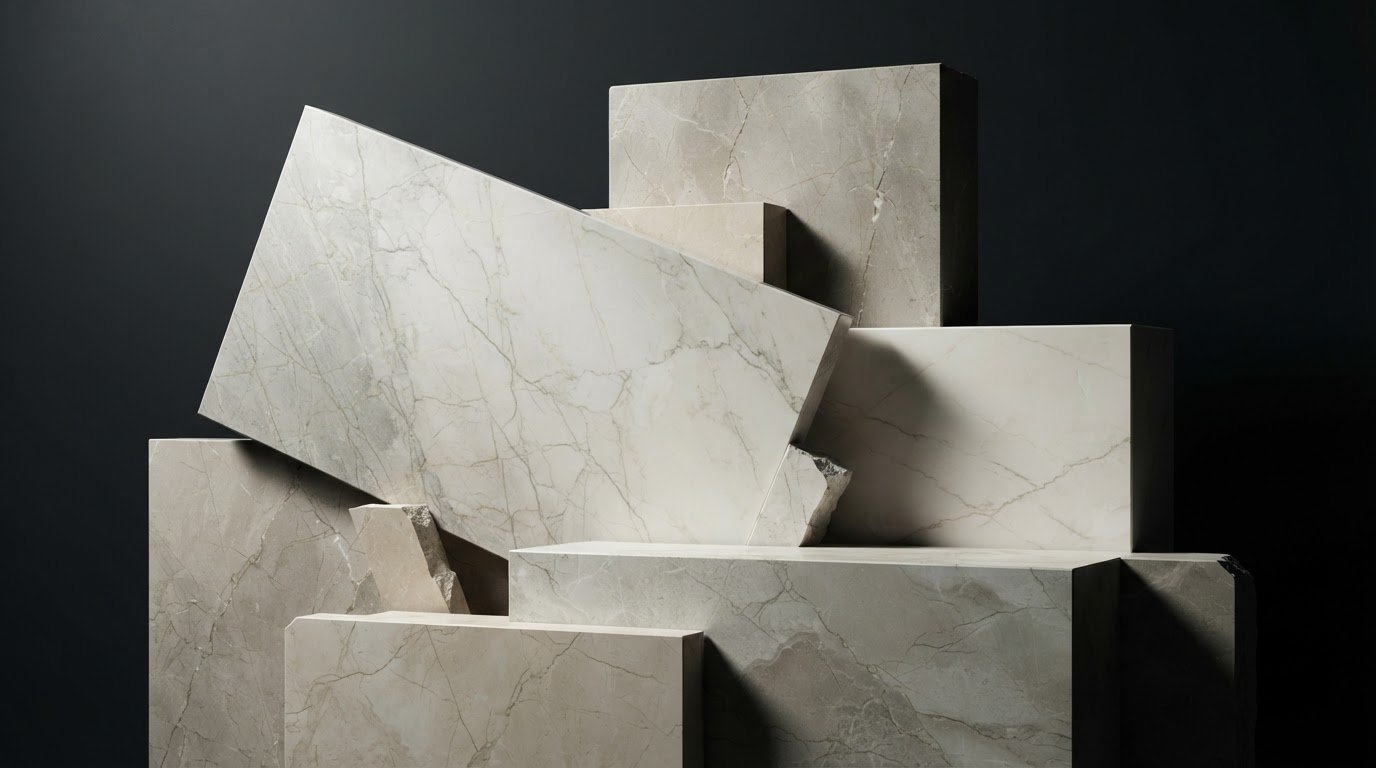
A block’s appearance alone is not enough to predict the pattern of the slabs that will be cut from it. Quarry selection is an initial reference point for evaluating the material, but veining and discontinuities may reveal their full pattern only after cutting. For this reason, the process of inspecting and selecting blocks at the quarry requires looking beyond colour and considering each characteristic in relation to the project.
To obtain the desired visual result, especially for flooring or wall cladding, it is necessary to consider several elements together. The shape and dimensions of the block, visible fractures and the direction of the cut help provide an initial assessment; the characteristics of the stone can then be assessed more accurately on the slabs.
This guide explains what to observe, how to distinguish natural variations from potential issues and how to compare blocks and batches according to format, veining and intended use. The objective is to establish clear criteria for bringing the material selection closer to the desired aesthetic result, using examples such as Bianco Carrara, Calacatta and Arabescato.
Key Points
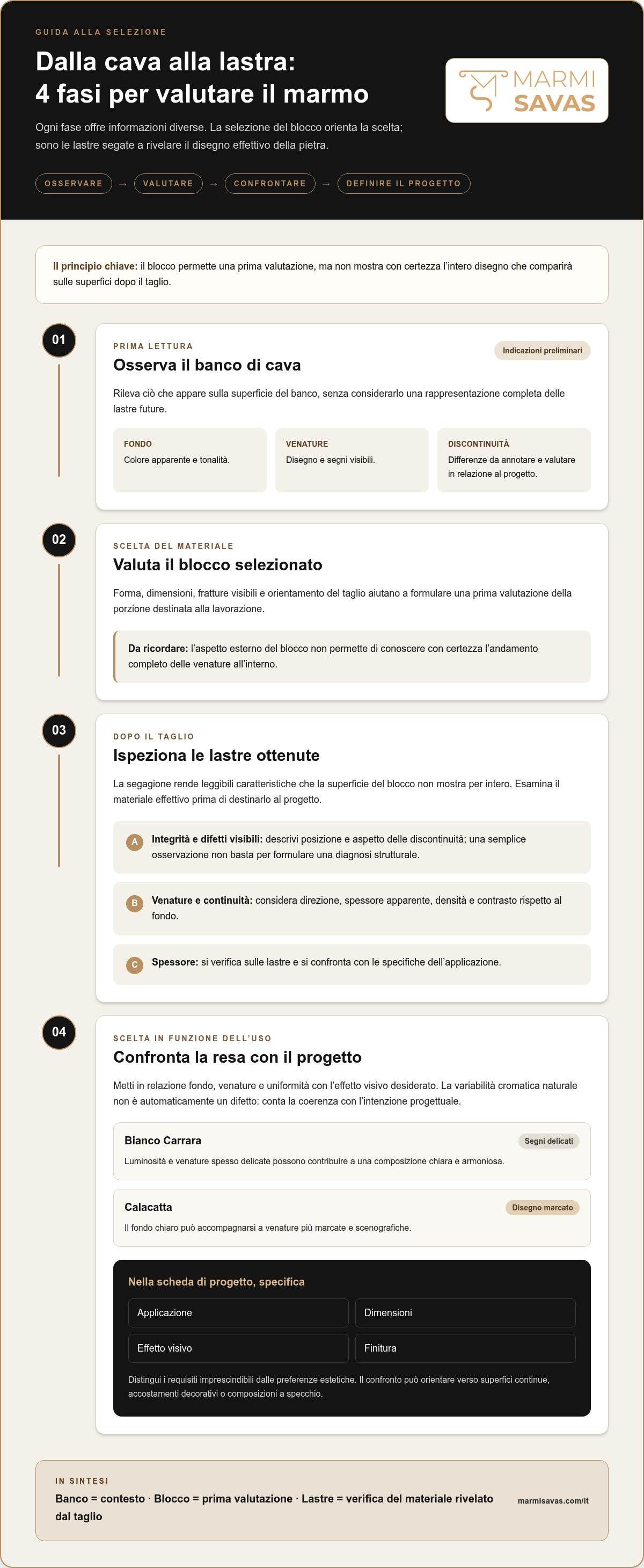
- Quarry inspection and slab selection involve several stages: observing the block, assessing it and checking the slabs.
- Noting colour variations helps distinguish the natural richness of marble from characteristics that should be evaluated in relation to the project.
- Comparing the background, veining and uniformity helps guide the selection towards continuous surfaces, decorative layouts or bookmatched compositions.
- A clear brief specifying the application, dimensions, desired visual effect and finish helps prioritise aesthetic preferences.
- MARMISAVAS supplies slabs and natural stone, with more than 200 options and stock available for large volumes.
Index
- Quarry Inspection and Slab Selection: What Is Really Being Evaluated?
- Technical Criteria for Inspecting Marble Before Cutting
- How to Compare Blocks and Batches According to the Project
- How to Prepare a Brief for Quarry Slab Selection
- From Quarry Selection to Supply: Choosing Stone with MARMISAVAS
Quarry Inspection and Slab Selection: What Is Really Being Evaluated?
Marble evaluation begins with the block from which the slabs will be cut, but it does not end with quarry inspection. Checking the slabs involves assessing their integrity, the pattern of the veining and visible defects before assigning the material to a project. It is a progressive process: each stage provides different information and helps establish more realistic expectations about the final result.
Block selection guides the choice of the block; slab inspection allows the material actually revealed by cutting to be evaluated. Distinguishing these two stages is important for architects, designers and clients who need to coordinate the appearance of the stone with the required formats, joints and visual continuity.
From the Block to the Slab: The Stages Not to Confuse
Observing a block at the quarry provides an initial assessment: the visible colour, the veins and discontinuities that may indicate differences in the stone are considered. This is followed by the assessment of the block intended for processing. Cutting and movement belong to the extraction stage; sawing comes afterwards and transforms the block into slabs. For a general overview of stone extraction, the Natural Stone Institute can be consulted.
These stages are not interchangeable. Observing the block helps consider the characteristics of the selected portion of stone. However, neither stage allows the entire pattern that will appear on the cut surfaces to be known with certainty. It is therefore useful to record what is visible without automatically interpreting every natural variation as a defect.
What Can Be Anticipated When Reading Marble at the Quarry?
The background and veining help identify the character of the stone and assess whether its overall appearance approaches the desired effect. In Calacatta, the light background may be accompanied by pronounced, dramatic veins; in Bianco Carrara, brightness is often associated with more delicate markings. These are aesthetic indications, but they do not fully represent the slabs that will be produced.
The structure and distribution of the veins may appear differently depending on the cut. A discontinuity visible on the surface of a block, for example, does not necessarily describe the design of the finished slab; similarly, a uniform-looking area does not guarantee a perfectly uniform result across the entire cut surface. A single view from the outside does not reveal the whole interior.
It is useful to distinguish three levels of information: what is observed on the block, the characteristics of the selected block and what appears on the slabs after cutting. Keeping these assessments separate makes comparison with the project clearer, especially when the composition requires harmonious veining or a precise balance between background and pattern. To explore the aesthetic characteristics of Calacatta marble, consult the relevant material references.
Technical Criteria for Inspecting Marble Before Cutting
A traditional evaluation of marble that considers its appearance and intended use focuses, before cutting, on the background, colour, veining and visible discontinuities. Thickness, by contrast, is checked on the resulting slabs and compared with the application specifications. Distinguishing these stages prevents characteristics that can only be verified after cutting from being attributed to the block. The technical criteria for inspecting marble describe colour, veining, thickness, defects and visible discontinuities, relating each element to the expected result and the project’s requirements. This approach helps record observations and compare materials without reducing quality to a generic judgement.
Colour, Veining and Visual Continuity
To describe colour, record the background tone, its intensity and any visible shading. For veining, or marble veining, consider direction, apparent thickness, density and contrast against the background. A fine, diffuse pattern creates a different effect from broad, branching or highly contrasting veins. Precise descriptions make comparisons between materials easier to understand.
Natural variability should not automatically be considered a defect: it can be interpreted as part of the intended aesthetic effect. A project may require a stone with a uniform appearance or may enhance the differences between one slab and another. In Bianco Carrara, for example, delicate markings may contribute to a luminous composition; in a marble with a more pronounced pattern, visible variations may become a central part of the selection. The objective is to understand whether the background and veining are consistent with the design intention.
Integrity, Thickness and Characteristics to Consider
A line or a change in visible tone may be an aesthetic discontinuity, while a fracture is a distinct feature that should be noted. Visual observation alone is not sufficient to establish a structural diagnosis: it is more appropriate to describe the location and appearance and leave the assessment to qualified professionals. The resources of the Natural Stone Institute provide an industry reference for exploring quality control and knowledge of natural stone.
Thickness is checked on the finished slab and compared with the project specifications, not assessed in isolation. Any treatments applied deserve attention: resin treatment, for example, may be used on stone to improve resistance while preserving its natural appearance. The presence of a treatment should be evaluated according to the material’s characteristics. To guide selection towards the project’s requirements, it is possible to share the project brief, specifying the application, visual priorities and dimensional requirements.
How to Compare Blocks and Batches According to the Project
An effective comparison does not establish which block is best in absolute terms; it identifies the material best suited to the intended effect, format and scale of the planned surface. During quarry inspection and slab selection, background and veining are indicators to be considered in relation to the final composition. Even a highly dramatic marble may be poorly suited to a project that calls for a discreet, uniform visual field.
To make the comparison concrete, assess each batch using the same questions. A simple grid helps distinguish the characteristics observed from their compatibility with the project:
- Background: light, grey or crossing into other shades? For large surfaces, assess whether variations support the overall composition.
- Veining: fine or broad, straight or branched? Consider whether the veins should accompany the composition or become its dominant feature.
- Uniformity: are the slabs from the same batch visually consistent or do they show marked differences? The answer guides the layout and distribution of the different areas.
- Visual compatibility: does the material’s character suit the project’s overall intention, from a discreet decorative background to a more prominent design feature?
From Veining to the Overall Surface Design
The direction of the veins can guide the arrangement of pieces and the way they are placed next to each other. For a continuous surface, the format and sequence of slabs matter as much as the pattern of each individual piece: differences in the background or interrupted veining may be more noticeable across a large area. In bookmatched compositions, successive slabs are arranged as mirror images to create a continuous pattern. For this reason, it is important to consider the sequence as a whole rather than evaluating each slab separately.
The priorities depend on the desired result. A uniform surface may require careful control of the veining throughout the layout; a decorative arrangement may enhance variations in tone and pattern. In bookmatching, the correspondence between pieces is central. Comparing slabs as a group makes it possible to assess format, the rhythm of the veining and colour transitions, going beyond the impression created by an individual piece.
Comparing Varieties Without Reducing Them to a Ranking
Calacatta is distinguished by its light background and pronounced, broad or dramatic veining; Bianco Carrara is appreciated for its brightness and more delicate markings. Arabescato may feature grey veins intertwined in a net-like pattern, a design that becomes more prominent when several slabs are viewed together. These are different characteristics, not levels in a ranking: the choice depends on how much the pattern should stand out and the space it will occupy.
When choosing Calacatta marble, consider the relationship between the background, the veining and the intended composition. In every comparison, note the differences between batches and assess which one best contributes to the desired continuity. The project, rather than an absolute standard of prestige, determines the most coherent choice.
How to Prepare a Brief for Selecting Slabs at the Quarry
A brief translates an aesthetic intention into clear criteria for comparing materials. To make the inspection and selection of slabs at the quarry more effective, describe not only the marble you have in mind, but also its intended use, the surface to be covered and the characteristics that are truly essential. This allows the evaluation to focus on the project's actual requirements.
The Information Needed to Define the Scope of the Selection
Collect the information in an order that connects the context with the desired visual result. This sequence helps prepare a clear supply request for the slabs.
- Application: indicate the intended use, for example, flooring, wall cladding or a worktop, and describe the environment in which the stone will be installed.
- Surface and dimensions: specify the areas to be covered and the desired sizes of the slabs, distinguishing between ready-to-use formats and the need for cutting.
- Visual effect: specify whether you are looking for chromatic continuity, a luminous background with subtle veining or a bolder, more expressive design.
- Finish: indicate the desired finish and the role it should play in the overall appearance, without assuming that one universal solution is suitable for every application.
- Priorities: separate essential requirements, such as a particular reading of the background, from aesthetic preferences for which you are willing to consider alternatives.
This distinction is decisive. If chromatic continuity is essential, indicate how important it is; if the project allows some variation, describe it as a guideline. Presenting every preference as mandatory unnecessarily restricts the comparison, whereas prioritised criteria help evaluate the options more accurately.
How to Turn Priorities into Selection Criteria
Keep the aspects to be observed separate so that one quality is not confused with another. Record the background colour, the character of the veining, the expected natural variability and the visible discontinuities. For each point, add a brief project-specific indication: “light background preferred”, “pronounced veining appreciated” or “uniformity between slabs is essential”. Concrete descriptions are more useful than generic judgements such as “perfect marble”.
Attach reference images, visual samples or diagrams showing the desired direction of the veining and the intended layout. For adjacent surfaces, indicate which elements should interact; for a bookmatched design, illustrate the desired sequence. These references clarify the intention but do not guarantee an identical reproduction: every block and every slab may have its own differences due to the natural characteristics of the stone.
Before finalising the brief, check that the application, dimensions, visual effect and priorities are consistent with one another. For example, a request for strong continuity should be accompanied by indications about the overall layout, whereas a varied design may allow more room for chromatic differences. Share your project brief to guide the material selection according to the required characteristics.
From Quarry Selection to Supply: Choosing the Material with MARMISAVAS
The choice of marble becomes more conscious when the evaluation criteria are translated into a precise supply request. MARMISAVAS specialises in supplying slabs and natural stone for architectural and interior design projects. Commercial selection is based on the characteristics required by the project; it should not be confused with an inspection carried out directly in the quarry.
Every project has different needs: a background that plays a central role, a specific format and application, or a particular balance between the veining and the overall surface. The specifications provided should therefore be considered together with the natural characteristics of the material. The aim is to bring the material closer to the intended effect while recognising that veins and shading may vary from one block to another. Defining priorities helps maintain realistic expectations without expecting an identical reproduction of a reference image.
Aesthetic and Design Criteria for Choosing Marble
The variety of materials allows different aesthetic intentions to be interpreted. Calacatta is appreciated for its light background and often broad, pronounced veining, capable of creating rhythm across the surface. Bianco Carrara is distinguished by its understated luminosity and more delicate markings, with an elegance suited to refined compositions. Arabescato may feature more intricate patterns in which the veining takes on a more prominent presence. These are not alternatives arranged on a scale of quality: each responds to a different compositional intention.
When comparing marble slabs, the comparison helps find the right balance between background and veining. A project that requires visually calm surfaces may favour subtle veining; a dramatic wall may benefit from stronger contrasts and more pronounced patterns. MARMISAVAS offers more than 200 material options and stock available for large volumes, with solutions for different project requirements.
From Selection Criteria to a Discussion About the Project
To guide the search for the right slabs, collect the information that describes the expected result: application, format, surface layout, design effect and aesthetic priorities. Add images or diagrams, specifying which aspects are essential and which are simply references. Indicating a preference for a luminous background and pronounced veining, for example, communicates a more useful intention than a generic request for light-coloured marble.
Sharing these elements helps match the material to the scale and intended use of the project while keeping expectations about natural variations clear. To discuss supply requirements and identify the slabs most consistent with your vision, contact MARMISAVAS about your project.
Turn Your Vision into an Informed Choice
Natural stone brings an unrepeatable element to a project. To appreciate it, consider not only an individual slab but also how its colour, veining and format will interact with the light, proportions and surrounding materials. In this way, inspecting and selecting slabs at the quarry becomes part of a broader design decision: not a search for absolute uniformity, but a balance between the characteristics of the marble and the identity of the space.
Before choosing, define the role of the surface: should it complement the architecture discreetly or draw attention through a more expressive design? A clear answer helps evaluate alternatives consistently and communicate supply priorities more effectively. Reference images can also help define the desired atmosphere while leaving room for the natural individuality of each slab.
For the next step, share your material selection criteria with MARMISAVAS for your project.
Frequently Asked Questions About Marble Inspection
Does a marble sample accurately represent the entire slab?
No. A sample helps identify the colour and general character of the stone, but it does not reproduce the full variety of veining and shading present on a slab. If the surface will play an important role in the space, evaluate the material in the largest format possible in relation to the project. Consider the sample a visual reference, not a promise of a perfect match with the supplied slabs.
Does marble with the same commercial name always look the same?
No. The commercial name identifies a type, but it does not make individual materials identical: the background, tonal variations and pattern can differ between blocks and slabs. This variability is part of the identity of natural stone. To make a targeted choice, evaluate the material intended for the project and consider how its differences will fit into the space, taking into account the light and colours of the surrounding elements.
Can the finish change the perceived colour of marble?
Yes. The finish changes how light is reflected and can influence the perception of the background and veining. A polished surface tends to show more pronounced reflections, while a honed matt finish appears softer and more subdued. Neither is always preferable: compare the finish with the stone's colour, natural pattern and the desired atmosphere of the space.
How can the origin of a batch of marble be documented?
Keep the batch references and commercial information received with the supply organised so they can be consulted throughout project management. Origin helps contextualise the declared source of the material, but it does not by itself describe its appearance: two batches may differ in background and veining. Therefore, evaluate origin and visual characteristics as distinct but complementary aspects.
Does pronounced veining necessarily indicate a defect in the slab?
No. Pronounced veining may be a distinctive aesthetic feature, appreciated to a greater or lesser degree depending on the project's design language. It should not automatically be confused with a fracture: a photograph alone does not allow a structural diagnosis. If a mark raises concerns, describe its position and appearance and evaluate the material in context. The aesthetic criterion remains the comparison with the priorities established in the brief.
Does quarry selection allow every slab to be known exactly before cutting?
No, not completely. Quarry inspection and slab selection provide useful information for guiding the choice, but they do not anticipate every detail of the surfaces that will emerge. For example, a vein visible on the block may follow a different course in the individual slabs obtained from it. Therefore, consider the initial assessment a guide to selection, not an exact prediction of the final result.