Bianco Perlino Marble: Characteristics, Selection and Comparison

What if the most suitable slab were not the one that appears the most uniform? When evaluating Bianco Perlino, the name provides an initial indication, but it does not tell the whole story of a natural material’s nuances. Bianco Perlino comes from the quarries of the Asiago Plateau and can feature shades ranging from ivory white to a cooler white, with delicate veins that are sometimes grey-green.
Before choosing a light-coloured marble, it is useful to distinguish similar varieties and observe how the background, pattern and appearance change from one slab to another. In Bianco Perlino, these variations are not necessarily imperfections: they should be assessed in relation to the desired effect and the project as a whole.
In this guide, you will find criteria for comparing Bianco Perlino with other light-coloured marbles, reading the veining and evaluating a slab according to its intended use. We will also look at how cutting and layout can enhance a more uniform pattern or highlight linear veining.
Key Points
- To evaluate Bianco Perlino, consider the appearance of the individual slab and the project’s aesthetic requirements, not just the commercial name.
- Compare Bianco Perlino, Bianco Carrara and Calacatta based on the background tone, contrast and direction of the veining.
- Before choosing, define the intended use, format and desired effect, then review the technical information available for the material.
- Observing the entire slab helps you understand whether its pattern and variations work with the overall project.
- MARMISAVAS supplies slabs, marble tiles and customised, rapid solutions for residential and commercial projects.
Index
- What Is Bianco Perlino Marble and How Can You Identify It?
- Appearance and Veining of Bianco Perlino: What to Look for in the Slabs
- Bianco Perlino Compared with Other Light-Coloured Marbles: Useful Criteria
- How to Evaluate a Bianco Perlino Slab According to the Project
- From Selecting Bianco Perlino to Supplying It for the Project
What Is Bianco Perlino Marble and How Can You Identify It?
Bianco Perlino is an Italian marble extracted in the Asiago Plateau area, in the province of Vicenza. It is also described using names such as Biancone, Bianco Asiago and Asiago Perlino. To identify the material selected for a project, however, it is important to refer to the name stated in the documentation accompanying the slab and to the information about its origin.
Citable definition: “Bianco Perlino is an Italian marble associated with the quarries of the Asiago Plateau, whose identification should be considered in relation to the documentation for the material and the individual slab.” This wording distinguishes general information about origin from the specific characteristics of the selected material.
The term “marble” indicates a category of natural stone, but it does not by itself provide a complete material specification. To learn more about the formation and general characteristics of marble, you can consult a geological overview dedicated to [marble]; to identify a specific slab, however, you need to consider the documentation for the selected material.
What Information Should Be Checked Before Describing Bianco Perlino?
An accurate description separates origin data and technical information from visual impressions. Expressions such as “bright” or “delicate” communicate an aesthetic perception, but they do not replace a technical data sheet. Before stating the origin, composition or performance, compare the available information with the identification associated with the slab.
- Name: Check the name stated in the documents and its consistency with the material’s identification.
- Origin: Refer to the documented information about the area or quarry from which it was extracted.
- Characteristics: Use the available technical data without inferring composition or performance from appearance alone.
Bianco Perlino: Material Name and Natural Variability
A shared name does not mean that every slab has the same pattern or shade. As with other natural stones, visible differences can occur between blocks and slabs. For this reason, aesthetic descriptions should refer to the material actually observed and selected.
To evaluate a slab, examine it in its entirety and compare what you see with the available information. Distinguish declared data, the visible characteristics of the individual piece and the project’s design preferences. This helps interpret the commercial name without confusing it with a guarantee of uniformity or independent proof of origin.
Appearance and Veining of Bianco Perlino: What to Look for in the Slabs
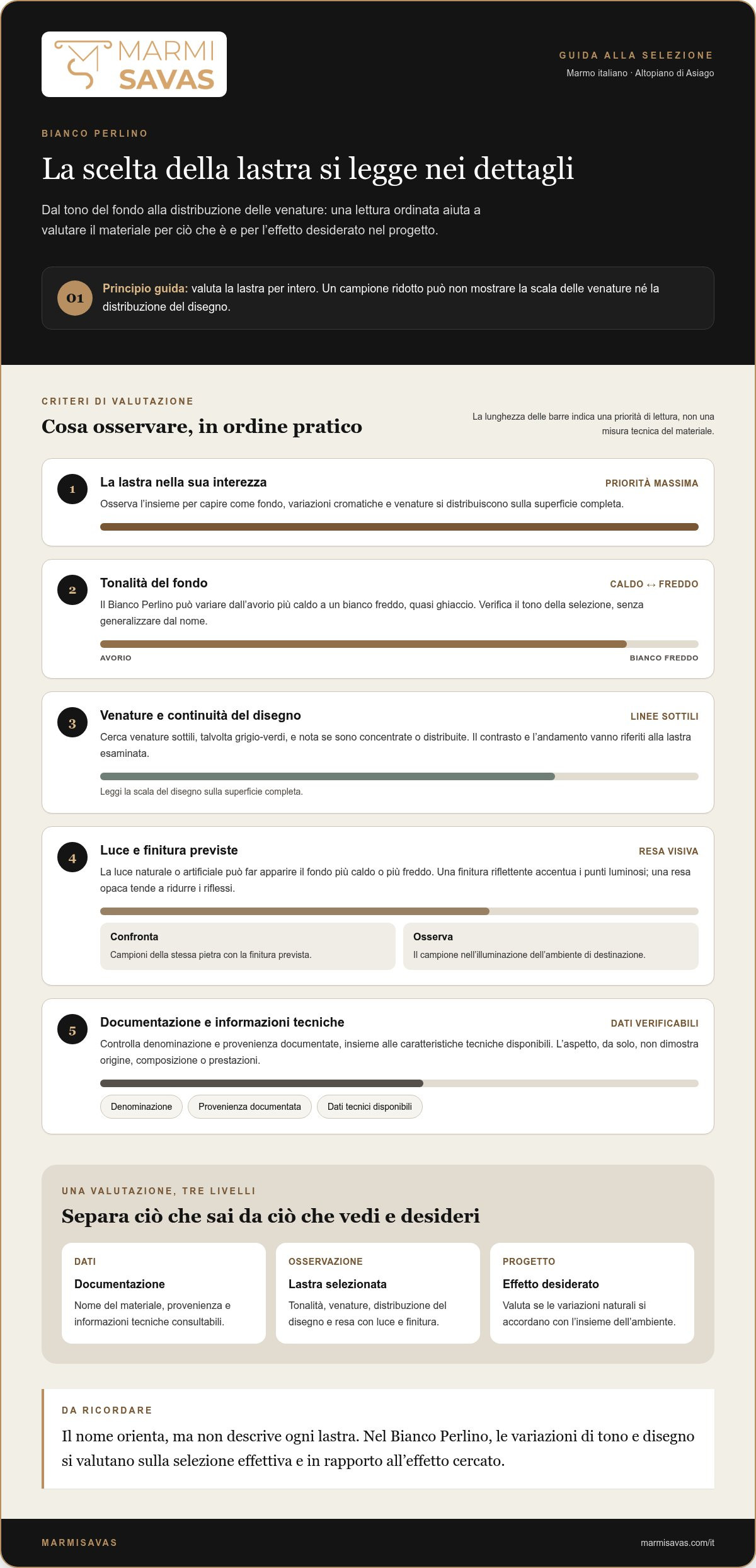
Descriptions of Bianco Perlino highlight its fine grain, luminous white background and generally understated appearance. Its shades can range from warmer ivory to cool, almost ice-white tones; fine veins, sometimes grey-green, are also described. These references help guide the selection, but the colour and pattern must be checked on the selected slab.
It is useful to distinguish characteristics that recur in descriptions of the material from those specific to an individual block. A more prominent vein, a warmer-coloured area or an uneven distribution can change the overall perception. For an overview of Italy’s natural stone sector, you can also consult Confindustria Marmomacchine; when making an aesthetic choice, however, observing the specific surface remains essential.
Guiding statement: “A Bianco Perlino slab should be evaluated as a whole, because a sample, lighting and finish can reveal only part of the complete surface’s visual effect.”
Tone and Veining: Reading the Visual Effect Without Generalisations
Natural and artificial light can make the background appear warmer or cooler. If possible, observe the sample under the lighting planned for the space. A small fragment does not necessarily show the scale of the veining or how it is distributed across the entire slab. Therefore, assess the background, direction and continuity of the pattern across the complete surface.
Observe the slab from the front and from different distances. Note whether the veins are concentrated or distributed and whether the colour contrast matches the intended effect. These observations describe the piece being examined; they do not establish a rule that applies to every Bianco Perlino slab.
Finishes and Surface Perception
The finish changes the way light is reflected and, consequently, how the colour and veining are perceived. A more reflective surface may accentuate highlights, while a matte finish tends to reduce reflections. For a reliable assessment, compare samples of the same stone with the intended finish. Visual appearance alone does not allow you to determine resistance or maintenance requirements.
- Observe the sample under the lighting of the intended space.
- Compare a small section with the entire slab to understand the scale of the pattern.
- Record preferences regarding tone, contrast and continuity, keeping them separate from technical data.
These criteria turn an initial impression into an assessment that is useful for the project. To compare aesthetic requirements with other white marble materials, you can speak with the MARMISAVAS team.
Bianco Perlino Compared with Other Light-Coloured Marbles: Useful Criteria
A useful comparison does not establish which marble is best in absolute terms; it clarifies which background, pattern and degree of visual movement suit the project. Bianco Perlino, Bianco Carrara and Calacatta are distinct materials. The name is a starting point; the selected slab and its accompanying information help assess its actual appearance.
The table summarises some of the aesthetic references described for these types. The indications concerning variations are indicative and do not replace examining the slab.
Material — Described appearance — Variations and data to check
Bianco Perlino: A background ranging from ivory white to a cooler white; fine veins are described, sometimes grey-green. Observe the tone and pattern of the individual slab. Check the name, origin and technical data in the accompanying documents.
Bianco Carrara: Appreciated for its brightness and delicate veining. Examine the contrast and distribution of the veins on the specific selection; verify the origin against the material documentation.
Calacatta: A light background with more pronounced veins, often broad and dramatic. Assess the intensity and direction of the pattern on the slab; check the declared origin and characteristics of the selected material.
Bianco Perlino and Bianco Carrara: Which Differences Should Be Compared?
When comparing Bianco Perlino with Bianco Carrara, focus particularly on the background tone and the visual presence of the veining. Carrara is associated with elegant brightness and delicate patterns; Perlino may feature warmer or cooler shades depending on the selection. To compare materials and slabs of white Carrara marble, examine surfaces using consistent criteria, under the same lighting and from similar distances.
Bianco Perlino and Calacatta: How to Make a Proper Comparison
Calacatta is a useful reference when the project calls for a more prominent pattern: its light background may be crossed by broad, dramatic veins. Bianco Perlino is a distinct material and should be assessed according to the characteristics of the individual slab. Observe the two marbles under the same lighting and consider how their veining interacts with the other elements in the space. Calacatta marble slabs provide a visual point of comparison.
To make the comparison concrete, record the name stated in the documents, the declared origin, the available technical data and your aesthetic preferences. Even two slabs of the same material can produce different effects in terms of tone, vein scale and pattern continuity. A consistent assessment therefore combines documentation and direct observation, without relying solely on photographs or commercial descriptions.
How to Evaluate a Bianco Perlino Slab According to the Project
Choosing a slab is not based on colour alone. Consider the material’s appearance in relation to its intended use, the required dimensions and the available technical information. Bianco Perlino can be evaluated for different architectural solutions; its suitability depends on the conditions of use and the documented specifications, which should be examined with a professional.
Guiding statement: «Before selecting a slab, compare its intended use, visible pattern, format and technical documentation: their consistency with the project guides the choice.»
Which Technical and Visual Criteria Should Be Considered?
Evaluating a slab includes examining its integrity, the continuity of the veining and any visible defects. Visual inspection does not replace the performance data provided in the technical documentation. Consider the shade, the direction of the veins, thickness and surface conditions, without applying numerical tolerances unless they are supported by documented references.
For a practical check, observe the entire surface and note differences that may affect the result, such as colour variations, interruptions in the pattern or visible marks. Then compare these observations with the technical data sheet and the documents relating to the slab. If a property is decisive for the intended use, it must be established by the documentation rather than inferred from appearance.
Architectural Applications and Consistency with the Concept
For flooring, wall cladding or other surfaces, first define the function and the desired effect. The format affects the number and position of joints; the continuity of the veining contributes to the overall reading of the design. Relating the choice to the technical requirements of the application helps evaluate the material in the correct context.
- Intended use: indicate where the material will be used and which requirements it must meet.
- Visual effect: clarify whether the project calls for a uniform background, subtle veining or a more uniform composition.
- Format: consider the dimensions, required thickness and arrangement of the slabs in the final design.
- Documentation: collect the material identification and technical data sheet, distinguishing declared data from aesthetic impressions.
- Professional assessment: verify consistency between the specifications, intended use and actual project conditions.
This method turns a preference for Bianco Perlino into a considered design decision. Also consider how many slabs are needed and how their patterns will work together as a whole, rather than relying on a single sample. To define the selection and discuss the project requirements, contact the MARMISAVAS team.
From Selecting Bianco Perlino to Supplying It for the Project
A well-planned choice is easier to translate into a supply request when the essential information is clearly collected. For Bianco Perlino, as with any natural stone, distinguish what has already been defined in the project from aesthetic preferences that still need to be explored. An accurate description helps discuss quantities, format and desired characteristics without confusing the material’s name with the assessment of the individual selection.
Prepare a brief specification sheet with the intended use, dimensions, required format, estimated quantity and desired visual effect. If the designer has already identified the thickness, finish or technical requirements, include them together with their respective specifications. These indications connect the stone selection with the architectural and functional priorities.
Which Details Help Define a Supply Request?
A useful request makes the project requirements clear. Indicate the surfaces concerned, the expected quantities and the format to be considered. Add visual references or notes on preferred shades and patterns, specifying which aspects are essential and which can accommodate the natural variability of the stone.
- Intended use: specify the design application and any use requirements that have already been defined.
- Quantity and format: communicate the dimensions and estimated requirements, including any need for continuity between surfaces.
- Aesthetic preferences: describe the desired tone, contrast and character of the veining.
- Available documents: attach the specifications already shared by the designer and identify the aspects that still need to be assessed.
A Specialist Partner for Natural Stone Projects
MARMISAVAS specialises in supplying slabs, marble tiles and customised solutions in marble and natural stone for residential and commercial projects. The selection includes more than 200 options, with stock available for large volumes. The offering includes white marbles such as Calacatta, Bianco Carrara and Arabescato, as well as a variety of black, grey and brown stones.
Architects, designers, companies and clients can share the information needed to define the supply: intended use, quantity, format and preferences. An organised comparison helps clarify aesthetic and design priorities while keeping them distinct from technical requirements. Whether the project starts with Bianco Perlino or considers other natural stones, these indications make the selection process clearer.
To discuss your project requirements and the supply of suitable materials, talk to us about your natural stone project.
Turn Your Priorities into a Design Choice
Selecting natural stone becomes valuable when it responds to a specific intention: defining the atmosphere of a space, complementing the surrounding materials and meeting the project’s functional requirements. If you are considering Bianco Perlino, translate what you are looking for into concrete indications, distinguishing essential elements from preferences that may evolve as you examine the slabs.
Bring an overall vision to the comparison: the surfaces involved, estimated quantities, desired format and expected aesthetic character. A project reference or a brief description of the desired effect can help you assess natural stone alternatives carefully in relation to the material specifications.
Every project has its own balance. Sharing objectives and constraints helps guide the selection and establish a supply process consistent with the intended result. Share your project requirements with MARMISAVAS and define the next step for supplying natural stone.
Frequently Asked Questions About Bianco Perlino
Is Bianco Perlino Suitable for Outdoor Spaces?
It may be considered for an outdoor space after checking the technical data sheet for the specific selection and the application requirements. The commercial designation alone does not demonstrate suitability for conditions such as exposure to weathering agents or temperature variations. Before including it in the project, have a natural stone professional assess the documented performance, intended finish and conditions of use.
How Should a Bianco Perlino Marble Surface Be Cleaned?
For routine cleaning, follow the technical instructions provided for the material and the selected finish. Marble can be sensitive to acids, so avoid applying acidic products, including descaling products, without specific instructions. If substances are spilled, proceed carefully and do not use aggressive detergents or abrasive tools. For persistent stains, choose a treatment based on the surface documentation.
Can Bianco Perlino Show Colour Differences Between Slabs?
Yes. As a natural stone, Bianco Perlino may show visible variations between slabs identified under the same name. If the project includes adjoining surfaces, assess together the pieces intended for the same space and consider how the edges and joints will meet. This check helps plan the overall effect without expecting perfectly uniform colour matching.
How Is the Quality of a Bianco Perlino Slab Evaluated?
Examine the entire slab and compare its visible condition with the associated technical documentation. Check that the material identification is consistent, observe the surface from different angles and note any marks or discontinuities that should be assessed by a professional. Quality is not judged solely by aesthetic uniformity; also consider the requirements of the intended use and the declared specifications.
Does the Finish Change the Appearance of Bianco Perlino Marble?
Yes. The finish can change how light is reflected and therefore how the colour and pattern are perceived. To compare two samples, observe them under similar lighting and take into account the light expected in the final space. Do not infer resistance or maintenance characteristics from visual appearance alone: these depend on the documented specifications of the material and the selected processing.
How Can Bianco Perlino Be Combined with Other Interior Materials?
Start with the slab’s actual tone and compare it with real samples of the other materials rather than relying only on photographs. A warmer background can work well with woods in soft tones, while a cooler setting can enhance metals and neutral colours. Also consider the contrast of the veining and the lighting in the space: this helps the combination support the project without competing with the other elements.