How to clean marble without damaging it: practical guide for every surface
A stain on marble doesn’t always require a stronger detergent: sometimes, even a common remedy can leave a dull halo. Understanding how to clean marble without damaging it means choosing gentle actions, respecting the finish and intervening promptly, especially if wine, coffee or other coloured substances are spilled.
For ordinary cleaning, a simple routine with a soft cloth and a pH-neutral detergent helps remove dirt without resorting to aggressive solutions. Drying after washing limits the formation of halos. Vinegar, lemon and limescale removers, on the other hand, can attack marble and make it dull.
In this guide we look at how to manage daily maintenance, distinguish a halo from a stain that requires careful treatment and adapt the precautions to polished and honed surfaces. The rules of caution apply to both, even if marks may be more noticeable on the polished finish. Knowing the material and its finish is the first step to preserving its veining and natural beauty.
Key Points
- Recognize why some substances can dull or attack marble and which signs to look for.
- Follow a gentle daily sequence: remove dust, clean with a soft cloth and dry the surface.
- Treat stains without confusing a residue with a sign of corrosion, which may require a different approach.
- Adapt your care to the polished or honed finish, without assuming that one is immune to marks.
- Reduce the risk of damage with simple precautions and consider the stone and finish before applying protective treatments.
Index
- Why marble gets damaged during cleaning and which signs to look for
- How to clean marble without damaging it: the daily sequence
- Stains and home remedies: what to do and which mistakes to avoid
- Polished or honed finish: how to adapt cleaning
- Preventing damage and choosing marble with maintenance in mind
Why marble gets damaged during cleaning and which signs to look for
Marble is a natural stone prized for its veining and variations in tone, but its surface can react to unsuitable products. Its composition helps explain why maintenance requires attention: marble is largely made up of calcite, which is sensitive to contact with acidic substances. To learn more about the properties of marble, it is useful to consider composition, use and finish together.
Vinegar, lemon juice and limescale products are substances to keep away from the surface. Contact can cause corrosion: it is not simply dirt left on the top, but a change in the appearance of the surface. To understand how to clean marble without damaging it, therefore, it is important to observe the mark before applying a stronger product.
An unsuitable detergent can alter the appearance of marble, not just leave residues. A removable halo, a penetrated stain and a dull area may look similar at first glance, but they do not necessarily indicate the same problem. Treating them all the same way, by scrubbing or adding detergent, can complicate the assessment.
How to recognize stains, halos and dullness
Before intervening, observe the surface in natural light and from several angles. A stain tends to be a localized alteration, sometimes of a different colour from the background. A halo, on the other hand, may appear as a trace or a residue left by washing. If the mark changes or disappears when you gently pass a clean, dry cloth over it, it could be a surface deposit. This test alone, however, does not allow a certain diagnosis.
A dull area requires particular caution. If it reflects less light than the nearby areas and does not change with gentle cleaning, it could indicate an alteration of the finish, not simple dirt. Avoid insisting with scrubbing or abrasives. Instead, observe the extent, shape and position of the mark: distinguishing a residue from a possible alteration of the finish helps you not to confuse ordinary cleaning with the assessment of damage.
Which characteristics make marble sensitive
Acidic substances can react with calcite and leave a duller or marked surface. Even a product that is effective on other surfaces can be unsuitable for marble. Colour, veining and a glossy or matt appearance describe the aesthetics of the stone, but on their own they identify neither its composition nor the appropriate treatment.
Different marbles can have different characteristics and finishes, so advice that is valid for one surface should not be automatically extended to all the others. Ordinary maintenance serves to remove dirt with gentle methods; a persistent stain or a mark that seems to have modified the surface instead requires a separate assessment. Recognizing this difference is the first step to choosing an intervention consistent with the material.
How to clean marble without damaging it: the daily sequence
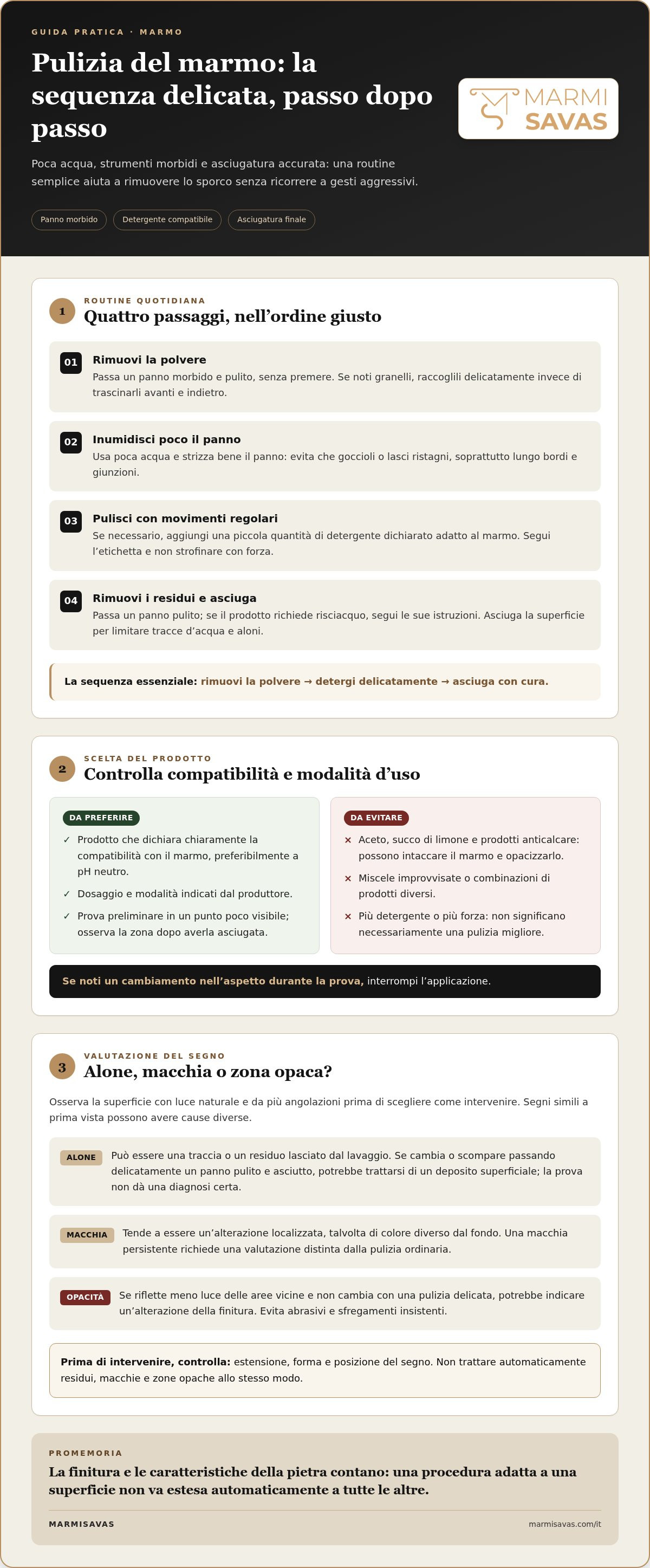
A regular routine does not have to be complicated. The order of the steps helps avoid dragging particles across the surface or leaving water and detergent to dry on the marble. To understand how to clean marble without damaging it, prepare clean, soft tools, use little water and do not scrub hard. The following sequence is a cautious reference; material and finish may require specific attention.
The ordinary cleaning routine, step by step
Before wetting the surface, remove dust and particles from the top with a soft, clean cloth. This reduces the risk of dragging them around during washing. Then pass a barely damp, well wrung-out cloth over it, with regular, gentle movements. Finish with a second clean, dry cloth, without letting the water evaporate on the surface.
- Remove the dust. Use a soft cloth or a tool suited to the surface, without pressing. If visible grains are present, gather them gently instead of sweeping them back and forth.
- Dampen the cloth. Use little water and wring it out well. A dripping cloth can leave streaks, especially along edges, joints or less ventilated areas.
- Clean with regular movements. If needed, add a small amount of detergent suitable for marble and follow the instructions on the label. There is no need to insist with vigorous scrubbing.
- Remove any residues and dry. Pass a clean cloth, following the product’s instructions if rinsing is necessary. Then dry the surface to limit traces of water and halos.
The cautious sequence is simple: remove the dust, clean with a soft, barely damp cloth and dry carefully. Adapt it to the specific indications of the stone and the finish: there is no procedure identical for every surface.
How to choose and test a detergent with caution
For ordinary cleaning, choose a product that clearly states compatibility with marble, preferably pH-neutral. Follow the manufacturer’s dosage and method of use: a larger quantity does not necessarily mean better cleaning and can leave residues. Avoid improvised mixtures and do not combine different products.
Before using a new detergent or treatment, test it in an inconspicuous spot. Apply a small amount according to the instructions, respect the stated times and observe the area after drying it. If you notice a change in appearance, stop the application. The check is particularly useful when you do not know the history of the surface or the finish.
Gentle cleaning helps manage ordinary dirt, but it is not a universal remedy for persistent stains or altered surfaces. If you are choosing marble for a project, also assess material and finish in relation to daily maintenance. You can learn more about choosing marble with MARMISAVAS.
Stains and home remedies: what to do and which mistakes to avoid
If a liquid spills on marble, blot it without rubbing and do not immediately try one remedy after another. At first, the goal is to contain the spill, not to treat the mark blindly, since it may remain. Wine, coffee or tomato juice can leave traces, but their appearance is not always enough to establish which intervention is appropriate.
What to do immediately when a liquid spills
Press absorbent paper or a clean cloth on the area and blot, without dragging it. After absorbing the liquid, remove any residues with a barely damp soft cloth suited to the surface. Dry and observe the result before repeating the intervention. If the mark remains, do not increase the pressure and do not layer different products.
- Contain the spill by pressing absorbent paper or clean fabric on the stain, without rubbing.
- Remove what remains on the surface with a barely damp cloth, avoiding streaks.
- Dry and rewatch the area before deciding whether another intervention is needed. A persistent mark should not be automatically treated as ordinary dirt.
Before choosing how to proceed, consider the shape and extent of the trace. A surface deposit can behave differently from a mark that stays visible after gentle cleaning. If the area appears changed compared to the nearby ones, insisting with the same action can make the assessment more difficult. Stopping is often more useful than trying one remedy after another.
Why acids and abrasives can leave marks
As a precaution, do not use vinegar, lemon or limescale detergents on marble. They are unsuitable products for this surface and are not a shortcut to remove a stain. Abrasive powders and rough sponges can also scratch or modify the finish. Energetic rubbing, moreover, can extend a mark instead of limiting it.
Avoid automatically applying baking soda, pastes, poultices or mixtures suggested for other materials. Without technical indications referring to the stone and the finish, ingredients, quantities and application times become uncontrolled attempts. Do not combine different detergents: besides making the intervention less predictable, it can become difficult to understand which product left residues or changes in appearance.
If the stain remains after gentle cleaning, note what was spilled and which products have already been used. This information helps describe the problem without resorting to other random attempts. At the project stage, considering from the start the use and characteristics of marble helps define realistic expectations. To evaluate the most suitable stone, you can learn more about choosing marble with MARMISAVAS.
Polished or honed finish: how to adapt cleaning
The finish changes the way light meets the marble and makes some marks more or less evident. On its own, however, it does not determine which treatment is suitable. To understand how to clean marble without damaging it, consider both the appearance of the surface and the specific indications for the material. Basic precautions remain gentle in both cases; observation helps distinguish residues from possible alterations.
Finish Appearance Cleaning measures Cautions Polished Smooth, reflective surface that enhances brightness and veining. Use soft cloths and light passes; carefully remove any residues and dry. Halos and fingerprints can stand out in reflected light. Avoid abrasives and vigorous rubbing. Honed finish Matt finish, less reflective and with a velvety appearance. Keep cleaning gentle and check the result after drying. It is not exempt from stains or marks; do not apply products or methods without verifying their suitability.
Polished marble: how to preserve reflections and shine
On a polished surface, even a film of detergent or traces of water can appear as halos, because they interrupt the continuity of the reflections. Use a soft, clean, well wrung-out cloth, making regular passes without pressing. If you notice a hazy area, first check that it is dry and free of residues: a temporary dullness after washing does not necessarily equate to permanent damage.
Avoid rough sponges, powders and tools that may scratch or modify the finish. If the haze remains after careful cleaning, do not increase the force or repeat numerous washes. It may be necessary to understand whether it is a surface deposit or an alteration.
Honed finish: care of the matt surface
The honed finish is a matt and soft-looking finish, with reduced reflections compared to the polished surface. The less mirror-like appearance does not mean the stone is immune to stains, scratches or reactions to detergents. Use soft cloths and products declared suitable for marble. If you try a new product, test it in a little-visible area and follow the instructions on the label.
To learn more about the aesthetic differences between finishes and guide the choice in a project, consult the guide to Carrara marble finishes. Evaluate the finish together with the material and the intended use, without deducing resistance from whether the surface is polished or matt. To identify the marble most suitable for your project, learn more about choosing stone with MARMISAVAS.
Preventing damage and choosing marble with maintenance in mind
Marble care begins with daily habits and with an informed choice of stone. Knowing how to clean marble without damaging it is useful, but reducing prolonged contact with liquids and limiting accidental scratches helps keep the surface in order in everyday use. These are precautions, not guarantees against stains or marks: every marble and every finish may react differently.
Small habits that protect surfaces
In frequently used areas, such as a bathroom top or a kitchen surface, intervening promptly on spilled liquids reduces the time they stay in contact with the stone. Blotting and drying with a clean cloth is preferable to letting residues and moisture build up. In passage areas, removing dirt as soon as it is noticed helps prevent particles from being dragged across the surface.
- Use coasters for drinks and containers, especially where drops or small spills may occur.
- Apply felt pads or soft protectors to the base of objects that are placed on or moved across the marble.
- Avoid standing water and build-ups of residue along edges, corners and less accessible areas.
- When possible, lift objects instead of dragging them, to reduce the risk of scratches.
These precautions are practical above all on frequently used surfaces. They do not replace cleaning consistent with the material and finish, but they help prevent situations that may make a more complex intervention necessary.
How to include maintenance in the choice of marble
Before choosing a stone, assess where it will be used, how often it will be in contact with liquids or objects and which finish harmonizes with the project. A floor, a wall and an everyday surface are subject to different stresses; the intended use should therefore guide the comparison between materials and finishes. To choose marble intended for floors, also consider the type of environment and the care routine you will be able to follow.
The commercial name, the colour or the pattern of the veining are not enough to define a maintenance procedure. Bianco Carrara, for example, is appreciated for its light background and delicate veining, but its management must be assessed in relation to the specific stone and the chosen finish. Knowing the material helps plan care without relying on assumptions based only on appearance.
A protective treatment, too, is not automatically suitable for every marble: whether to apply it depends on the characteristics of the stone and on the relevant technical indications. Considering these aspects together with aesthetics allows you to choose with greater awareness, whether for a residential project or for a shared space. To evaluate marble and finish in relation to your project’s requirements, talk to MARMISAVAS about your project.
Plan care consistent with the chosen stone
Maintenance can become part of the project from the start: defining the use, the desired finish and the daily precautions helps you choose marble with realistic expectations. Knowing how to clean marble without damaging it is a starting point; knowing the selected stone allows you to adopt care consistent with its character.
MARMISAVAS specializes in supplying prized natural slabs and stones, including Calacatta, Bianco Carrara and Arabescato. For a floor, a wall or another architectural element, comparing veining, finishes and intended use helps guide the choice of material according to the identity of the space and its use.
Consider practical requirements together with the aesthetic vision. Contact MARMISAVAS to choose marble and natural stone for your project.
Frequently asked questions about cleaning marble
Is vinegar safe for cleaning marble?
No, it is preferable not to use vinegar on marble. If it accidentally comes into contact with the surface, immediately remove the liquid with a clean, damp cloth, then dry without rubbing. Do not try to neutralize it with baking soda or other products: adding substances can complicate cleaning and leave further residues. If after drying you notice a change, avoid improvised corrective treatments.
Can I use baking soda to remove a stain from marble?
Do not apply it automatically: its suitability depends on the stone, the finish and the nature of the stain. Before choosing a treatment, try to remember what caused the mark and how long it has been there. Avoid spreading the dry powder or rubbing it on the surface. If you do not have specific indications for that marble, it is more prudent not to experiment with a homemade paste.
How do I clean bathroom marble without leaving halos?
For the top near the sink, apply the detergent to the cloth instead of spraying it directly on the stone: this way you control the quantity better and limit build-ups around taps and dispensers. After cleaning, pass a clean cloth and dry the edges and the areas where water tends to collect as well. Good ventilation also helps dry the room after use.
Can steam be used to clean a marble surface?
Do not use steam without explicit indications of compatibility for that surface. The jet concentrates heat and moisture in one point, so it is not equivalent to a normal pass with a damp cloth. Before evaluating this method, also consider the presence of joints, edges or adjacent materials that might react differently. If you do not know the specifications of the surface, choose a gentle manual method.
How do I clean a wine stain on marble?
Absorb the wine as soon as possible, then remove any residues with a clean, damp cloth. If the trace is already dry, do not scrape it with blades or utensils: you could mark the finish. Also avoid covering it with a damp object or fabric, because the area would remain in contact with moisture. If the colour persists, note how long it has been there before evaluating other interventions.
Does every marble need to be treated with a protective?
No, there is no protective treatment to be applied indiscriminately to every marble. Before considering it, it is useful to know the stone, the finish and any treatments already present: intervening without this information can make it difficult to interpret a subsequent change. Follow the specific technical indications for the material and the product. The choice should be evaluated in relation to the use of the surface, not only to its colour or its gloss.