Weight of a marble slab: how to calculate it precisely
Two slabs of the same dimensions can have different weights. To estimate the weight of a marble slab, knowing its surface is not enough: the thickness and the density of the stone are also needed. The calculation is useful for assessing bulk and loads in the design, transport and handling phases.
The estimate is obtained by calculating the volume, that is length by width by thickness, and multiplying it by the density, expressed in kilograms per cubic metre. For marble, an indicative range of 2,700-2,800 kg/m³ is often considered, but the chosen variety may affect the result. Bianco Carrara, Calacatta and Arabescato are natural stones with different characteristics: the generic value does not replace the one referring to the individual slab.
In this guide you find the formula, an example applied to real measurements and the data to collect to make the calculation more precise. You will also see why a preliminary estimate must be distinguished from the actual weight of the slab, useful information for organizing transport and handling.
Key Points
- To estimate the weight of a marble slab, volume and density are needed: the surface alone is not enough.
- Use length, width and thickness expressed in metres; by multiplying the volume by the density in kg/m³ you obtain an estimate in kilograms.
- Slabs of the same format can have different masses depending on the density of the stone.
- Consider the calculation a preliminary reference and distinguish it from the actual weight of the selected slab, useful for planning transport and handling.
- Collect the variety, dimensions and density of the material, then assess the veining and the intended application together.
Index
- Weight of a marble slab: what the estimate depends on
- How to calculate the weight of a marble slab with the formula
- Why two marble slabs of the same dimensions can weigh differently
- How to use the weight estimate for design, transport and handling
- Choosing a marble slab with data useful for your project
Weight of a marble slab: what the estimate depends on
To estimate how much a marble slab weighs before choosing or moving it, consider two elements: the volume of the slab and the density of the stone. Weight is not a universal value associated with the name of the material alone; it varies according to the variety and the actual dimensions, including the thickness.
This distinction is useful from the first phases of the project. The surface, expressed in square metres, indicates how much area the slab covers. The volume, expressed in cubic metres, also takes the thickness into account. To estimate the mass you therefore need to know both the volume and the density; for transport and handling, the actual data of the selected slab may also be needed.
In everyday language we speak of weight and express it in kilograms. The result obtained from dimensions and density remains an estimate: it does not automatically describe a specific slab and does not include added elements, such as packaging and supports.
Weight, surface and volume are not the same thing
The surface is calculated by multiplying length by width, but it does not consider the thickness. To obtain the volume, multiply the surface by the thickness, using consistent units. A surface of one square metre with a thickness of two centimetres corresponds to a volume of 0.02 cubic metres; with a thickness of three centimetres, the volume is 0.03 cubic metres. To calculate the weight you still need the density.
The example clarifies why two slabs with the same surface can have different masses: it is enough for the thickness to change. Even when length, width and thickness coincide, the density of the stone can change the result.
Why the density of marble matters
Density indicates the ratio between the mass of a material and the volume it occupies. It is not necessarily identical for every stone and may vary according to the characteristics of the variety. Bianco Carrara, Calacatta and Arabescato have distinctive backgrounds and veining, but the visual appearance is not enough to establish the density to use in the calculation. You can explore Bianco di Carrara marble slabs as an example of a variety to consider in the choice.
To learn more about the general characteristics of the various varieties, it is possible to consult the overview on marble on Wikipedia. To obtain a numerical value, however, a technical reference relevant to the stone considered is needed, not a generic piece of data applied indiscriminately. Variety, dimensions and thickness define the starting data; density makes it possible to convert the volume into an estimate of the mass.
How to calculate the weight of a marble slab with the formula
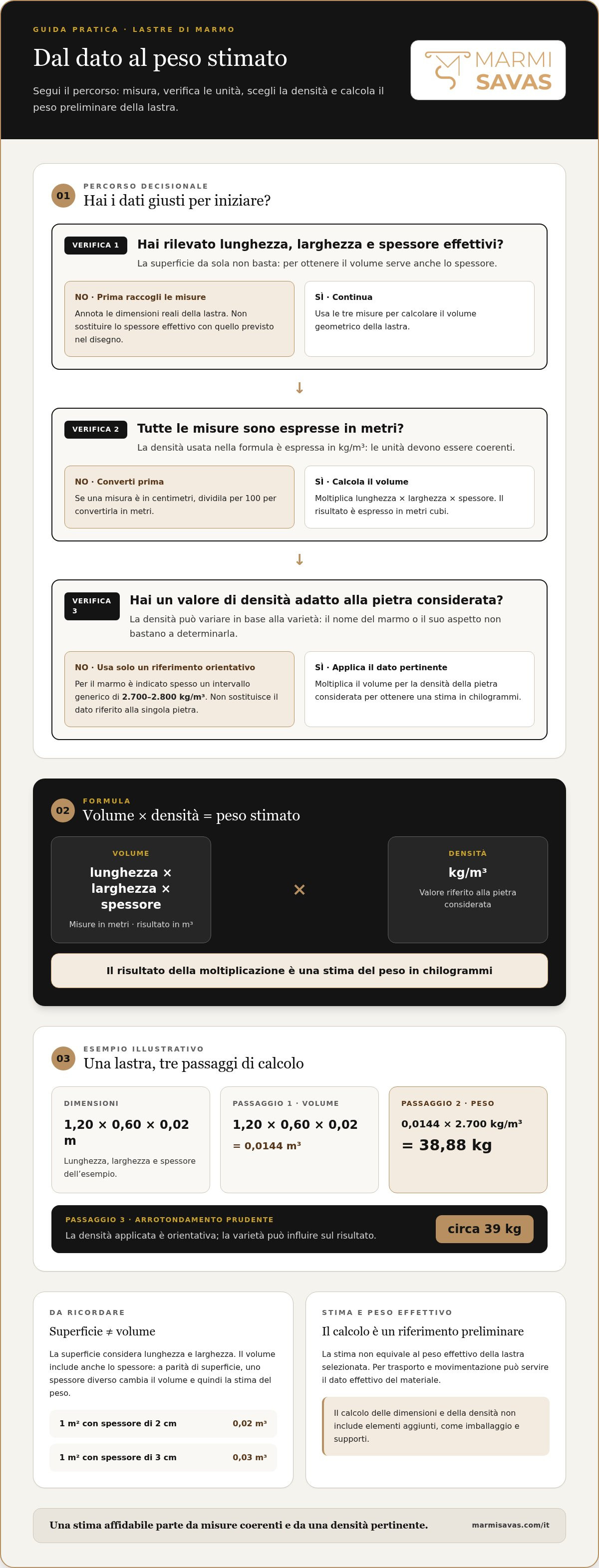
To estimate the weight, multiply length, width and thickness by the density of the stone. The formula is simple, but requires attention to the units: if the measurements are in metres and the density is expressed in kilograms per cubic metre, the result will be in kilograms. The calculation of the weight of a marble slab must start from precise measurements, not from approximate values taken from the drawing.
The estimated weight in kilograms is calculated by multiplying length, width and thickness in metres by the density of the marble in kilograms per cubic metre. The density makes it possible to convert the volume of the slab into an estimate of its mass. For a more in-depth look at the general characteristics of the material, you can consult the definition of marble on Treccani; for the calculation, however, a density value suited to the stone considered must be applied.
Which measurements to note before the calculation
Measure the actual length and width of the slab, then note the real thickness. Do not replace it with the one foreseen in the drawing: even a small difference changes the volume and, consequently, the estimate. If the dimensions are given in centimetres, convert each measurement into metres by dividing by one hundred before entering it in the formula.
Check that all the units are consistent. Multiplying measurements in centimetres by a density expressed in kg/m³ without converting them produces a result with incorrect units. The sequence is: record the dimensions, convert them into metres, calculate the volume in cubic metres and finally apply the density.
A calculation example explained step by step
Let us consider an illustrative example, not a product specification: a slab 1.20 m long, 0.60 m wide and 0.02 m thick. To show the procedure, we apply an indicative density of 2,700 kg/m³, within the generic range of 2,700-2,800 kg/m³ indicated for marble. The actual density may vary according to the stone.
- Calculate the volume: 1.20 × 0.60 × 0.02 = 0.0144 m³.
- Multiply by the density: 0.0144 × 2,700 = 38.88 kg.
- Round prudently: the estimate is about 39 kg, not the certified or measured weight of the individual slab.
The precision depends on the data entered, especially on the thickness and on the density applied. For a selected slab, the calculation is a preliminary reference and does not replace the actual weight of the material. The contact page is available to share the details of the project and guide the choice of the material.
Why two marble slabs of the same dimensions can weigh differently
If length, width and thickness coincide, the geometric volume of the two slabs is the same. It does not follow, however, that they have the same mass: the density also counts in the calculation, and it may vary between natural stones and, to a different extent, between materials of the same family. The format alone is therefore not enough to determine the weight of a marble slab.
To interpret a difference correctly, separate the factors linked to the dimensions, which determine the volume, from those linked to the material, which affect the density. A different result may also depend on actual measurements that differ from the nominal ones. To compare two slabs, use the data referring to the selected elements.
- Variety and density: different stones may have different densities; at equal volume, this may change the estimated mass.
- Thickness: by increasing the thickness the volume grows, even if length and width remain unchanged.
- Length and width: a larger format increases the surface and, at equal thickness, also the overall volume.
- Actual measurements: for a reliable comparison the real dimensions are used, not only those indicated in the project.
Thickness and format: the effect on the overall weight
At equal surface, a thicker slab contains a greater volume of stone. At equal thickness, a longer or wider slab has a greater volume than a smaller-format one. In both cases, the variation in volume changes the estimate; the density is the datum needed to convert it into mass. Do not take a standard format for granted: consider the dimensions of the chosen slab.
Marble is not a uniform material
Marble is a natural stone, not a material identical in every slab. Calacatta, Bianco Carrara and Arabescato have distinctive visual characters, but the commercial name alone does not indicate the precise mass nor always provide the density needed for an accurate calculation. Appearance and veining describe the aesthetic identity of the stone, but do not replace the technical data.
Bianco di Carrara, for example, is appreciated for its light background and grey veining; to estimate the weight, however, the volume and a suitable density value are still needed. Do not automatically transfer to another variety the datum used for a different slab. If the material is the same but the result changes, first recheck thickness, length and width. If the measurements coincide, the specific density may explain the difference.
In short, equal dimensions guarantee the same geometric volume, not necessarily the same mass. A reliable comparison puts actual measurements and stone variety in relation, without attributing a universal weight value to the name of marble.
How to Use Weight Estimates for Project Planning, Transport, and Handling
Calculating the weight of a marble slab helps guide initial decisions, but it should not be confused with the operational data of the selected slab. The estimate is based on dimensions and density, whereas the actual weight refers to a specific item and its real characteristics. Distinguishing these two values helps move from preliminary design to practical planning without relying solely on theoretical data.
The load to be managed may also include elements excluded from the stone calculation. Packaging and transport supports, for example, add weight to the material. Keeping these values separate and clarifying which component each one refers to makes transport and handling planning easier.
When Weight Estimation Is Useful During the Design Phase
In the early stages, the estimate allows you to compare formats and thicknesses and understand how the volume and expected load change. It is a tool for evaluating alternatives, not a definitive verification. When the project moves on to material selection, the reference becomes the actual slab, with its dimensions and technical data.
Record the assumptions used: the measurements considered, the expected thickness, and the applied density. If any of these values changes, the result changes as well. Keeping this information together with the design helps reconstruct the calculation and update it when the slab's actual dimensions are established.
Which Data to Distinguish for Transport and Handling
For operational planning, separate the weight of the stone from that of the packaging and supports. Collect the actual measurements and consult the technical information relating to the selected slab. A calculated and rounded result may be sufficient for an initial comparison, but it does not replace the specific data required to organise load management.
- Stone weight: an indicative value calculated from the dimensions and the adopted density.
- Weight of the selected slab: data relating to the actual item and its dimensional and technical characteristics.
- Total logistical weight: a value that also includes packaging and supports, when present.
Before transferring an estimate into the planning process, verify that the assumed format corresponds to the selected one and that the data describes the slab, not the material in the abstract. In architectural and interior design projects, this distinction makes the transition between aesthetic choice and practical organisation clearer: colour and veining guide the selection, while dimensions and weight help define how the material will be handled.
The contact page allows you to share the material and dimensions planned for your project.
Choosing a Marble Slab with Data Relevant to Your Project
The estimate is useful when it refers to a material and defined dimensions. Before comparing slabs, collect the data required for the calculation and clarify the role the stone will play: covering a wall, defining a surface, or complementing a floor. You can then evaluate overall dimensions, expected weight, and aesthetic appearance together, without treating the calculation as a universal characteristic of marble.
To establish a useful reference, note the following:
- Variety: for example, Calacatta, Blanco Carrara, or Arabescato.
- Actual dimensions: the length and width of the slab.
- Actual thickness: the thickness of the selected slab, not an assumed measurement.
- Density: the technical value relevant to the stone being considered.
If any of these data changes, update the estimate. Aesthetic selection also requires attention: the distribution of the veining and the background tone influence visual continuity between slabs and the character of the environment.
From Preliminary Calculation to Slab Selection
Compare the dimensions required by the project with those of the available slabs, then evaluate colour and natural pattern. Blanco Carrara is appreciated for its light background and delicate grey veining; Calacatta often features more pronounced contrasts, while Arabescato stands out for its distinctive, repeated patterns. These are visual characteristics, not indications of weight: dimensions and density are still required for the estimate.
Choosing a white marble allows you to compare backgrounds and veining according to the desired effect. If several slabs are placed next to one another, also evaluate the continuity of the pattern from one element to the next; for a single surface, background tone, format, and proportions may be especially important. Aesthetic selection and dimensional verification go hand in hand, but they address different requirements.
Comparing Materials Suitable for the Project
MARMISAVAS specialises in supplying slabs and natural stone and offers more than 200 material options. This variety makes it possible to explore alternatives according to the architectural language and application, evaluating the technical data of the stone and the specific slab. The comparison can start with colour and veining, followed by the format and information needed to estimate weight.
To make the comparison practical, define the intended measurements, desired thickness, variety of interest, and intended application. If the project requires multiple slabs, also consider the total volume and the visual consistency of the selection. This approach connects the authentic character of natural stone with the practical requirements of the project.
To discuss the required material, format, and volume, you can visit the MARMISAVAS contact page.
Turn Your Project Requirements into a Concrete Choice
A natural slab defines a space through colour, the rhythm of its veining, and the material presence of its surface. Choosing means balancing aesthetic intentions with the characteristics relevant to planning, so that the material meets the design and intended use. The weight of a marble slab is part of this assessment, together with format, thickness, and visual appearance.
The next step is to clarify priorities: what atmosphere do you want to create, what dimensions does the project require, and which variety best expresses your vision? From a luminous background crossed by subtle veining to a more pronounced and dramatic pattern, each stone has a distinctive character. Comparing these aspects before finalising the selection helps you proceed with greater clarity.
To evaluate slabs in relation to your project's requirements, contact MARMISAVAS and share the intended application and reference dimensions. You can compare the marble and natural stone options best suited to the material, format, and design vision.
Frequently Asked Questions About the Weight of Marble Slabs
How much does a marble slab weigh per square metre?
The weight per square metre varies according to the thickness and density of the stone. To compare materials, record the value together with the variety and the thickness to which it refers; without this information, the data may be of limited use. During the design phase, distinguish the mass of the net surface from the total quantity of material planned, especially if the measurements are still provisional.
How is the weight of a marble slab calculated?
Multiply the length, width, and thickness to obtain the volume, then multiply the volume by the documented density of the material. The result is an estimate of the weight of a marble slab. To make the calculation verifiable, record the variety, the units used, and the data reference. If you compare several alternatives, apply the same rounding criteria.
How much does a marble slab that is 2 centimetres thick weigh?
Thickness alone, at 2 centimetres, does not determine a single weight: a slab for a small covering and one covering a larger area contain different quantities of material. Before using a figure in a document, define the required area and the format to which it refers. This prevents the data for a single element from being applied to the entire supply.
Does Calacatta marble weigh more than Blanco Carrara?
The commercial name alone is not enough to conclude that Calacatta weighs more than Blanco Carrara. To compare the two materials, consider elements with equivalent dimensions and technical data relating to the specific variety. This allows you to separate the aesthetic comparison, associated with background tone and veining, from the quantitative assessment required for planning.
Does the calculated weight include packaging and supports?
No. The result relating to the slab does not automatically include packaging and supports. When consulting logistics documents, check whether the value is the net weight, referring only to the stone, or the total weight of the prepared unit. This distinction is also important when comparing different documents: values referring to different components are not directly comparable.
Can I calculate the weight of a slab if I know only the square metres?
No. Square metres describe the area, but they are not sufficient to calculate the weight. They can be used to estimate the surface to be covered and organise the list of elements planned for the project. Before planning the load, complete the data with thickness and density, checking that the surface refers to the slab in question and not to the entire area of the room.
Does the weight of a slab change with the finish?
The finish alone does not allow you to attribute a reliable weight variation. If you compare slabs with different surface treatments, refer to the final measurements of the material and the technical data associated with each item. Avoid inferring differences solely from the name of the finish and base the comparison on the available information.