How to Evaluate the Price of Calacatta Marble per Square Foot
Calacatta Marble Price per Square Foot: What You Need to Know
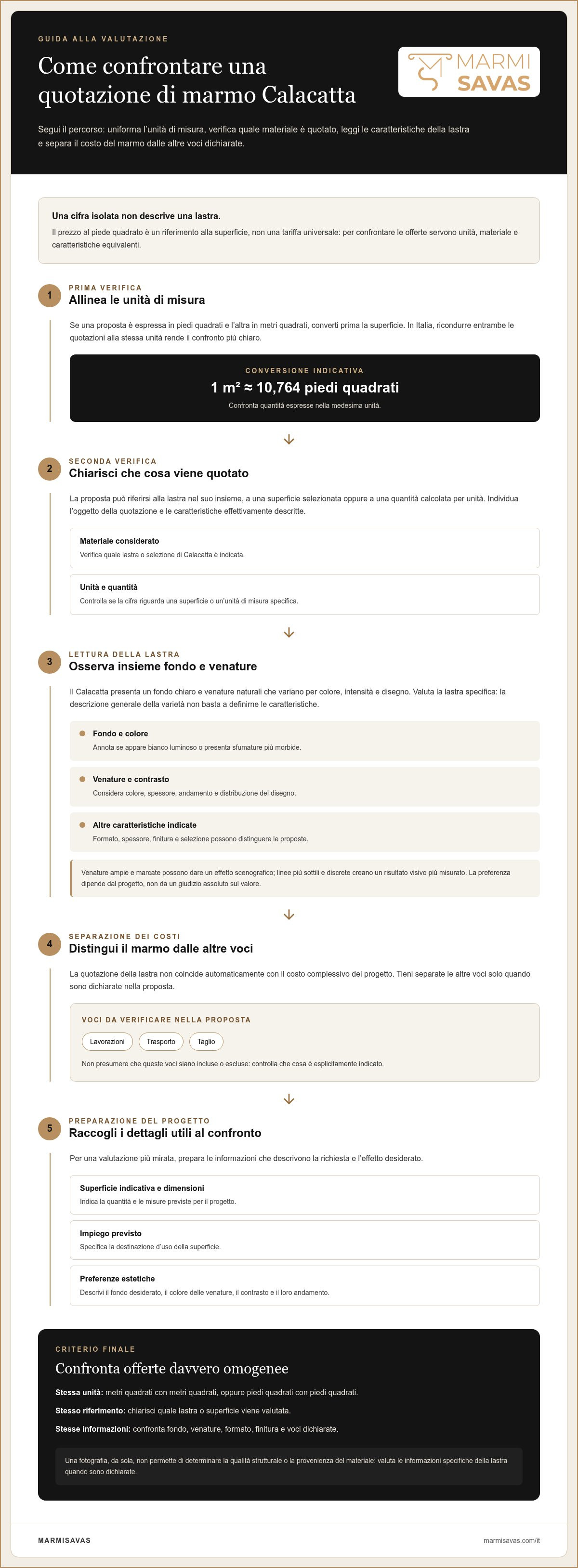
A quote per square foot alone does not tell you how much a Calacatta slab is worth. “Calacatta marble price per square foot” must be considered alongside the material's characteristics and, in Italy, converted to price per square metre: one square metre equals approximately 10.764 square feet. Without this conversion, comparing offers expressed in different units can lead to misleading assessments.
It is natural to expect the price to reflect the quality of the marble, but two slabs of the same variety can differ in background colour, veining patterns and contrast, as well as in format, thickness and finish. In Calacatta marble, these natural differences define the character of each slab and contribute to its valuation. The intended use also guides the choice of the most suitable material.
In this guide, you will discover which factors affect valuation, how to compare quotes on a like-for-like basis, and which details to prepare when requesting a quotation that matches your project. By distinguishing material costs from overall expenses and visually assessing the slabs, you can compare offers more clearly without reducing a unique stone to a simple price per unit of surface area.
Key Points
- Evaluate the background, colour and direction of the veining to identify the slab that best matches your desired aesthetic.
- When reading a quote for “Calacatta marble price per square foot,” also consider the specified format, finish and selection.
- Compare offers only after verifying that they describe equivalent materials and characteristics.
- Prepare an approximate surface area, dimensions and intended use to obtain a valuation more closely tailored to your project.
- Discover how MARMISAVAS's other 200 options can help guide the selection of slabs and natural stones.
Index
- Calacatta marble price per square foot: what it really means
- Which slab characteristics determine the price of Calacatta marble
- How to compare two Calacatta marble quotes without errors
- What information to prepare when requesting a Calacatta quotation
- MARMISAVAS and the selection of Calacatta slabs for your project
Calacatta Marble Price per Square Foot: What It Really Means
The price per square foot is a reference to surface area, not a universal rate applicable to every Calacatta slab. An isolated figure does not describe the material: to interpret it, you need to know which slab was assessed, which characteristics are included and which market the quote refers to. The Calacatta price per square foot therefore provides an initial indication, but it does not replace a quotation tailored to the project's actual requirements.
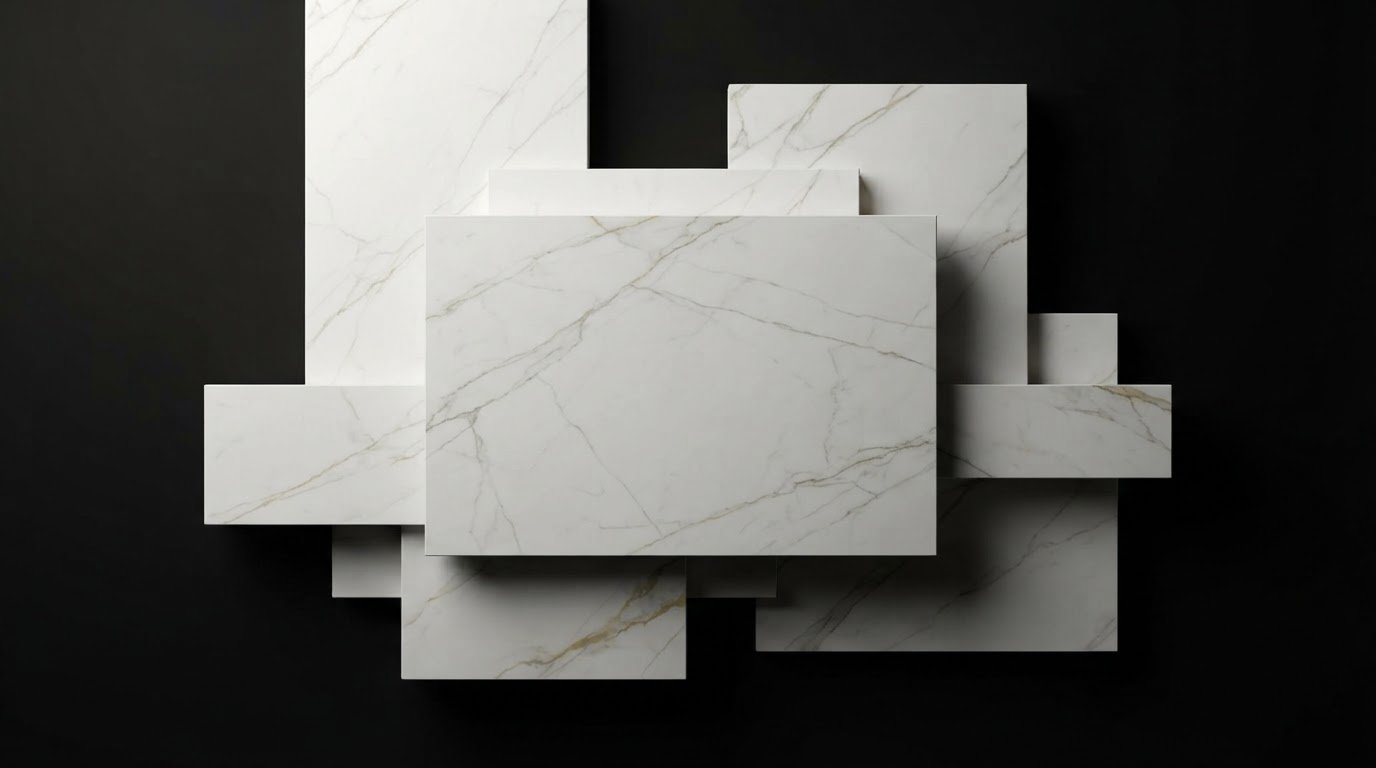
Calacatta is a natural marble with a light background, often bright white, crossed by pronounced veins that can vary in colour, intensity and pattern. As with any marble, its natural origin results in visible variations from one slab to another. A general description of the variety is not enough to establish the value of a specific piece: the proposed selection and the actual characteristics of the surface matter.
It is important to distinguish, from the outset, the cost of the material from the other items in an architectural project. A slab quotation does not automatically include processing, transport, cutting or installation costs. These elements belong to separate cost items and should be considered when they are stated in the proposal. Adding them to the material price without checking what they cover makes the comparison unreliable.
What Does a Calacatta Quote Include?
A proposal may refer to the entire slab, a selected surface or a quantity expressed per unit of measurement. Before comparing amounts, identify what is being quoted and which characteristics are described. The unit price indicates the cost of the material for a specific surface-area unit, according to the selection and conditions specified in the quotation. Do not attribute costs to the figure that are not explicitly included.
For example, two offers may appear to refer to the same marble but describe materials that differ in background, veining or format. Even if both state a unit price, they cannot be directly compared until it is clear what each figure represents. Record the quoted material and any declared additional costs separately, without assuming that they are included or excluded.
How to Read Square Feet in the Italian Context
The square foot is a unit of area used in some markets. In Italy, when evaluating a supply offer, it is more practical to convert the quotation to the same unit used in the other offer. The exact conversion between square feet and square metres is provided in the answer to the related frequently asked question. The essential criterion is to compare quantities expressed in the same unit.
A reference published for another country should not automatically be applied to an Italian request: the currency, slab description and what the quoted figure includes may differ. For a proper comparison, align the units of measurement, the surface or slab being considered, and the material description. Only then does the price become useful for assessing the proposal rather than remaining a number without the necessary context.
Which Slab Characteristics Determine the Price of Calacatta Marble?
The value of a Calacatta slab is understood by examining its characteristics together, rather than relying on a single detail. The background may appear bright white or display softer shades; the veins, often prominent, vary in colour, thickness and movement. These natural differences guide aesthetic selection and may affect valuation. A photograph alone, however, cannot establish the material's structural quality or origin.
To read a product specification accurately, separate what is visible from what requires a specific description. You can note the background colour, contrast and distribution of the veining; information about origin, technical characteristics or any treatments applied to the stone should be considered when declared. An overview of the characteristics of Calacatta marble helps put into context how its natural composition contributes to colour variations.
Veining, Background and Continuity of the Pattern
Broad, pronounced veins give a slab a dramatic presence, while thin, subtle lines create a more restrained visual effect. Neither option is automatically better: the choice depends on the surface and the atmosphere the project aims to achieve. Every Calacatta slab has a naturally variable pattern, so the background and veining must be assessed on the specific material.
On a large wall, the same pattern may appear more continuous or more concentrated depending on how the surface is divided. For this reason, it is useful to relate the visible pattern to the planned dimensions and desired effect, without judging value solely by the intensity of the veining.
During selection, describe your preference in concrete terms: a very light background, grey or golden veins, strong contrast or a more delicate pattern. If graphic continuity is essential, also consider how the slabs will be placed next to one another in the project. These indications make comparisons between proposals clearer and distinguish an aesthetic preference from a technical specification.
Format, Finish and Required Quantity
The planned dimensions, desired finish and total quantity complete the picture of the request. Indicate the surface measurements and intended use, such as vertical cladding or a countertop, and specify the finish to be compared. These details help put the choice into context and assess the slab in relation to the project.
When comparing offers, verify that they describe the same type of finish and comparable surfaces. The required quantity is a project parameter, not a guarantee of a discount; format alone does not demonstrate superior quality. To present dimensions, requirements and aesthetic preferences, you can share your project details with MARMISAVAS.
How to Compare Two Calacatta Marble Quotes Without Errors
Two offers may use the same commercial name and still refer to different slabs. To understand which proposal best meets the project's needs, align the unit of measurement, declared characteristics and contents of the quotation before looking at the amounts. A simple table helps identify differences and distinguish available information from details that have not been specified.
The Table for Aligning Offers
Transcribe the information from each proposal without filling gaps with assumptions. If a detail is missing, mark it as “not specified”: this will help you assess clearly whether the offers are genuinely comparable.
Element to compare: Quotation A / Quotation B
- Unit of measurement: Square metre, square foot or another stated unit / Declared unit of measurement
- Dimensions: Measurements of the slab or surface under consideration / Measurements stated or not specified
- Finish: Declared finish / Declared finish or not specified
- Selection: Description of the background, veining and appearance / Description of the background, veining and appearance
- Quotation contents: Material and other explicitly included items / Material and other explicitly included items
Offers with different units, surfaces, selections or contents are not comparable until the differences have been clarified. For example, a figure referring to a slab and an offer referring to a selected surface do not necessarily describe the same supply. Similarly, a quotation for the material should not be confused with a proposal that includes processing or other project items: consider these components separately and only when they are specified.
The same caution applies to online references. An isolated advertisement or a price expressed in the currency and units of another market does not, by itself, constitute an Italian average. A search for Calacatta marble price per square foot may also return non-uniform values: use them as context only after verifying which material and scope they refer to, without automatically transferring them to a quotation in Italy.
Calacatta and Carrara: Distinguishing Aesthetics from Pricing
Calacatta is appreciated for its light background and often more pronounced, contrasting veins; Blanco Carrara, by contrast, tends to feature a finer pattern and grey shades. These are general aesthetic indications, not descriptions sufficient to identify every slab. The marble's name alone does not specify the background, pattern or selection being offered. To explore the visual characteristics of the available Calacatta marble selection, consider the individual slabs and compare their descriptions with the effect intended for the project.
What Information Should You Prepare to Request a Calacatta Quote?
A well-structured request starts with the project, not with a price taken as an isolated reference. Collecting measurements, the intended application and visual preferences in advance makes it possible to describe the desired slab precisely and obtain a more relevant assessment. There is no need to define every execution detail: even preliminary indications, if clear, help guide the selection.
Project Details
Before sending your request, organise the information in a simple sequence. Start with the surfaces involved and add approximate dimensions; then clarify the intended use of the marble and the effect you want to achieve. If some measurements are still being defined, indicate this to distinguish provisional quantities from final ones.
- Define the areas: note how many surfaces you intend to cover or their approximate extent.
- Provide the dimensions: share the available measurements, dimensioned sketches or project drawings, distinguishing final data from preliminary information.
- Describe the application: indicate whether the Calacatta is intended, for example, for vertical cladding, flooring or another architectural surface.
- Specify the priorities: indicate your preferred finish and any need for visual continuity between slabs.
These elements provide a concrete picture of the required quantity and intended use without turning an initial estimate into an already approved technical specification. To facilitate the assessment, accompany the information with a brief note about your priorities and the aspects that can remain flexible during selection.
From Visual Selection to Assessment
The light background and veining pattern play a decisive role in the presence of Calacatta within a space. You can describe a preference for a bright background, broad and contrasting lines, or a more delicate pattern. These are guiding criteria, not requirements: keeping the selection open makes it possible to assess the slabs in relation to the overall character of the setting. The white Calacatta marble selection provides a reference for becoming familiar with the visual variations.
If you have a reference image, a project board or a colour sample, attach it to your request and clarify which aspect you want to evoke: tone, contrast or the movement of the veins. The reference communicates the aesthetic intention but does not guarantee an identical match, since every natural slab has its own pattern.
Also indicate the preferred unit of measurement for the assessment. Anyone arriving from a search such as “Calacatta marble price per square foot” can specify the reference consulted, but for comparing the project, it is useful to provide the surface areas in square metres or include both units. To share measurements, intended use and preferences and request a Calacatta assessment, send the available details together with the relevant visual materials.
MARMISAVAS and Choosing Calacatta Slabs for Your Project
Choosing a Calacatta slab makes sense when it is considered in relation to the project: surface proportions, the desired visual effect and the marble’s natural characteristics must work together. MARMISAVAS specialises in supplying slabs and natural stone for residential and commercial projects, offering Calacatta alongside other varieties of white marble and natural materials.
A Broad Selection for Different Project Requirements
Calacatta’s light background and often broad, dramatic veining can become a distinctive feature in a space. The actual choice depends on the pattern of the individual slab and how it works with the dimensions, lighting and surrounding materials. In the category dedicated to Calacatta marble, you can explore this type alongside a selection of white marbles.
Other varieties suitable for different projects include Bianco Carrara, generally characterised by more delicate grey veining, and Arabescato, appreciated for its distinctive pattern. MARMISAVAS offers more than 200 options and a large stock for high-volume requirements. This variety makes it possible to assess different materials according to aesthetic and project requirements.
For architects, designers, stone professionals and clients, the decisive step is to turn aesthetic preferences into useful criteria: a bright background, strong contrast, veins in a particular shade or a pattern that extends across a large surface. The planned dimensions and architectural application also help guide the choice of slab rather than relying on a generic description of the material.
From Unit Price to Material Selection
A unit price becomes useful only when it corresponds to the requested selection and characteristics. To interpret the reference “Calacatta marble price per square foot”, distinguish the unit of measurement, the slab description and the contents of the quotation. In Italy, specify the surface area in square metres and provide the planned dimensions so that the comparison remains connected to the actual project.
Before choosing, collect the available measurements, intended application and preferences regarding the background and veining. If the selection is still open, describe the expected effect without unnecessarily limiting the alternatives: every slab has its own natural individuality. This allows the assessment to focus on the material and actual requirements rather than an abstract rate or assumed characteristics.
Share your project and request an assessment by indicating the surfaces, dimensions and aesthetic objectives: MARMISAVAS can frame the request according to the characteristics of the Calacatta you are looking for.
Bringing Your Project Vision to Life
Choosing Calacatta can become a design decision, not merely a purchasing decision. The way its light background and veining interact with light, materials and proportions defines the character of the surface. The question of “Calacatta marble price per square foot” can therefore open up a broader consideration: which slab will give coherence and personality to the setting you envision?
Before proceeding, consider the role you want the stone to play: a discreet presence, an element of continuity or a focal point. This intention helps you choose more consciously and keep the project faithful to its vision, whether you are designing a residential interior or a space intended for hospitality.
Share your measurements, intended use and aesthetic direction with MARMISAVAS to begin discussing the most suitable material. Talk to MARMISAVAS about your project and define the next step clearly: a considered choice can enhance the authentic character of marble.
Frequently Asked Questions About Calacatta Marble Prices
How many square metres are equivalent to one square foot?
One square foot corresponds to approximately 0.0929 square metres, while one square metre equals approximately 10.764 square feet. To compare a quotation expressed in square feet with one expressed in square metres, first convert the surface area and apply the same rounding method to both values. The conversion changes the unit of measurement, not the price of the material or the characteristics of the slab.
Does the price per square foot refer to the slab or to installed marble?
The expression indicates a price referring to a surface area, but it does not, by itself, specify what the offer includes. MARMISAVAS supplies stone materials, not laying or installation services. If a document indicates only a surface area and an amount, do not assume that processing or other services are included: check the stated scope and consider the material and the other project items separately.
Does a Calacatta sample show exactly what the slab looks like?
No, a sample does not necessarily reproduce the entire slab. It is useful for observing the tones, background and character of the veining up close, but the pattern of natural marble can change from one area to another. Use it as a reference for the aesthetic direction, not as a guarantee of a complete match. For a large surface, also consider how variations in colour and texture might appear when viewed as a whole.
Can the price of Calacatta be estimated from a photograph?
A photograph can communicate aesthetic preferences, but it is not sufficient to determine an assessment tailored to the project. It does not necessarily show the actual dimensions, total surface area or required quantity. If you have found an image with veining similar to what you want, send it together with the available measurements and intended application. The photograph guides visual preferences, while the dimensional information defines the scope of the request.
Why can two slabs called Calacatta look different?
Because Calacatta is a natural stone, the background, tones and veining are not identical in every slab. One may feature broad, contrasting grey lines, while another may have a more discreet pattern or different shades. The name helps identify the marble type but does not describe every visual detail. Therefore, consider the character of the individual slab in relation to the surface where it will be installed.
What information is needed to request an assessment for Calacatta?
Prepare the approximate surface area, available dimensions and intended architectural use. Add your preferences for the background, veining pattern and finish; if available, attach a dimensioned drawing or reference images. Specify which measurements are final and which are provisional. These details help describe the desired result and assess the material in relation to the project’s actual requirements.