Brown marble: guide to slab selection for prestigious projects
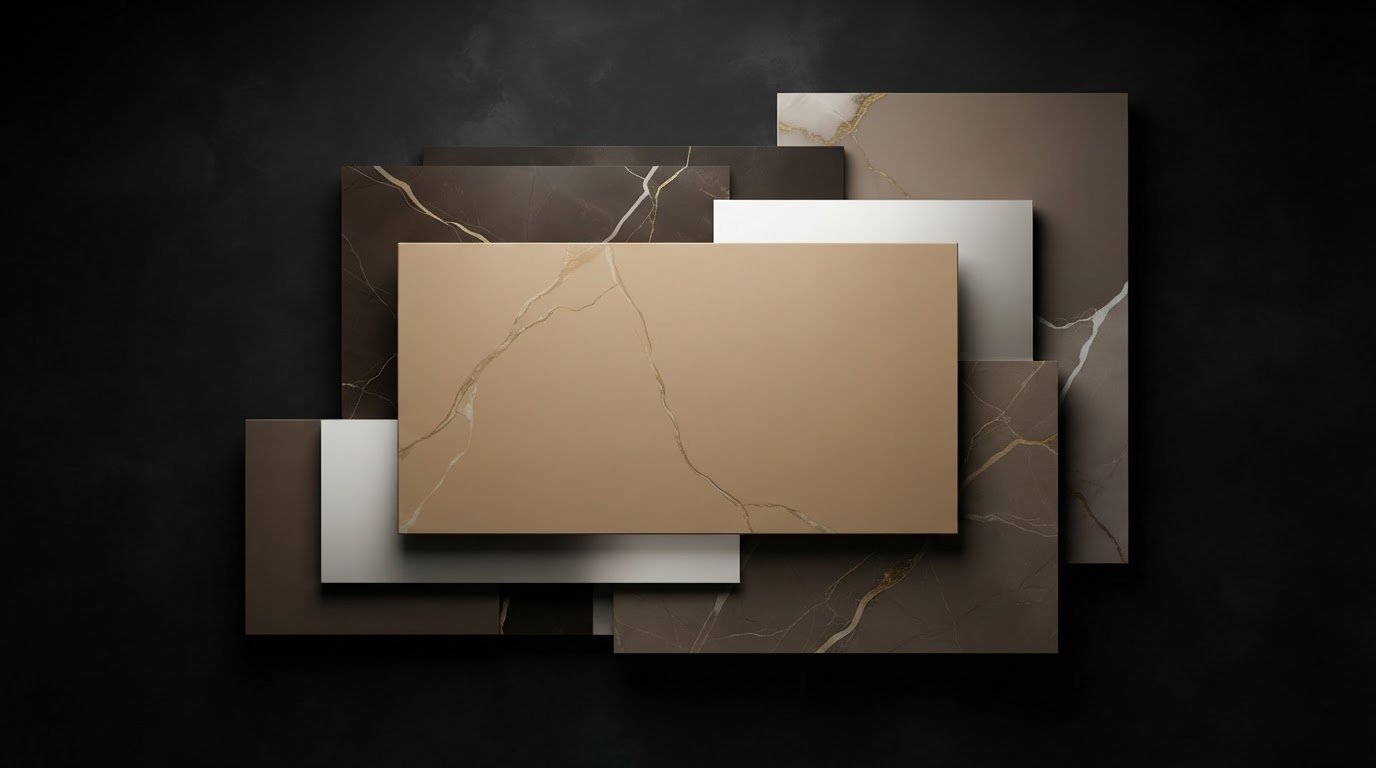
What if the Most Beautiful Marble Slab in the Catalog Isn't the Right One for Your Project?
Choosing a brown marble based solely on color can be misleading: light alters the perception of tones, and the slab format can make the veins more or less prominent. It is natural to wonder which marble best matches floors, metals, woods, and color palettes that are already defined. To achieve a harmonious ensemble, evaluate the material in context, considering shades, natural design, and finish, rather than just the impression evoked by a photograph or a reduced sample.
In this guide, you will discover how to compare the tones of brown marble with ambient light and surrounding materials, how to read veins and visual continuity between slabs, and what role the finish plays in the project's rendering. We will also see why observing the real format helps select slabs consistent with architecture and interior design, paying attention to aesthetic quality and the visible characteristics of the material.
Key Points
- Brown marble encompasses different tones and veins: observe the overall design, not just the background color.
- Evaluate how light, surface dimensions, and surrounding materials influence the chromatic balance of the environment.
- Compare glossy and matte finishes to understand which visual rendering best matches the project.
- Before selecting a slab, define application, palette, tones, veins, finish, and format.
- Examine integrity, vein continuity, and visible defects to guide the choice towards slabs consistent with the desired result.
Index
- Brown marble: why tones and veins change the reading of a project
- How to read color, design, and finish of brown marble
- Does brown marble make a room too dark? How to evaluate the balance
- How to select a brown marble slab for your project
- Brown marble supply: transforming selection criteria into a concrete project
Brown Marble: Why Tones and Veins Change the Reading of a Project
Brown marble is a natural stone with a brown background and veins of varying intensity and movement. The definition of marble helps frame this family of materials, but choosing a slab relies above all on observing its concrete appearance. Shades, contrast, and pattern distribution mean that two brown surfaces can suggest very different atmospheres.
A deep background can give the composition a cozy character, while warmer notes or light variations can lighten the perception of the surface. The result also depends on the light, the extent of the marble, and the accompanying materials. Wood, metal, and stones of different colors contribute to defining the overall balance. Aesthetic appreciation is therefore a starting point, not the sole criterion for selection.
What Characterizes Brown Marble?
The color range can span from intense brown to softer and more luminous tones, with intermediate transitions between background and veins. Observing only the base color risks yielding an incomplete impression: lighter or darker lines modify the visual weight of the slab and how it harmonizes with the project palette. Consider background and veins as parts of a single design. A brown marble with a dark background and marked clear marks has a different presence than a slab with more discrete chromatic variations. The page dedicated to brown marble in slabs offers a reference to explore this category without reducing it to a single tone.
What Role Do Veins Play in the Appearance of the Slab?
Marble veins are natural marks that cross the stone and define its visual rhythm. Density, direction, and contrast with the background can make the design more dynamic or more discrete. Closely spaced lines create a visually rich texture; more distant lines leave greater prominence to the base color. Natural design varies from slab to slab. When evaluating brown marble, therefore, consider the surface as a whole and imagine how the veins will dialogue with other elements. In this way, the choice is based on the real composition of the material and consistency with the project, not just on the effect of a sample or photograph.
How to Read Color, Design, and Finish of Brown Marble
To compare different brown marble slabs, follow a precise sequence: examine the background first, then the veins, chromatic variations, and finally the finish. A photograph can help get oriented, but does not always faithfully reproduce reflections, shades, and design proportions. Observing the slabs in the visible format offers a more concrete basis for evaluating the rendering in the project. The choice is based on the combination of tone, design, finish, and context. This criterion is useful both for a surface destined to become a protagonist and for an element that must harmonize with floors, claddings, or already defined materials. For examples of marble use in interiors, the Archiproducts article on prestigious projects with marble offers further insights to connect the stone's choice to spatial composition.
How to Evaluate Vein Continuity Between Slabs?
Observe each surface in its entirety, not just an enlarged detail. Follow the direction of the veins, note how dense they are, and verify how they distribute across the background. If the design is intense, ask yourself whether it supports the desired character or risks competing with other visual elements, such as a decorative wall or an already rich palette.
- Direction: Lines oriented in an evident way can give the surface a more dynamic rhythm.
- Density: Closely spaced veins make the design more prominent; an open pattern lets the background stand out more.
- Contrast: Marked differences between veins and base catch the eye, while more gradual chromatic passages can appear more measured.
The design is natural and can change from one slab to another. Evaluate continuity on the surfaces selected for the project.
How Does the Finish Influence Marble Rendering?
The polished surface reflects light more evidently and can make chromatic contrasts more pronounced; the honed finish, matte and softer to the view, softens reflections and returns a different reading of the material. Neither is ever strictly the correct choice: evaluate both in relation to ambient light and surrounding surfaces. For a reliable comparison, observe the finish and verify how the perception of the background and the same design changes. If you are evaluating brownmarble for an architectural or interior design project, share the requirements with the MARMISAVAS team to discuss slab selection.
Does Brown Marble Make an Environment Too Dark? How to Evaluate Balance
No, brown marble does not darken every environment in the same way. Perception depends on the tone chosen, the expected surface quantity, light, and combinations. A deep brown background can become a decisive visual accent; a more delicate tone can blend in with greater discretion. In both cases, evaluate the result against the entire composition, not the isolated color.
The table offers a preliminary grid to focus on the desired effect. It does not replace observing the slabs: veins, finish, and chromatic rendering can modify the overall impression.
Comparison Matrix
- Element: Possible visual reading to evaluate in the project
- Tone: Deep background
- Density: Intense and marked presence
- Surface extension: Surface extension and available light
- Available tone: Lighter tone
- Chromatic effect: More delicate chromatic effect
- Palette harmony: Agreement with the palette and nearby surfaces
- Veins: Contrasting veins
- Design: More evident and dynamic design
- Balance: Balance with other visual elements
- Veins: Discrete veins
- Background: More uniform background for reading
- Role: Role of stone in the composition
- Finish: Reflective finish
- Reflections: More present reflections
- Light direction: Direction of light and adjacent materials
- Finish: Matte finish
- Reflections: Softer aspect
- Overall effect: Desired overall effect
How to Coordinate Brown Marble with Light and Materials?
Consider exposure and expected light, observing the surface under the lighting conditions in which it will be lived. Pairing a marble sample with already defined materials, for example wood or light surfaces, helps evaluate tone and contrast ratios. A light pairing can create a visual separation, while materials with similar tones can compose an enveloping ensemble. These are possibilities, not rules: balance depends on the design and quantity of each material.
When to Choose a Deep Tone or a Delicate Shade?
Start from the stone's role. If it is to be a protagonist, a deep tone or evident veins must give greater prominence to the surface. Conversely, if brown marble accompanies an already articulated palette, a more delicate tone or less contrasted design can help keep the ensemble balanced. Also consider surface extension: a wide slab makes the design readable in a different way than a circumscribed detail. To explore the use of brownmarble in your project, gather references on light and surrounding materials and share project requirements to initiate a supply discussion with MARMISAVAS.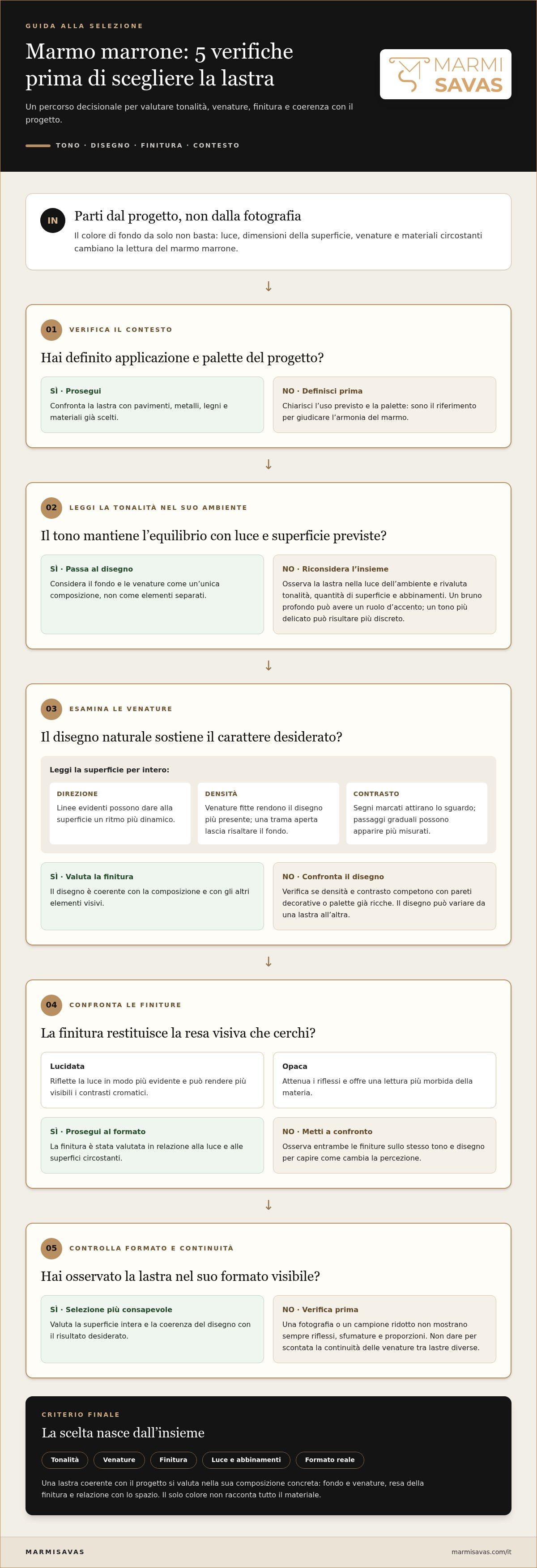
How to Select a Brown Marble Slab for Your ProjectA careful choice starts from the needs of the space and arrives at the slab, not the other way around. Define the application and the visual role of the marble, then compare palette, tones, veins, finish, and format. This sequence helps evaluate brown marble in relation to the project, instead of relying solely on a chromatic impression. 1. Define the application: Clarify which surface the marble will cover and how it will be observed in the space. 2. Outline the palette: Gather references of materials already foreseen to compare colors and contrasts. 3. Choose the tone: Evaluate how much the brown background should stand out or accompany the composition. 4. Read the design: Observe the density, direction, and contrast of the veins across the entire surface. 5. Consider finish and format: Relate surface appearance and slab dimensions to the desired design effect. What aspects should be observed when evaluating the slab?Slab quality inspection, i.e., the qualitative inspection of the slab, considers integrity, vein continuity, and visible defects. For an orderly check, observe chromatic uniformity, design distribution, and thickness, paying attention to any visible imperfections. These technical criteria help describe with precision what is seen and compare slabs based on project requirements. Natural stone authenticity, i.e., the authenticity of the natural stone, is also appreciated by observing the slab as a whole: a detail or a single image does not always faithfully reproduce the design and surface variations. Explore the category of brown marble in slabs considering the visible characteristics of the material and coherence with the foreseen composition. How to plan format and visual continuity?Compare slab dimensions with those of the surfaces to be covered and the proportions of the environment. The format affects how much of the natural design remains visible and how joints are distributed. If the project requires a specular motif between consecutive slabs, the mirror technique, also called bookmatch, can be evaluated during the selection phase. Placement depends on the actual design of the chosen slabs and the desired effect. To define the selection based on application, format, and visual rendering, share your project requirements with MARMISAVAS. Exchanging ideas with stone professionals helps translate aesthetic criteria into a more conscious supply choice. Brown Marble Supply: Transforming Selection Criteria Into a Concrete ProjectAn effective choice translates aesthetic intentions into clear supply requirements: intended use, foreseen surfaces, desired rendering, and quantity. For brown marble, this means evaluating tone, veins, finish, and format together, so that slabs integrate coherently into the architectural or interior design project. Before the discussion on supply, it can be useful to prepare these references: Desired effect: A protagonist surface or a more discreet integration. Light and palette: Foreseen lighting conditions and materials already defined, such as wood or light surfaces. Veins and finish: A preference for a marked or measured design with a glossy or matte rendering. Format and surfaces: Dimensions and layout foreseen along with the areas to be covered. Volume requirements: Approximate quantity and visual references that help describe the sought result. Dialogue containing this information starts from concrete criteria rather than getting stuck on color name, connecting material selection to overall composition. What information should be prepared to talk about supply?Explain where the marble will be applied and which surfaces it will concern. Specify whether the goal is to enhance the veins or achieve a more modest balance with other materials. Design references, palette samples, and format instructions help frame the selection. MARMISAVAS provides marble and natural stone slabs and tiles for architectural and interior design projects, with over 200 options and stock ready for large volumes. Supply also includes brown marble. How is material selection connected to economic evaluation?Economic evaluation depends on the selected material and supply requirements, including format, finish, and required volume. For brown marble, it is more useful to base comparison on selection and real project needs rather than relying on generic figures. Defining aesthetic and dimensional criteria first makes evaluation more targeted and facilitates comparison between alternatives. Share your project requirements and discuss supply with MARMISAVAS: discussion with stone professionals can help translate your preferences into a slab selection coherent with space and project vision. Bring the Choice of Brown Marble Into Your ProjectA well-chosen slab is born from the meeting of matter and project. Tones and veins define the visual character, while light, finish, and format help evaluate balance with surrounding surfaces. For brown marble, observing the natural design as a whole makes it possible to go beyond color and find a solution consistent with the desired effect. Before defining the selection, gather palette references, foreseen application, and surface dimensions. These elements make comparison on slabs more targeted. MARMISAVAS specializes in the supply of natural stone slabs and tiles for architecture and interior design projects. It offers stock ready for large volumes and over 200 options, with the expertise of stone professionals in material evaluation. Share your project and contact MARMISAVAS to initiate a discussion on supply requirements. With clear criteria and careful selection, brown marble can find its place in a refined and personal composition. Frequently Asked Questions About Brown MarbleIs brown marble suitable for a small environment?Yes, it can be considered even in a confined space: tone, light, and surface extension matter. A deep brown can become a protagonist accent, while a more delicate tone can blend in with discretion. Evaluate the slab together with nearby materials like wood and light surfaces, considering the overall effect rather than just color. Does brown marble make the room darker?Not necessarily: perception depends on tone, light, finish, and the surface clad. Contrasting veins can add movement, while light pairings can create a visual contrast. To evaluate rendering, observe the slab in the context of the palette and foreseen lighting conditions. Concrete evaluation of the material is more useful than a conclusion based solely on color name. How to choose a brown marble slab?Start from application and desired effect, then compare background, veins, finish, and format. Observe the slab in its entirety: natural design can vary, and a partial image does not always reproduce the whole. To choose brown marble with greater awareness, prepare a reference palette and consider how the slab relates to other surfaces and foreseen proportions. Is brown marble suitable for floors and cladding?It can be evaluated for various architectural and interior design applications, including floors and vertical claddings. Selection depends on the stone's characteristics and the specific requirements of the application. Consider format, finish, vein design, and the relationship with light, alongside the general composition of the space. These elements help determine whether the material is consistent with the foreseen aesthetic result. How to compare the veins of brown marble?Observe direction, density, contrast, and continuity of the design across the entire visible surface. Compare the slabs in relation to the project palette and evaluate whether veins should have a modest role or become a dominant visual element. Since natural design varies from slab to slab, direct examination of selected surfaces offers more pertinent indications than a generic category description. What is the price of brown marble per square meter? Cost depends on the selected material and supply requirements, including format, finish, and required volume. To obtain a pertinent evaluation, first define the application and desired aesthetic characteristics, so that comparison can be based on the real needs of the project. Preparing these details allows discussing supply with greater precision, without relying on generic ranges that might not represent the foreseen selection.