Carrara Marble Finishes: Selection Guide for Projects of Excellence (2026)
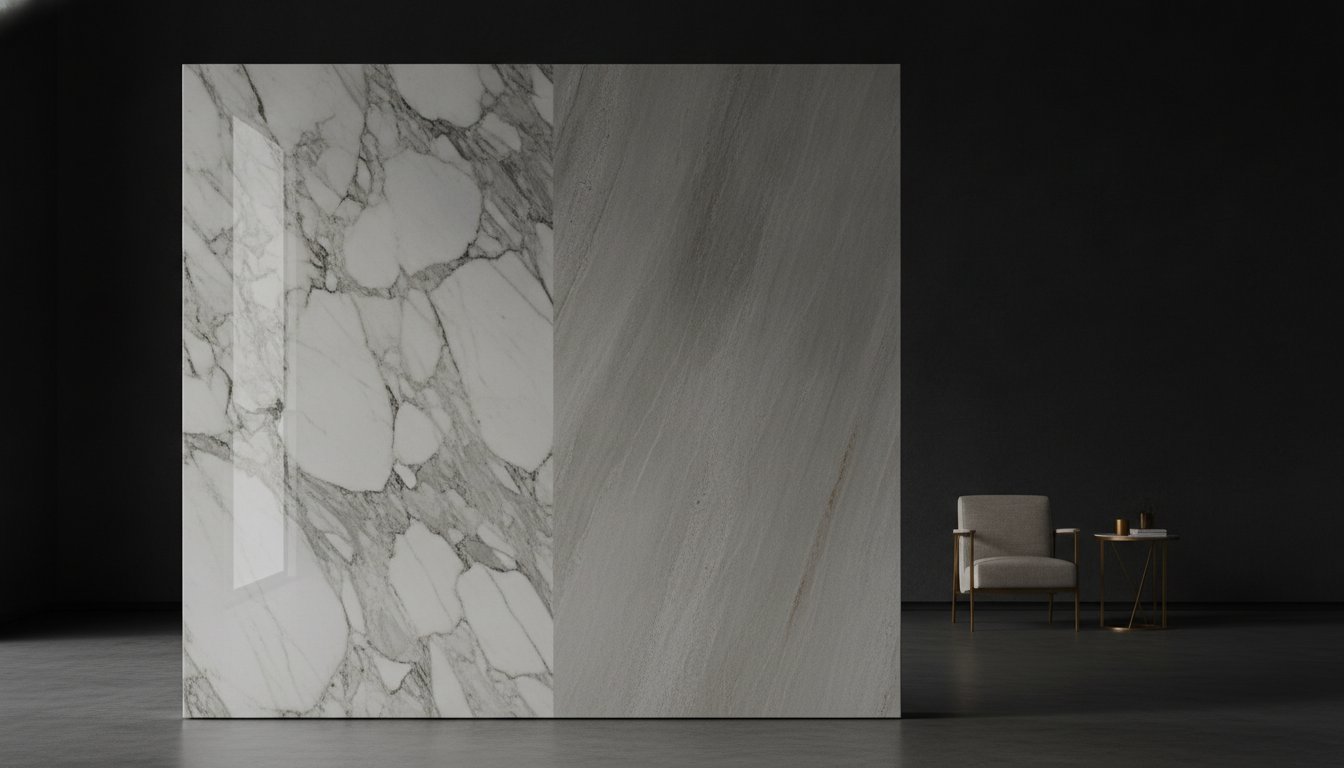
Many designers believe that choosing the slab is the only step toward excellence. However, the reality is that the wrong finish can dull even the most premium Bianco Carrara. Carrara marble finishes are not merely surface treatments; they represent the technical soul that determines whether a floor will maintain its prestige or become a constant maintenance challenge. We understand the frustration of distinguishing between a honed and a satin effect, as well as the fear that an overly glossy surface might prove slippery and impractical in a luxury bathroom.
You certainly agree that an architectural project must combine beauty and functionality without compromise. In this guide, you will discover how to select the perfect finish for every environment, ensuring durability and that touch of Italian mastery that defines contemporary luxury in 2026. We will analyze the latest material trends, from tactile surfaces to classic mirrored finishes, providing you with the necessary tools to transform your creative vision into a timeless work of art.
Key Points
- Visual and Luminous Impact: Discover how different surface treatments transform the color perception of veins and the light reflectance of Bianco Carrara marble.
- Technical Comparison: Compare the technical characteristics of the most requested Carrara marble finishes, analyzing the advantages of polished, honed, and satin options.
- Modern Textures: Explore modern material textures, such as brushed and bush-hammered finishes, to add visual and tactile depth to your wall coverings.
- Practical Selection Criteria: Get practical criteria to select the ideal finish based on intended use, ensuring safety in bathrooms and durability for kitchen countertops.
- Professional Sourcing: Deepen your understanding of professional sourcing based on advanced technologies and rigorous quality controls for every single slab.
Index
- The Importance of Finishing in Bianco Carrara Marble
- Classic Finishes: Polished, Honed, and Satin
- Modern Textures and Material Finishes
- Selection Guide: The Ideal Finish for Every Environment
- Professional Sourcing: Finished Slabs with MARMISAVAS
The Importance of Finishing in Bianco Carrara Marble
Choosing Carrara marble finishes is not a simple concluding aesthetic detail. It is the final act that determines how the stone will interact with its surrounding environment for decades to come. A finish profoundly alters the color perception of the gray veins that traverse the white background typical of this material. While a polished surface saturates colors—making contrasts vivid and almost dramatic—a matte treatment softens tones, creating an atmosphere of calm elegance.
Furthermore, the surface processing serves as a vital protective barrier. By mechanically closing the stone's natural pores, it increases mechanical resistance against daily wear and stains. It is not just a matter of style; it is a technical decision that guarantees the longevity of the investment.
In 2026, we observe a fascinating dichotomy in the stone sector:
- Matte Minimalism: Continues to dominate contemporary projects where tactility and naturalness are paramount.
- Mirror Polished: A decisive comeback in ultra-luxury contexts aiming to evoke the splendor of historic estates.
This evolution reflects the desire for extreme customization demanded by the most discerning clients. Carrara marble remains the undisputed protagonist of this scene, capable of adapting to these stylistic shifts without ever losing its millennial identity.
Aesthetics and Light Reflection
The grade of the stone drastically affects the final result of the processing. Bianco Carrara C, characterized by a whiter and more crystalline background, reacts to light with a brilliance that grade CD (tending toward ash gray) cannot match.
In high-profile residential projects, architects and designers skillfully use different Carrara marble finishes to visually amplify spaces. A polished slab acts as a natural mirror, doubling the perception of volume and diffusing natural light into every corner of the room. Conversely, a honed surface absorbs light softly, eliminating sharp reflections that could disturb environments designed for relaxation. Light does not merely hit the marble; it passes through it, revealing its geological depth through reflectance.
Sustainability and Natural Stone
Sustainability is now a cornerstone of design excellence. Choosing finishes obtained through cutting-edge mechanical processes, such as honing or brushing, drastically reduces the need for intensive chemical sealants during the production phase.
The Durability Advantage: The intrinsic durability of marble makes it infinitely superior to any synthetic alternative or porcelain stoneware. While industrial materials show irreversible signs of aging, natural stone possesses the unique capability to be regenerated. It can be re-honed after years, returning to its original splendor.
Classic Finishes: Polished, Honed, and Satin
Classic treatments represent the foundation of stone aesthetics and define how the stone inhabits a space. The modern industrial process relies on progressive-grit abrasive wheels. It starts with coarse grits to flatten the slab, gradually moving to increasingly finer passes that close surface porosity. Understanding these different stone finishing techniques is essential for anyone wishing to enhance the material's geological peculiarities.
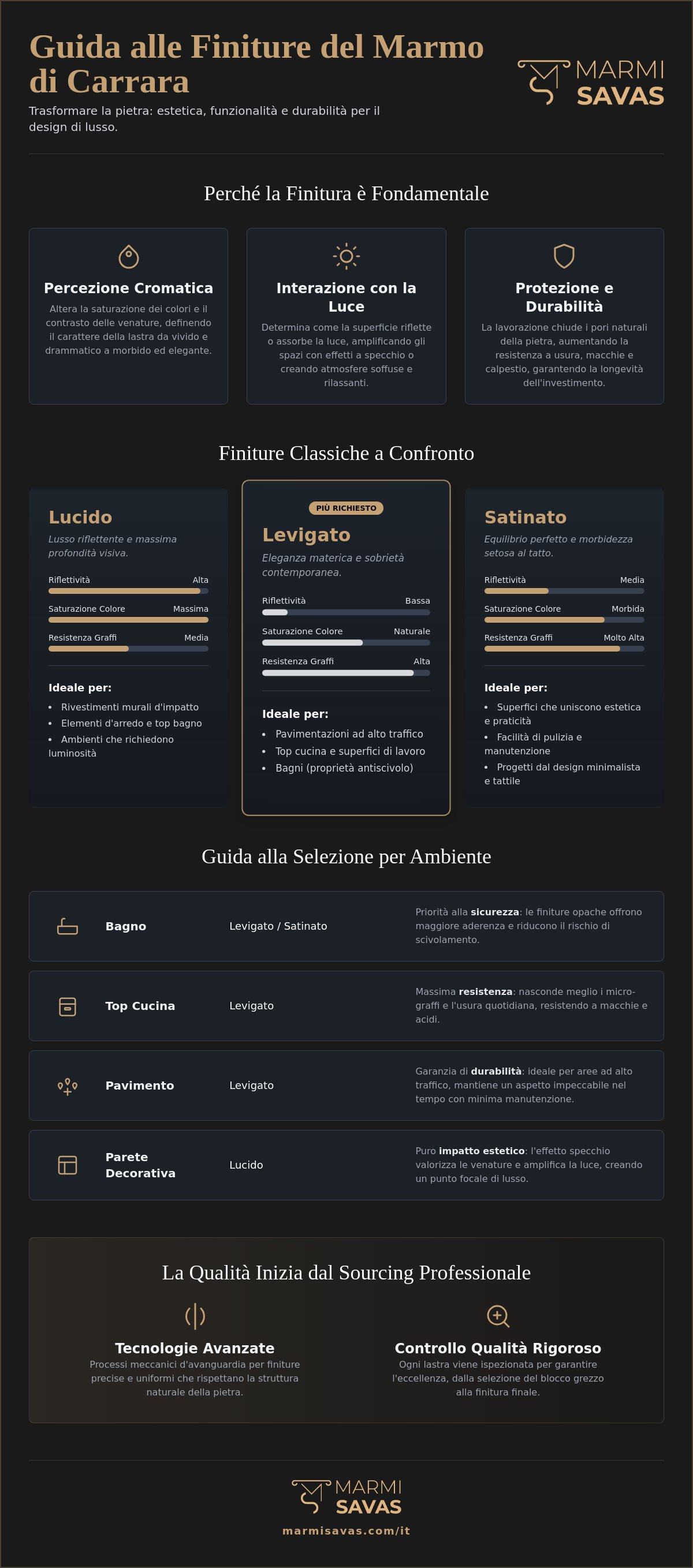
FinishAesthetic EffectLight ReflectionBest Used ForPolished (Lucido)Vivid, deep veins; high color saturation.High (Mirror-like)Feature walls, entryways, luxury flooring.Honed (Levigato)Sober, contemporary elegance; matte look.Low (Diffused)High-traffic areas, kitchen counters.Satin (Satinato)Silk-like softness; hides imperfections well.Minimal (Soft glow)Daily living spaces, bathroom floors.
The Polished Finish: When Elegance Takes Center Stage
The polished surface is the choice of excellence for dramatic feature walls and prestigious floors. Beyond the aesthetic impact, polishing acts as a natural seal. The mechanical friction of the wheels closes the stone's pores, making it less absorbent than unrefined versions. To maintain this crystalline brilliance over time, it is vital to avoid aggressive waxes or acidic detergents that could dull the marble's natural mirror. Consistent maintenance with pH-neutral products is sufficient to preserve the prestige of the original slab.
Honing vs. Satin: A Tactile Guide
While polished surfaces reflect light sharply, a honed finish diffuses it gently. This finish is preferred by architects for contemporary design projects because it eliminates distracting reflections and provides a sense of solid materiality.
Satin, on the other hand, stands out for its minimal gloss and inviting texture. It is a treatment that "hides" minor fingerprints or water spots exceptionally well, making it highly practical. The final choice often depends on balancing the atmosphere you wish to create with the room's intended use.
Modern Textures and Material Finishes
Architecture of excellence is progressively moving away from two-dimensional surfaces to embrace a tactile tridimensionality that exalts the stone's geological nature. Modern Carrara marble finishes do not just decorate; they transform the slab into a sculptural element capable of interacting with shadow and space. The integration of CNC (Computer Numerical Control) technology now allows for geometric patterns and organic textures on Carrara slabs that were once unimaginable.
However, deep textures can retain dust or residues more easily than a smooth surface. For this reason, applying high-quality water- and oil-repellent treatments is a mandatory step to preserve the chromatic integrity of Bianco Carrara without altering its natural look.
Brushed Finish: The Charm of the Lived-In Look
The brushed finish, also known as the "leather" effect, is one of the most appreciated treatments for wellness environments. Through the action of rotating abrasive brushes, the surface is worn down following the natural hardness of the veins. The result is an irregular yet soft texture, extremely pleasant to the touch. This finish is ideal for flooring in SPAs and residential wellness zones, as it provides a warm and natural feeling under bare feet.
Bush-Hammering and Sandblasting for Outdoors and Wet Areas
When a project requires maximum safety and grip, bush-hammering and sandblasting become the choices of excellence. In contract settings and luxury hospitality projects, compliance with anti-slip regulations is a mandatory legal requirement.
- Bush-Hammering (Bocciardatura): Creates a surface sculpted by small craters, offering exceptional mechanical resistance and stability even in the presence of water.
- Sandblasting (Sabbiatura): Offers a finer, more uniform roughness, ideal for those seeking a matte and material look that is less aggressive.
- Flamed Finish (Fiammato): Represents a further frontier, where controlled thermal shock causes surface crystals to pop, giving the marble a rustic yet incredibly refined appearance.
Selection Guide: The Ideal Finish for Every Environment
Selecting the right Carrara marble finish requires a vision that goes beyond immediate aesthetic impact to embrace daily functionality. There is no universally correct finish, but there is a perfect combination of material and destination of use.
Carrara Marble in the Kitchen and Bathroom
In the kitchen, the choice of finish for the countertop is crucial. Although the charm of a polished surface is undeniable, a honed finish is often the smartest solution for worktops. Kitchen life exposes marble to acidic substances like lemon or tomato, which can locally etch and dull the surface. On a honed slab, these small etches are nearly invisible, whereas on a polished mirror, they would create an unsightly contrast. Managing acidity becomes much simpler with a matte surface.
The bathroom environment, however, allows you to play with contrasts to create a true spa effect. You can opt for wall coverings in polished Bianco Carrara to amplify light and space, pairing them with flooring in a satin or brushed finish. This choice ensures greater anti-slip safety without sacrificing visual prestige.
Large-Format Flooring
Trends see the triumph of large-format slabs, where the continuity of the veins is interrupted only by minimal joints. In these cases, the flatness of the finish becomes an essential technical requirement. An imperfectly flat process would make minor unevenness between slabs visible, ruining the monolithic effect of the floor.
In commercial areas or luxury hotels, resistance to wear is the top priority. In these contexts, we prefer to recommend honed or satin finishes, as they are easier to restore in case of scratches from high foot traffic. A matte surface can be regenerated with less invasive interventions compared to a polished one.
Professional Sourcing: Finished Slabs with MARMISAVAS
The final quality of any project of excellence depends not only on the nobility of the raw material, but on the precision of its transformation. At MARMISAVAS, we consider Carrara marble finishes as the crowning achievement of a rigorous selection process that begins directly in the heart of the Apuan quarries.
The use of CNC machinery and cutting-edge polishing lines ensures perfect flatness and an uniformity of gloss that traditional artisanal processes can hardly replicate on a large scale. Every single slab undergoes a meticulous visual and technical inspection aimed at identifying and resolving any natural micro-fractures or color inconsistencies before the material leaves our warehouse.
From Quarry to Finished Slab
The competitive advantage of MARMISAVAS lies in our deep knowledge of the origin of every block. Understanding the specific geology of a given quarry section allows us to predict how the material will react to different surface treatments. We offer complete customization of Carrara marble finishes for contract projects, adapting the degree of roughness or reflectance to the specific needs of the client, while ensuring full traceability and transparency.
Advisory for Architects and Designers
We collaborate daily with architecture and design studios to transform abstract concepts into tangible surfaces. We provide a rapid sampling service, essential for creating professional mood boards and validating finishes under different lighting conditions. Our technical expertise is particularly valuable in optimizing cuts for book-matched finishes, where the precision of the finish is vital so that the veins mirror each other perfectly without visual interruptions.
Frequently Asked Questions (FAQ)
What is the difference between polished and honed finishes for Carrara marble?
The main difference lies in the degree of light reflection and the color saturation of the stone. A polished finish creates a mirror-like surface that enhances the depth of gray veins on a white background, while a honed finish offers a matte, silky appearance ideal for a understated contemporary design. Both processes use abrasive wheels, but polishing requires passes with much finer grits to completely close surface pores.
Is a polished finish too slippery for a bathroom floor?
Yes, a polished finish can become extremely slippery when wet, making it unsuitable for shower floors or main bathrooms. In these environments, we recommend opting for satin or brushed surfaces, which offer a higher coefficient of friction and greater safety. Many designers choose to use polished marble exclusively for wall coverings, pairing it with safer finishes underfoot.
How can I protect material (brushed) finishes from stains?
Protecting textured surfaces requires the periodic application of high-quality, water- and oil-repellent treatments specific to natural stone. Because brushed textures feature natural micro-cavities, they tend to retain liquids and dust more easily than a perfectly smooth surface. A professional sealant penetrates deeply without altering the natural look, creating an invisible barrier that facilitates daily cleaning.
Which finish hides scratches best on a marble kitchen countertop?
A honed finish is the most effective solution for masking small scratches and acid etching typical of daily kitchen use. On a matte surface, signs of wear blend into the natural texture, whereas on a polished countertop, they would immediately stand out as unsightly dull spots.
Is it possible to restore the polished finish of Carrara marble after years of wear?
Certainly. Carrara marble can be completely regenerated through a professional re-honing and polishing process carried out directly on-site. This is one of the great virtues of natural stone compared to synthetic or ceramic materials. Using specific machinery and polishing powders, technicians can eliminate surface scratches and dullness, restoring the slab to its original splendor.
Do sandblasted finishes change the original color of the marble?
Sandblasted finishes do not alter the chemical composition of the color, but they do modify its visual perception, making the marble look slightly lighter and paler. The roughness created by the sandblasting fragments light reflection, softening the natural contrast of the veins. This chalk-white effect is highly valued in projects seeking a pure, raw aesthetic.
What are the delivery times for Carrara slabs with special finishes?
Supply times for slabs with custom finishes typically range from two to four weeks, depending on the complexity of the project. This window allows us to perform mechanical steps with the necessary precision and conduct rigorous quality controls on each batch. For large contract projects, we coordinate logistics to ensure staggered deliveries that align with the site's progress.
Are there specific finishes recommended for Carrara marble in outdoor settings?
For outdoor applications, the most suitable finishes are bush-hammering, sandblasting, or flaming, which guarantee the necessary grip for safety. These treatments increase the surface's mechanical resistance and stability even in the presence of rain or moisture, allowing the material to effectively withstand weather agents and freeze-thaw cycles.