Difference between marble and granite: characteristics, uses, and selection criteria
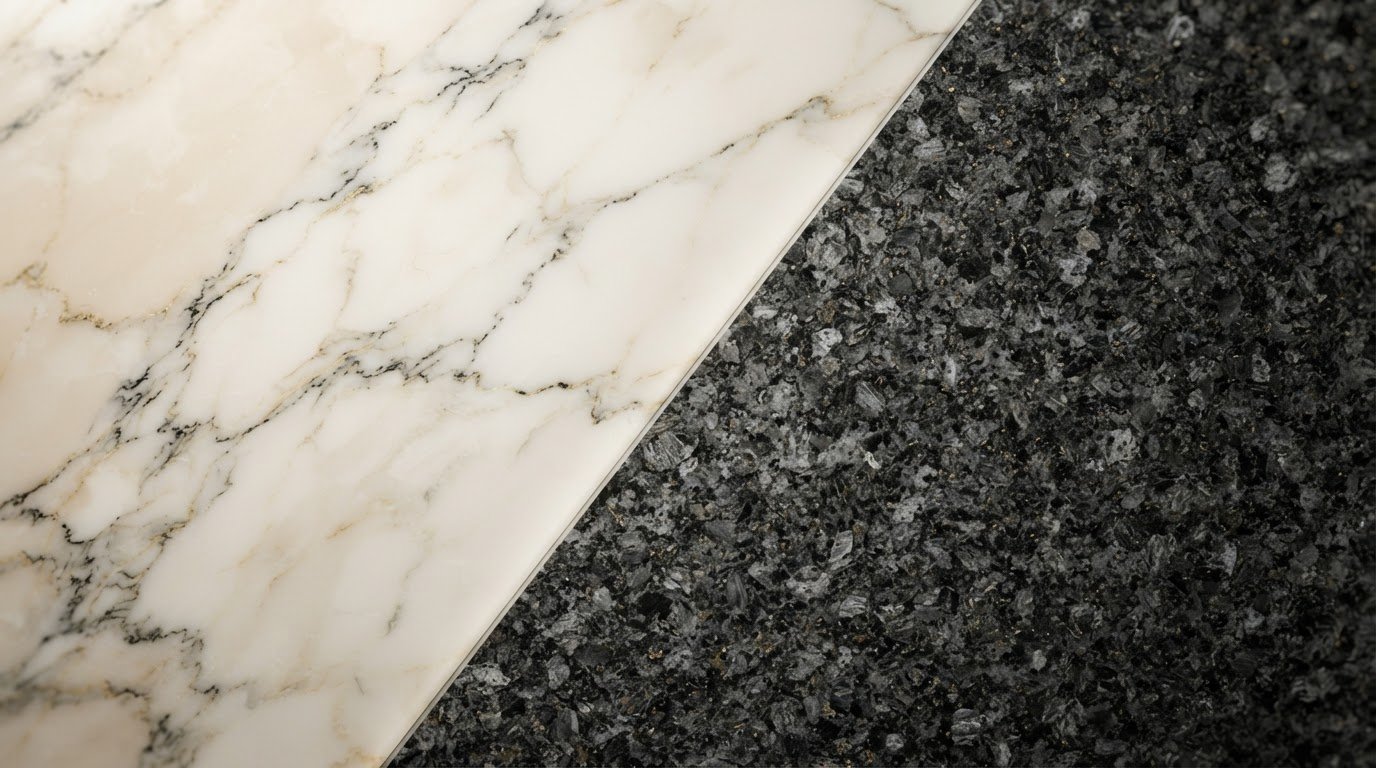
The most resistant stone is not always the best suited to the project. Understanding the difference between marble and granite means going beyond prestige or color: geological origin, composition, and behavior in daily use affect the choice as much as the visual impact. The veins and shades immediately attract attention, but a slab must also respond to the function of the surface and planned maintenance.
Marble originates from the transformation of calcareous rocks and is often distinguished by wide or delicate veining, such as that of Bianco Carrara, Calacatta, and Arabescato. Granite, on the other hand, forms from the slow cooling of magma and generally has a granular texture, with visible crystals. Performance also differs: granite is generally harder and less sensitive to acids, while marble requires more attention in contact with acidic substances and stains.
In this you will see how to recognize the two materials by origin and appearance, which characteristic values to evaluate for floors, wall coverings, and surfaces of daily use, and why there are no rules valid for every project. You will also find practical criteria for examining a natural slab, from shades to the trend of the veins, so as to choose with awareness and design consistency.
Key Points
- The difference between marble and granite is evaluated by considering together origin, structure, and aesthetic yield, not just color.
- To compare resistance, distinguish hardness, sensitivity to acids, absorption, and wear: these are different properties.
- Choose based on the function of the room, frequency of use, and desired effect, without relying on absolute rules.
- When selecting a marble slab, observe tonality, vein trend, thickness, and possible defects in relation to the project.
Index
- Difference between marble and granite: a first definition to orient yourself
- Origin, composition, and veins: what changes between marble and granite
- Marble or granite: which material is more resistant?
- How to choose between marble and granite based on the environment
- From material selection to the selection of marble slabs
Difference between marble and granite: a first definition to orient yourself
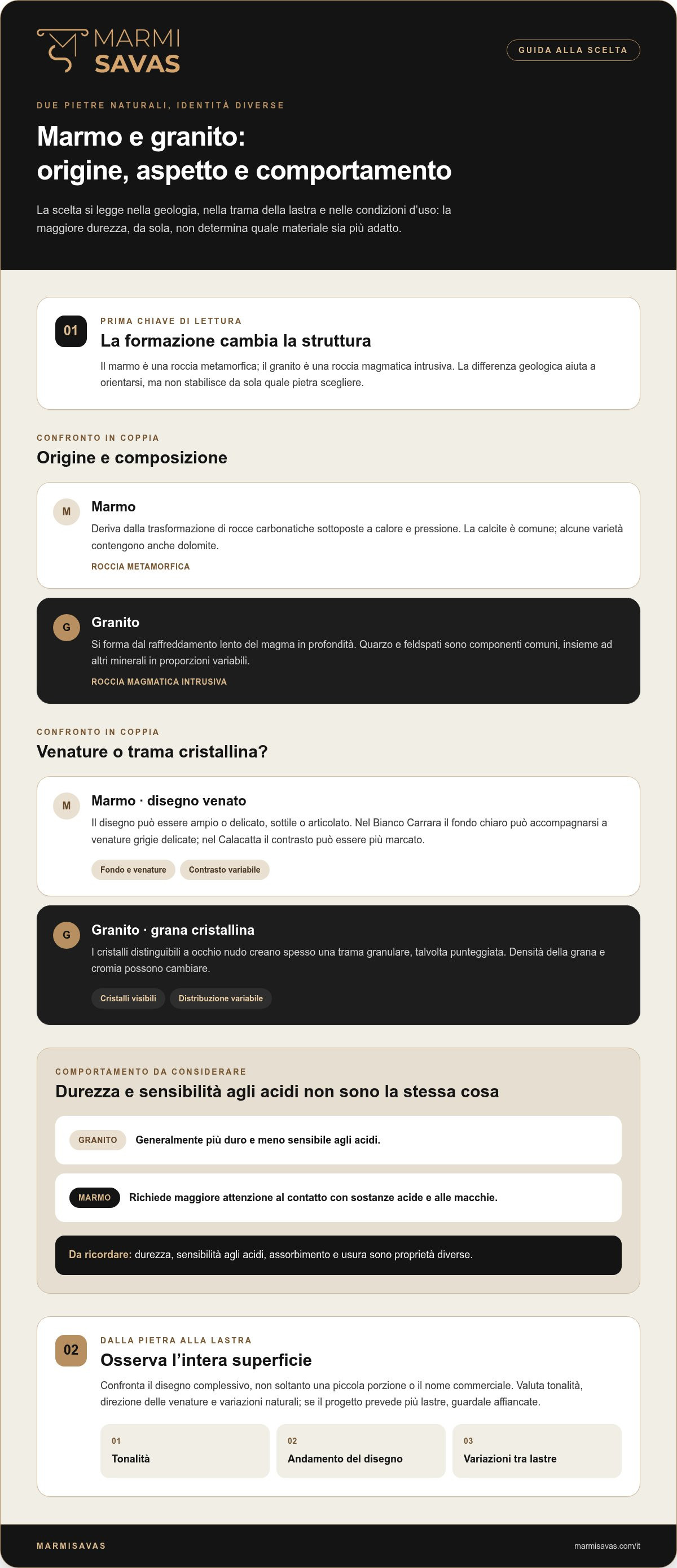
Marble and granite are natural stones, but they form through different geological processes and have characteristic compositions and structures. In short, marble is a metamorphic rock, often recognizable by its veins; granite is an intrusive igneous rock, generally identifiable by the crystals that make up its grain. This distinction helps to orient oneself, but does not alone establish which material is most suitable. The choice also depends on the aesthetic effect and the expected conditions of use.
To correctly read a slab, it is useful to distinguish three aspects: origin, which explains how the stone formed; structure and appearance, which describe what is observed on the surface; destination of use, which determines which characteristics matter in the project. Neither of the two materials is uniform like an industrial product: tonality, design, and distribution of minerals vary from one variety to another and even between slabs of the same stone. Each natural selection therefore has its own visual configuration.
What marble is and how it is formed
Marble derives from the transformation of carbonate rocks subjected over time to heat and pressure. During metamorphism, the minerals recrystallize. Calcite is a common component, while some varieties also contain dolomite. Mineral composition and inclusions contribute to defining color and design. In Bianco Carrara, for example, the light background can be accompanied by delicate gray veins; in Calacatta the contrast can be more marked. For a deeper look at formation and characteristics, it is possible to consult the Marble entry.
What granite is and how it is formed
Granite is an intrusive igneous rock: it forms when magma cools slowly at depth, giving crystals time to develop. Quartz and feldspars are common components, together with other minerals present in variable proportions. Crystals distinguishable to the naked eye often create a granular texture, sometimes dotted, different from the fluid veins associated with marble.
These visual differences guide the comparison, but do not constitute an infallible rule. Marble can feature subtle, cloudy, or articulated designs; granite can have fine grain or different chromatic contrasts. Finish and light also modify the perception of the surface. When you compare samples or slabs, therefore observe the overall design and do not stop at a small portion or the sole commercial name of the variety.
The difference between marble and granite becomes useful in the project when connecting geology to the desired yield. A surface crossed by wide veins can become a protagonist visual element; a crystalline texture instead offers a more point-like and distributed rhythm. Evaluating origin, appearance, and function together allows choosing with greater awareness, without attributing a validity-wide superiority to a stone in every situation.
Origin, composition, and veins: what changes between marble and granite
Geological classification helps to orient oneself, but does not alone anticipate the appearance of a slab. To compare materials destined for the same project, flank the general categories with what you can concretely observe: tonality, design distribution, internal variations, and relationship with surrounding surfaces. The text mentions that a table summarizes these criteria without transforming natural differences into rules valid for every variety.
Criterion of comparison Marble Granite
Geological category Metamorphic rock Intrusive igneous rock
Reference composition Carbonate minerals, with variations between variety Crystalline minerals, with variable proportions
Reading of the surface The design can cross the background with different trend and intensity The arrangement of crystals creates a texture whose density and chroma can change
Variability between slabs Background, contrast, and direction of the design can vary Tonality, distribution, and apparent size of crystals can vary
Useful control in selection Compare the overall trend of the design Evaluate the balance of the grain on the entire surface
Mineral composition and structure of the stone
Composition allows classifying a stone, but does not describe every single slab. Within the same category, mineral proportions, color, and visible structure can change. In a specification or a project sheet, therefore distinguish the geological family of the selected variety from the specific slab. The term Marble offers a general terminological reference; visual comparison should instead be conducted on the material destined for the project.
Veins, grain, and natural variations
To evaluate the design, it is not enough to recognize a vein or a grain. Observe how they distribute on the slab, if they create contrast zones and which portion will remain visible in the expected format. Two surfaces of the same variety can appear different: one more lively, the other more collected, while sharing a similar background tonality.
For a reliable comparison, look at each slab in its entirety and, if the project requires more than one, observe pieces placed side by side. Verify coherence between tonality, design direction, and variations in the various areas. Also consider the light of the space and adjacent materials, because they can change the perception of contrast.
This observation helps to choose with intention. A surface rich in variations can become a protagonist, while a more measured design can accompany other elements without competing with them. Selection is based on the concrete choice and its role in the project, not just the name of the stone.
Marble or granite: which material is more resistant?
Granite is generally harder than marble, but this does not mean it is always the most resistant choice in every situation. Performance depends on what the surface must face: impacts, frequent passage, contact with acidic substances, humidity, and cleaning methods. To correctly compare materials, distinguish the different properties and consider the specific variety, finish, and conditions of use.
Hardness and sensitivity to acidic substances
Hardness indicates a mineral's resistance to scratches, not the overall robustness of a slab. On the Mohs scale, granite generally measures between 6 and 7, while marble is placed between 3 and 4. These are typical values, not a guarantee on the performance of every variety or worked surface.
Chemical sensitivity also counts. Marbles rich in calcite or dolomite can react with acidic substances, such as lemon and vinegar, leaving opacifications or marks on the finish. Granite is generally less sensitive to acids, but it is not correct to consider it immune to any alteration. In the kitchen, for example, an occasional contact with an acidic ingredient followed by prompt cleaning does not equal prolonged or repeated exposure.
Stains, wear, and maintenance: why conditions count
Absorption and ease of cleaning vary based on the stone, finish, and any treatments. A honed and a polished surface can make different signs visible; color and pattern also influence how much a stain or scratch stands out to sight. No category guarantees the absence of wear: evaluate the chosen slab and the environment in which it will be used.
For daily care of marble, neutral pH detergents are indicated. It is preferable to avoid acidic and abrasive products, which can alter its appearance. Also for granite, choose cleaning products and methods suitable for the specific stone and present treatment, without applying a rule valid for all surfaces. Any protective treatments do not replace cleaning coherent with the material.
In practice, the difference between marble and granite on the resistance plane is not summarized in a ranking. Granite generally offers greater hardness and tolerance to acids; marble requires more attention to scratches, acidic substances, and stains, but can be well suited to environments where aesthetic yield is a priority and use is compatible with the required care. Before choosing, consider:
- The stress: frequency of passage, risk of impacts, and contact with liquids.
- The surface: variety, finish, and possible treatment of the slab.
- Daily management: cleaning products and attention that the environment allows dedicating to the material.
The most useful comparison is therefore not «which stone is more resistant?», but which material, with its specific finish and maintenance, is coherent with the intended use.
How to choose between marble and granite based on the environment
The choice part is about how the surface will be lived. A decorative wall, a hallway floor, and a countertop subject to daily use have different needs. To compare marble and granite, consider function, frequency of use, exposure to liquids or detergents, and desired visual effect. Evaluate the stone in the specific variety and finish: the name of the material alone is not enough to establish suitability.
For tops, bathrooms, and surfaces subject to daily use In the kitchen, consider contact with food, oil, beverages, and acidic substances, as well as cleaning frequency. Granite is often considered for its hardness and lower sensitivity to acids; marble can be chosen for the depth of the veins and the character of the surface, keeping in mind the greater care required for products and stains. Functional priority does not exclude aesthetic priority, but helps establish a compromise that is consistent with the project. In the bathroom, evaluate recurring exposure to water, cosmetics, and detergents. For both materials, finish and treatment affect appearance and care; indications must refer to the chosen stone, not to a general rule. Also consider how natural or artificial light reflects on the surface and what you want to highlight in the slab's pattern.
For floors, walls, and interior design projects For a floor, passage frequency and visual continuity are central criteria. Slab size, vein layout, and light can make a space feel more compact or more fluid. To learn more about design variables related to stone selection, consult the guide to marble floors. On a wall, marble can enhance wide and contrasting veins, while many granite varieties feature a more point-like and distributed crystalline texture. The choice depends on the surface's role in the environment: scenic presence, balance with other materials, or discrete visual background. If the project requires light shades, white marbles offer different designs, from a luminous background with delicate marks to more marked veins.
Before deciding, focus on these elements:
- Function: identify the type of surface and expected stresses.
- Exposure: consider water, food, products, and cleaning.
- Aesthetic effect: choose between protagonist veins and crystalline texture.
- Care: match finish and maintenance to usage habits.
Thus, the difference between marble and granite becomes a design criterion, not a choice based on an assumed absolute superiority. Share your project requirements to direct the selection of marble slabs towards coherent shades, veins, and applications.
From material selection to marble slab selection Once the material most consistent with the environment is identified, the choice moves to the single slab. Color, natural pattern, and technical characteristics become concrete project elements. The difference between marble and granite guides the comparison, but accurate selection requires evaluating the specific stone, its destination, and the desired visual result.
What details to observe in the natural slab Start from the intended use and surface dimensions. These elements help establish which format and thickness are consistent with the application, without relying on standard measures valid for every project. Then observe the slab as a whole: a subtle vein on a sample can take on a dominant role when extended over a large surface.
The evaluation takes a few practical steps:
- Define the desired effect: establish whether you prefer protagonist veins, a more delicate design, or a uniform tone.
- Examine direction and continuity: observe how veins cross the slab and whether their flow accords with the design of the project.
- Compare shade and light: consider natural variations alongside room lighting and already provided materials. Light can make the background appear warmer, cooler, or more luminous.
- Evaluate thickness and surface: relate them to the planned application and chosen finish.
- Check stone conditions: identify potential visible defects and evaluate their position regarding use or cut outcome.
A natural slab should not be judged based on a single detail. Background tone, vein distribution, and chromatic variations define its overall character. Comparing multiple slabs under similar light makes the relationship between each surface and the project clearer.
A coherent selection with the project vision The final slab connects aesthetics, destination of use, and maintenance. Calacatta can offer a light background crossed by marked and scenic veins; Bianco Carrara is appreciated for its luminosity and more delicate marks; Arabescato features articulated designs, with contrasts that vary depending on the slab. These varieties show how marble can interpret distinct project atmospheres, without the name substituting the physical material.
MARMISAVAS specializes in supplying marble slabs and natural stones for interior design and architecture projects. Selection considers the visible characteristics of the slab and their relationship with the planned application, to help translate design vision into a coherent material choice. To guide slab selection based on your project requirements, contact MARMISAVAS.
From criteria to a choice that enhances the project The choice of stone defines room character and guides the relationship between light, proportions, and surrounding materials. The difference between marble and granite offers a starting point; the decisive step is translating project needs into a concrete selection that unites daily use and aesthetic identity. Before defining the selection, gather visual references, identify surface dimensions, and clarify what role the stone should play: discrete element of continuity or distinctive presence. Comparing these intentions with slab characteristics helps build a harmonious whole. The choice thus acquires value not only for the single surface, but also for the dialogue it creates in the space.
MARMISAVAS supplies natural slabs for interior design and architecture projects. Share your project with MARMISAVAS to identify marble slabs most consistent with your vision, across shades, veins, and applications.
Frequently asked questions about the choice between marble and granite
Is granite always more resistant than marble? No, it is not a rule valid for every project. To decide, first identify the stresses the surface will face and the level of care the environment requires. Then compare variety characteristics and specific finish; these help evaluate the concrete case better than a general claim about the category.
How to recognize marble from granite with the naked eye? Appearance can suggest a distinction, but it is not always enough to identify a stone with certainty. A photograph, in particular, can alter colors and contrasts. It is preferable to examine the full slab live and also consider its commercial identification and material documentation. If the choice involves multiple surfaces, noting the selected slab reference helps maintain consistency in subsequent selections.
Are marble and granite both natural stones? Yes, both are natural stones. The difference in origin is useful in project choices and material description, but to compare two specific options, the proposed variety and slab must also be considered. Reporting the material name correctly in documents helps designers, clients, and stone professionals refer to the same product during selection and surface planning.
Can marble and granite be combined in the same project? Yes, if the pairing is defined as part of an overall composition. Establishing which surface will have greater emphasis helps choose a shade or finish for the other that does not create involuntary contrasts. Before finalizing selection, place samples next to wall colors and planned furnishings and observe them under room lighting.
Does marble stain more easily than granite? It is not possible to predict behavior based solely on the stone's name. To limit daily usage inconveniences, keep care indications associated with the variety and chosen treatments. In case of spills, remove the liquid with a soft cloth and avoid rubbing with random products. Then follow instructions suited to that specific surface: proper maintenance starts with knowledge of the specific slab.
Which material enhances a luxury project more? The most effective choice is the one that supports space hierarchy. Before deciding, define whether the stone should be the focal point or accompany other already prominent elements. Evaluate samples next to project materials and observe the effect under natural and artificial light. Also consider scale: a subtle motif on a sample can take on greater presence on an extended surface.
Are marble veins all equal across slabs? No, design can change from one slab to another. If the project includes contiguous surfaces, compare pieces together and plan layout before cutting. For a book-matched composition, evaluate in advance which slabs to pair side by side and how to orient them; you can then decide whether to seek continuity or create an intentional contrast. Keeping selected slab references facilitates coordination in later phases.