Gray Marble for a Modern Bathroom: Selection Guide
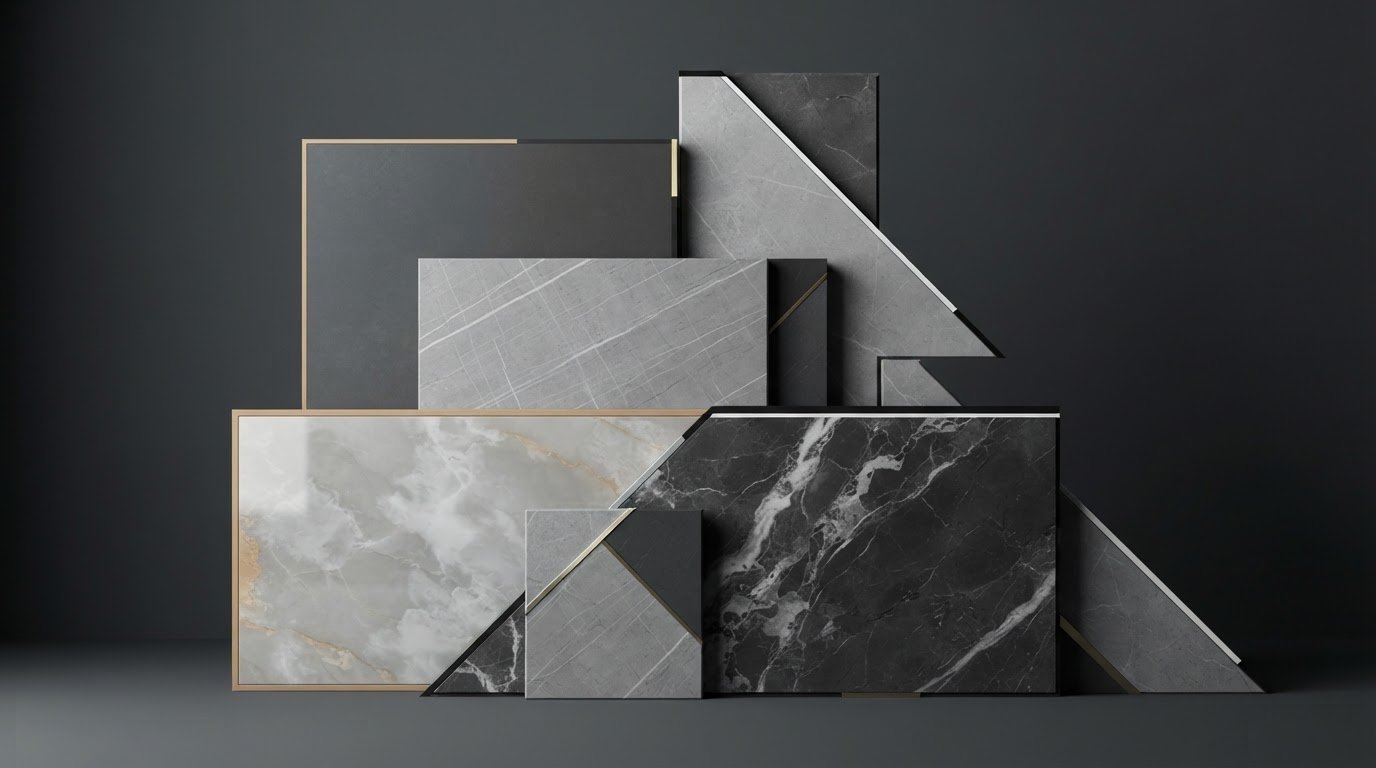
The most intense gray marble is not always the best choice for a modern bathroom: an elegant shade on the slab can appear different depending on the light and surrounding finishes. Choosing gray marble for a modern bathroom therefore means considering color, veining, finish, and context together. It is natural to have doubts: some varieties feature soft, clouded shades, while others have more marked designs. The finish can also change the perception between marble, wall tiles, and faucets. This guide helps you compare different expressions of gray marble, from Bardiglio to Grigio Carnico, and evaluate which finish is most coherent with the intended use. We will see how to read tones and veining in relation to the bathroom palette and why observing the slab as a whole is important before defining the project. You will thus be able to approach the choice with aesthetic and practical criteria, verifying the characteristics of the selected variety.
Key Points
- Evaluate how a light, medium, or dark gray can modify the perception of space and the balance of the bathroom.
- Compare tones and the flow of veining to anticipate the visual effect and possible combinations.
- Choose gray marble for a modern bathroom by considering the palette, light, finish, and intended use together.
- Examine the slab as a whole: natural variations make it important to evaluate the continuity of the design and the characteristics of the material.
- Compare gray, white, and black marble based on the project, without taking for granted that any palette suits every bathroom.
Index
- Why choose gray marble for a modern bathroom?
- Veining and finishes: how gray marble changes in the bathroom
- Gray, white, or black marble: how to compare bathroom palettes
- How to evaluate a marble slab before choosing
- From gray marble slabs to the choice for your bathroom
Why choose gray marble for a modern bathroom?
Gray marble features natural variations in tone and veining: the design of each slab contributes to the character of the project. For a definition of marble and further insight into its origin, you can consult the encyclopedic entry on marble. In the bathroom, the choice of gray does not depend solely on color: light, the dimensions of the room, and the role you want to assign to the stone also matter.
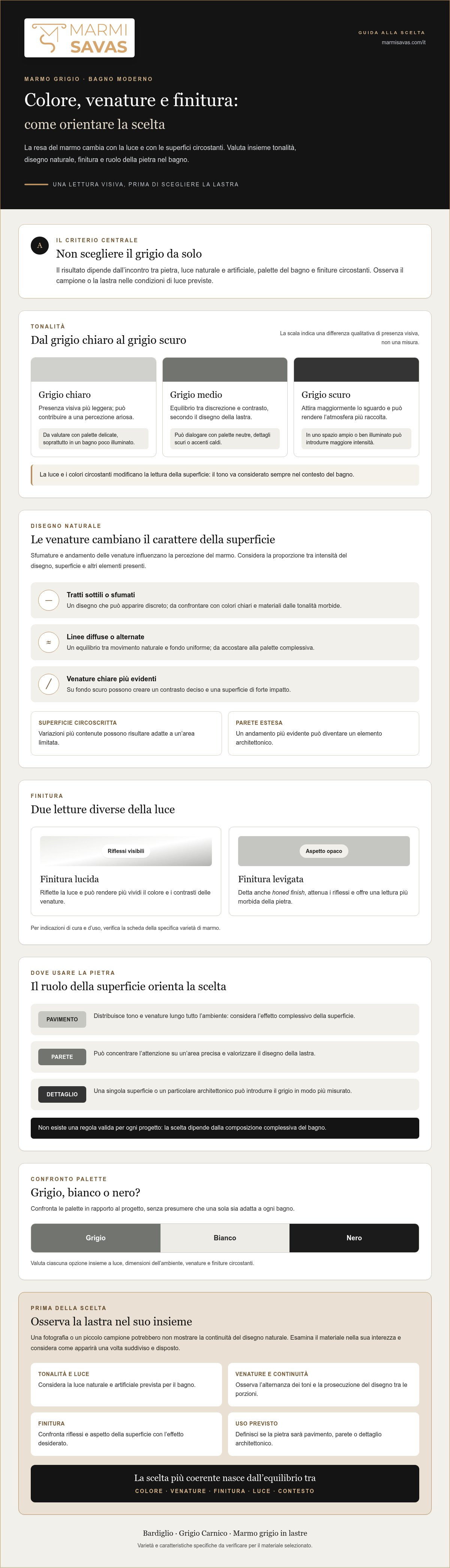
Light shades have a lighter visual presence and can contribute to an airy perception. Medium ones create a balance between discretion and contrast, while a dark gray tends to draw the gaze more and can make the atmosphere more intimate. These are effects to be evaluated in context: natural and artificial light, together with surrounding colors, modify the reading of the surface.
What atmosphere does gray marble create in the bathroom?
In a poorly lit bathroom, a light background can maintain a more open visual sensation, especially when paired with a delicate palette. In a spacious or well-lit space, a deep shade can introduce greater intensity without necessarily dominating the entire environment. Gray marble for a modern bathroom can be the protagonist or accompany materials and colors already present. Before choosing, observe the sample or slab under the anticipated light conditions.
Which surfaces best enhance the stone?
The floor distributes tone and veining throughout the room; a wall, on the other hand, can concentrate attention on a precise area. For a more measured intervention, evaluate a single surface or an architectural detail. In this way, gray can dialogue with other finishes without becoming the visual center of the bathroom. The choice depends on the overall composition, not on a rule valid for every project.
The continuity of the stone and the arrangement of the veining guide the gaze. A wide design can have more presence on an extended wall, while more contained variations can be suitable for a circumscribed surface. Think about the application before selecting the slab and consider how the design will appear once divided and arranged. MARMISAVAS supplies gray marble slabs to be evaluated according to project requirements; specific formats and finishes must be verified for the chosen material. To explore available varieties, consult the page dedicated to gray marble.
Veining and finishes: how gray marble changes in the bathroom
The color of a slab tells only part of its character. In gray marble, veining, shades, and finish change the perception of the surface and the way it dialogues with light. To choose judiciously, observe the material as a whole: a photograph or a small sample might not show the continuity of the natural design.
- Light gray, thin or subtle strokes: Delicate presence, with a design that can appear discrete, combined with light colors and materials with soft tones.
- Medium gray, diffuse or alternate lines: Balance between natural movement and uniform background, combined with neutral palettes, dark details, or warm accents.
- Dark gray, light veining more or less evident: Decisive contrast and high-impact surface, combined with more measured surrounding finishes to be verified in bathroom light.
Delicate or marked veining: which design to prefer?
In a bathroom of contained dimensions, thin veining can keep the design visually composed. On an extended wall, a more evident flow can instead become an architectural element. It is not an absolute rule: the proportion between surface, design intensity, and other present elements matters. Evaluate the entire slab and, if the project involves multiple elements, consider how the veining continues from one portion to another.
A single image can show only a detail, without returning the alternation of tones or the continuity of the design. Examining the slab as a whole helps to understand which part will be visible on the chosen surface.
Glossy finish or honed finish for a contemporary aesthetic?
The glossy finish reflects light and can make the color and contrasts of the veining more vivid. The honed finish, also known as honed finish, has a matte appearance and subdues reflections, giving the stone a softer reading. The choice is primarily aesthetic: for care and use instructions, check the data sheet of the specific marble variety.
The veining defines the rhythm of the marble, while the finish guides its reading through light and reflections. For further ideas on marble in contemporary interiors, Archiproducts collects examples of application in various environments. You can compare gray marble slabs with the criteria of your project and share your selection requirements with MARMISAVAS.
Gray, white, or black marble: how to compare bathroom palettes
The choice between gray, white, and black marble does not boil down to brightness: each color creates a different relationship between surfaces, contrasts, and details. Gray occupies an intermediate position, but can appear delicate or decisive based on the shade and veining. White tends to give greater prominence to light and can create continuity with a light palette; black introduces a more intense visual accent.
To orient yourself, start from the overall effect you want to obtain, then evaluate how woods, metals, and neutral colors dialogue with the marble. A wooden element can introduce a warm note, while metallic details or neutral surfaces can accompany sharper contrasts or maintain a measured ensemble. These are design cues, not mandatory combinations: the result depends on the actual shades and the light of the environment.
- Luminous bathroom: evaluate a light, gray, or white marble, and observe how its veining integrates with surrounding colors.
- Contrast bathroom: pair gray with darker details or consider black marble as an accent, verifying balance with light surfaces.
- Tonal bathroom: combine close shades of gray and neutrals for a coordinated effect, paying attention to differences in tone and design.
Gray and white marble: contrast or continuity?
White can act as a counterpoint to gray veining and make the design more legible. It can also contribute to a clear and continuous composition, if background and details are chosen with care. To compare varieties, consult the selection of white marble. Bring samples or slabs close to the actual palette of the project: observe the colors of walls, woods, and metals together in the anticipated light, instead of relying solely on separate images.
Gray and black: how much contrast is needed?
Black marble can accentuate the contrast with gray surfaces and draw the gaze. If you insert it on a circumscribed surface, the effect can be more controlled compared to an extended presence. Before defining the palette, consider how much light the bathroom receives and balance dark shades with lighter elements, coherent with the project. Gray marble for a modern bathroom is not a better choice compared to white or black: it is a solution to be evaluated in relation to proportions, light, and desired character.
How to Evaluate a Gray Marble Slab Before Choosing
A proper evaluation starts with the project, not with a tone observed in isolation. Choosing gray marble for a modern bathroom means first defining the intended surface and the role it will play. Then, compare the color, veining, and finish with the design and palette of the room. The natural slab presents its own variations: examining it as a whole helps to get a more precise idea of the visual result.
- Use case: clarify whether the marble is intended for the floor, a wall, or a circumscribed surface.
- Tone: compare the tone of the slab with the colors and lighting provided in the project.
- Veining: observe the flow, intensity, and distribution of the design across the entire surface.
- Finish: check the appearance of the workmanship and the care instructions associated with the material.
- Visual comparison: evaluate the slab side by side with other samples and the project drawing whenever possible.
What Technical Criteria Should Be Observed in the Slab?
The qualitative examination of the slab can include certain technical criteria: color uniformity, veining flow, thickness, and the presence of visible defects. These are aspects to be evaluated in relation to the specific variety and the information available on the material, without assuming that all marbles share the same characteristics. Compare the slab with the planned dimensions and design, and ask the supplier to clarify any identified natural variations. A photograph can be useful for an initial comparison, but it does not always reflect the proportions, shades, and continuity of the entire surface. Examining the complete slab is particularly important even when the design will not play a central role in the bathroom.
How to Envision the Arrangement of Veining?
If the project involves adjacent surfaces, consider where the veining will fall and how it will be perceived near the joints. The bookmatch technique consists of placing sequential slabs side by side in a mirrored fashion to create a reflected design, when the material and the project allow it. Feasibility must be verified on the specific selection; it is not a given feature for every slab. If the marble is also planned for the floor, evaluate the visual continuity together with the arrangement of the elements and the finish. The material data sheet can help you verify the use and care instructions. Share your selection criteria with MARMISAVAS to compare your project requirements with available slabs.
From Gray Marble Slabs to the Choice for Your Bathroom
To move from inspiration to a concrete choice, combine aesthetic and project requirements in a single framework. Define the palette, establish whether the marble will be used on a wall, floor, or multiple coordinated surfaces, then compare the tone, veining, and finish of the slabs. Also consider the technical information and care instructions of the selected variety. Slab selection must consider tone, design, and context together. A balanced veining on a circumscribed surface can assume a different role on an extended wall. Tone can also change perception when combined with the actual materials and effective colors of the bathroom.
What Information Should Be Prepared Before Comparing Slabs?
Gather reference images and palette samples, specifying the expected colors, woods, and metals. Indicate the surfaces of interest and the dimensions of the project: knowing whether the marble concerns a wall, the floor, or both helps to evaluate the layout and continuity of the veining. Also note your preferences on the design, for example a discreet or more evident flow. Share this information with the supplier and verify what information is available for each option: material characteristics, formats, finishes, and the availability of the specific slab. This way, you can compare relevant alternatives without taking for granted that every variety has the same characteristics.
How to Proceed with a Specialized Supplier?
MARMISAVAS supplies marble and natural stone slabs and tiles for residential and commercial projects; its activity concerns the supply of materials. The category dedicated to gray marble in slabs is a starting point to identify relevant materials. Formats and finishes must be verified for the specific selection. Before defining gray marble for a modern bathroom, share the planned surfaces, the palette, and the criteria with which you are comparing the slabs. Contact MARMISAVAS to explore options consistent with your project and evaluate the material considering the slab as a whole.
Define the Choice with the Project Ahead
Gray marble for a modern bathroom is chosen by evaluating tone, veining, finish, and light together. The palette must dialogue with the other surfaces, while the intended application helps to understand which design will best enhance the slab. Examining the material as a whole allows you to consider its natural variations before defining the project. Prepare reference images, indicate whether you foresee floors, walls, or coordinated surfaces, and clarify which characteristics of the slab you want to explore further. MARMISAVAS specializes in the supply of natural stone slabs and tiles. Formats, finishes, and availability of the specific selection must be verified based on project requirements. Share your project criteria to compare your needs with a specialized supplier and explore relevant options. Careful evaluation of the slab helps you move towards a choice coherent with the character of the bathroom and the overall vision.
Frequently Asked Questions on Gray Marble in the Bathroom
Is Gray Marble Suitable for a Modern Bathroom?
Yes, gray marble can fit into a modern bathroom when tone, veining, and finish are coherent with the light and palette of the project. Natural shades offer different expressions, from a delicate design to a more marked one. It can characterize a wall or accompany other surfaces in a more measured way. The choice depends on the desired effect and the specific slab.
What Tone of Gray Marble Should Be Chosen for the Bathroom?
Choose the tone considering the dimensions, lighting, and colors present in the bathroom. A light gray can have a more discreet visual presence, while a dark tone creates a more decided accent: intermediate shades offer a balance between the two. Observe the slab next to the palette samples and, if possible, in the anticipated light: the context can modify perception.
Glossy Gray Marble or Honed Finish in the Bathroom?
It depends on the aspect you desire and the use instructions of the chosen material. The glossy finish reflects light more and can make color and veining more evident; the honed finish, also known as honed finish, is matte and subdues reflections. To compare them, evaluate samples or slabs with the project light and check the data sheet of the specific variety for care instructions.
Can Gray Marble Be Paired with White Marble?
Yes, gray marble and white marble can be paired to create contrast or continuity, depending on the tones and designs of the slabs. White can bring out the gray veining, while neighboring tones can give the composition a more uniform aspect. Before deciding, compare the slabs or samples with the colors, woods, and metals planned in the bathroom.
How to Evaluate a Gray Marble Slab Before Purchasing?
Examine the entire slab and compare it with the use and design of the project. Observe tone, distribution of veining, thickness, and visible defects, asking for information on the specific characteristics of the material. Also evaluate the finish and visual continuity if coordinated surfaces are planned. A photograph can help in the initial comparison, but it does not replace the verification of the selected slab.
Does Gray Marble Require Special Maintenance in the Bathroom?
Maintenance instructions depend on the variety of marble and the finish, so it is advisable to consult the data sheet of the chosen material. Before purchasing, ask which products and cleaning methods are indicated for that specific stone and what attentions are recommended in the bathroom environment. Do not take for granted that all gray slabs have the same characteristics or require identical care.
Where Can You Buy Gray Marble in Slabs for a Bathroom?
You can turn to a specialized supplier in slabs and natural stones, like MARMISAVAS, which also deals with gray marble for residential and commercial projects. Before choosing, describe the planned surfaces and aesthetic criteria of the bathroom, then verify the characteristics and availability of the specific slab. Consult the selection of gray marble in slabs as a starting point.