How to Enhance a Backlit Marble Wall: 2026 Guide
To enhance a backlit marble wall, it is necessary to combine high-translucency slabs, with a thickness between 10 and 15 mm, an opaque LED frame spaced at least 5-8 cm. The careful selection of the material and the custom design of the lighting structure define the final aesthetic rendering of the work. The financial outlay depends on the rarity of the stone material, the extent of the surfaces, and how complex the installation is. Before ordering slabs or preparing the system, it is advisable to clarify three choices:
Key Points
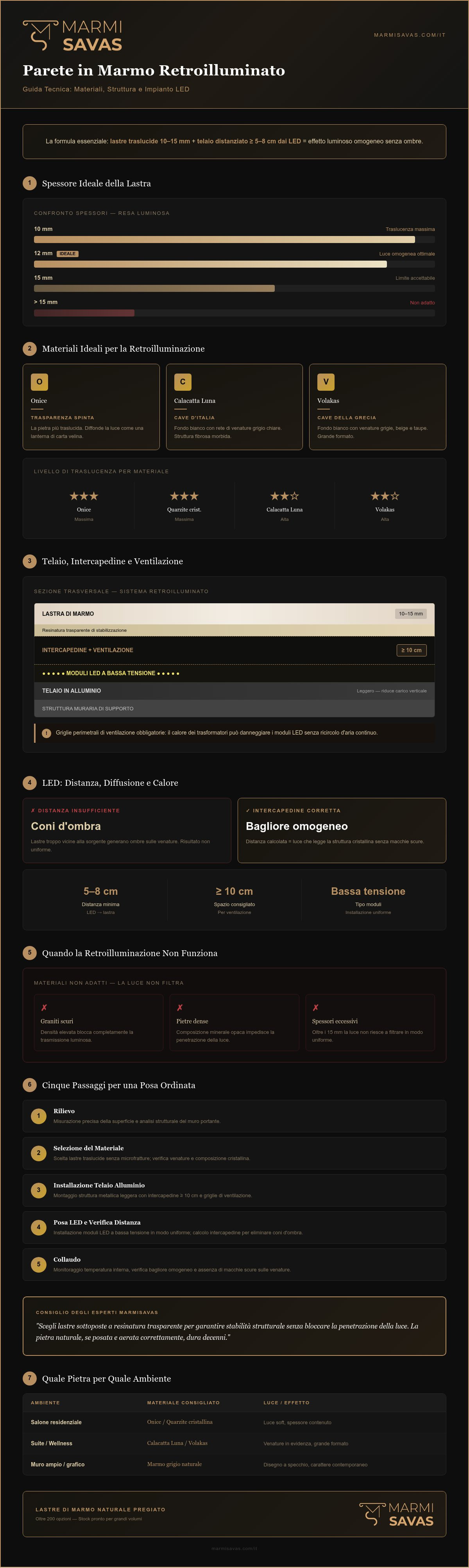
- Choose slabs with a thickness reduced to 12 mm to guarantee optimal luminous homogeneity.
- Avoid backlighting on dark granites or dense stones since the light would not filter through.
- Use onyx, Calacatta Luna, or Volakas to obtain the maximum possible natural translucency.
- Provide perimeter ventilation grilles to prevent the heat of the LED from damaging the stone.
Index
- Thickness and translucency: how to choose the right stone for your wall
- Onyx, Calacatta Luna, and Volakas: materials that let light through
- Frame, thickness, and ventilation: what supports the illuminated slab
- LED behind the slab: distance, diffusion, and heat control
- From survey to testing: five steps for an orderly installation
- Low voltage system and items that make up the budget
- When the backlighting does not deliver: dense stones and excessive thicknesses
Thickness and translucency: how to choose the right stone for your wall
The luminous translucency of the material determines the luminous yield of a backlit marble wall. In three recurring situations, the choice is oriented as follows: for a residential living room with soft light, prefer onyx or crystalline quartzite in a contained thickness; for a suite or a wellness area with prominent veins oriented towards Calacatta Luna or Volakas in large-format slabs free of microfractures; if the wall is large and you want a more graphic character, evaluate natural tones and a mirrored design that unifies geometric traits. Working on projects we see that the selection of the reduced thickness to 12 mm amplifies the homogeneity of the diffuse light. A thin slab minimizes internal shadows and enhances chromatic tones. Compact stones like onyx or crystalline quartzite guarantee reliable light transmission for exclusive environments. To access the most precious materials you can consult the page dedicated to Carrara white marble and evaluate the single blocks. Structured stones with dense veins create intense graphic contrasts, similar to fluid traces left by water. The installation of the wall requires large-format slabs free of visible microfractures. The design of the mirrored drawing unites geometric traits for a scenographic impact. The structural consistency of the chosen stone determines the final aesthetic balance of the room.
Onyx, Calacatta Luna, and Volakas: materials that let light through
The marmorean materials and onyx represent the suitable choice for backlighting, because they let light pass through their own minerals. Selected from the quarries of Italy of reference, Calacatta Luna distinguishes itself for its soft fibrous structure and rounded background on a white background, embellished with a network of light gray veins. Extracted from the quarries of Greece noted for this material, Volakas offers a white background ornamented with gray, beige, and taupe shades. For those looking for particular chromatic tones, the gray marble slabs of natural selection allow creating walls with a decisive and contemporary character. Onyx gives an extreme transparency, while gray marble offers a structured luminous elegance.
MaterialProvenanceVisual characteristicsCalacatta LunaQuarry of ItalyWhite background with network of light gray veinsVolakasQuarry of GreeceWhite background with gray, beige and taupe veinsGray marbleNatural selectionElegant gray tones for scenographic walls
The internal structure of the marble diffuses light like a tissue paper lantern. The vertical wall becomes a dynamic visual background thanks to the use of natural stone. Marmisavas selects the veins most suitable for emphasizing light diffusion in luxury interior spaces.
Advice
Choose slabs subjected to transparent resin coating to guarantee structural stability without blocking the penetration of light.
Frame, thickness, and ventilation: what supports the illuminated slab
A scenographic cladding requires a resistant metal substructure and a minimum space of ten centimeters. This space houses the LEDs and guarantees ventilation. The aluminum frame, light compared to other metal solutions, reduces the vertical load on the supporting structure. Large-format slabs need a reduced thickness of a few millimeters to let light pass through. When selecting Carrara white marble slabs, transparency depends on the veins and crystalline composition. The structure must support the weight without flexing. A few considerations: the caliber of the transformers behind the flat panel lacks LED perimeter rings. A continuous circulation protects electronic components and the internal temperature during design. Backlighting enhances candid tones and raking light reveals details that remain flat with front lighting. Thin marble requires delicate maintenance; natural stone, if installed and aerated correctly, lasts for decades.
LED Behind the Slab: Distance, Diffusion, and Heat Control
The backlighting of natural stone requires low-voltage LED modules installed uniformly behind translucent large-format slabs. In the laboratory, a recurring issue occurs: beautiful slabs placed too close to the source generate shadow cones on the veins; the gap between the LED and the stone is then recalculated, resulting in a homogeneous glow that reads the crystal structure without dark spots. During processing, we verify that the distance between the light source and the stone slab determines the final homogeneity of the visual effect. A well-calculated gap prevents the formation of unpleasant shadow cones on the veins. Translucent stone diffuses light in a controlled manner, transforming surfaces into living works of art. To achieve this scenographic result, it is necessary to choose stone materials with specific crystalline transparency characteristics. The Carrara and Calacatta selections offer valuable options for luxury projects. Backlighting functions like a natural prism. Dimmable LED systems allow modulating light intensity and enhancing the chromatic depth of natural rocks. Thin acrylic panels coordinated with the diodes ensure constant diffusion. Adequate heat dissipation preserves the resin and stone over time.
From Survey to Testing: Five Steps for an Orderly Installation
Rigorous site planning ensures the correct installation of a luminous wall. During the technical preparation of projects, we often notice that millimetric precision prevents unsightly internal shadows. Coordination between the stonemason and electrician guarantees a final result free of visual defects.
- 1. Executive survey: Measure the supporting structure and verify the flatness of the support wall.
- 2. Material selection: Select large-format slabs by evaluating the veins to optimize light transmission.
- 3. Lighting setup: Install LED modules with adjustable color temperature behind the main framework.
- 4. Cutting and testing: Carry out the processing by applying the mirrored design technique for coherent visual continuity.
- 5. Installation and testing: Fix the natural stone panels and verify the overall luminous yield.
Preparing the metal structure is like building the frame of a master painting: every millimetre counts to support the weight and eliminate shadow areas. It is advisable to use inspectable frames to simplify future maintenance of the lighting fixtures. If you fear that the light source will heat the surface too much, modern low-voltage LED systems emit negligible heat and safeguard the stone.
Low Voltage System and Items That Make Up the Budget
The installation of a backlit wall requires a dedicated low-voltage electrical system with isolated transformers to guarantee safety. This arrangement protects the natural stone structure, such as Calacatta marble or arabescato, avoiding the overheating of the rear LED panel.
In the laboratory, we often see how the positioning of electrical drivers influences the work's yield. Adequate ventilation prevents the premature degradation of the luminous modules installed behind the large-format slabs. Planning these components favors an orderly home automation integration and the scenographic management of light intensity. The choice of electrical systems directly affects the overall complexity of the site. The future accessibility of transformers deserves attention on-site: hiding electrical components inside inspectable niches avoids unnecessary demolitions in case of maintenance. Precise installation requires qualified technicians to enhance the page dedicated to Carrara white marble and evaluate individual blocks. To define the exact budget of your work, ask the specialists for a personalized quote.
When Backlighting Does Not Deliver: Dense Stones and Excessive Thicknesses
Backlighting is discouraged on opaque and very thick stones. When evaluating high-density options like certain dark granites, the light simply does not pass through. In the laboratory, we often notice this design error: the dense crystal structure blocks the light beam.
Using light on dark backgrounds creates only an unsightly perimeter halo. This effect frustrates the desired scenographic result and disperses resources. For compact materials, external projectors enhance the surface in a markedly superior way. The satin finish stands out when illuminated frontally. Backlighting should be reserved for translucent large-format slabs like onyx or certain light marbles, where the veins capture the internal ray and enhance the environment.
Details and request: MARMISAVAS.
Frequently Asked Questions
What is marble backlighting?
Marble backlighting is a decorative setup that projects light through translucent natural stone slabs. The solution enhances the veins, transforming vertical walls into scenographic and luminous surfaces.
Which natural stones are used for backlighting?
Onyx and precious marbles with high crystallinity are the natural stones suitable for backlighting. Volakas marble, extracted from the quarries of Greece renowned for this material, offers a white background embellished with gray and beige tones. Calacatta Luna marble, coming from the reference quarries of Italy, features a texture of soft and rounded fibers on a light background that offers special shades.
How does LED lighting work on marble/onyx?
High-efficiency LED panels are positioned directly behind the natural stone surface, with a homogeneous diffusion of the light beam. The glow highlights chromatic continuity and the visual depth of the raw material. A resin treatment can be applied to the slabs to improve mechanical resistance without altering the final aesthetic yield.
Where are backlit marble and onyx walls used?
A backlit marble wall finds placement in luxury interior environments such as residential living rooms, hotel suites, wellness areas, and accent walls. Marmisavas offers these natural stones for high-profile architectural claddings, with a final effect of strong visual impact and lasting charm.
How is a backlit surface maintained?
Maintenance requires regular cleaning with non-abrasive neutral detergents and soft microfiber cloths to preserve the stone's shine. Acidic substances that could dull the polished surface must be avoided. The initial inspection of the slab's quality also ensures the structural integrity of the system over the years.
A Luminous Atmosphere for 2026
Returning to the starting questions (which stone, which thickness and frame, when to avoid backlighting), a backlit marble wall transforms the interior space into a scenographic work of art only if translucency, gap, and system dialogue with each other.
The transparency of the selected slabs enhances the veins with chromatic shades of great visual impact. Extraction from precious deposits, like the provenance of Volakas marble or the quarries of the Italian Alps, ensures lasting elegance. In 2026, Marmisavas consultants accompany architects and designers in choosing translucent materials suitable for scenographic walls.
To explore the selection and receive personalized technical assistance for your project, contact the specialists and request a custom quote.