Italian natural stones for floors: selection guide
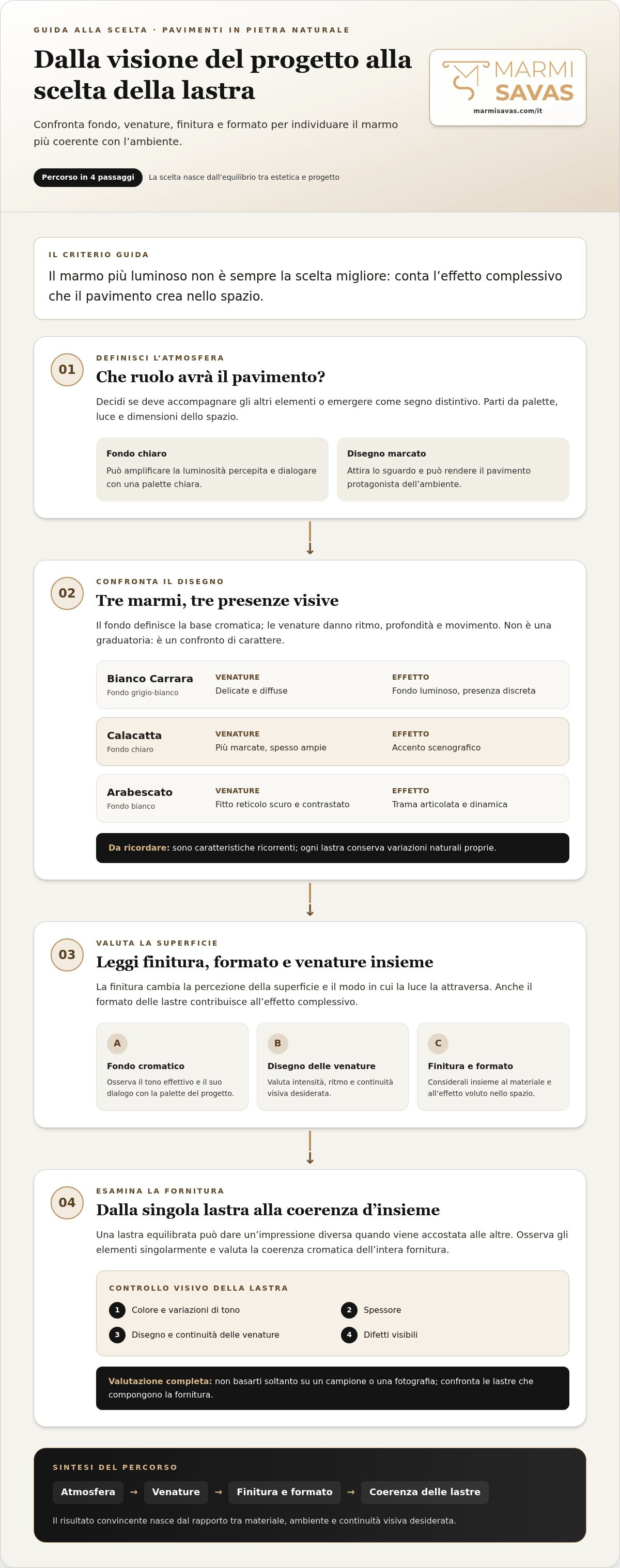
The complete, verbatim English translation of the text from the image, organized with ##, ###, and #### heading hierarchies, is provided below:
The brightest marble is not always the best choice for a floor: veins, finish, and the effect the stone creates in the space also matter. Among Italian natural stones for floors, materials that look similar at first glance can reveal important differences when comparing slabs, format, and visual quality.
Color is a starting point, but a convincing choice stems from the balance between aesthetics and project. Bianco Carrara offers a grey-white background with generally subtle and widespread veins; Calacatta stands out for its light background and wider markings, while Arabescato presents a dense and articulated design. Finish also changes the perception of the surface and the way light passes through it. This guide helps compare Italian marbles based on environment and use, read veins and characteristics of slabs, and evaluate the role of format and finish. MARMISAVAS, specialized in the supply of natural stone slabs and tiles, offers over 200 options for residential and professional projects.
Key Points
- Compare Italian natural stones for floors based on the atmosphere and desired visual continuity, not just color.
- Consider the finish together with the veins: both influence the appearance of the surface and the way it reflects light.
- Examine each slab for color, thickness, veins, and visible defects; also evaluate the chromatic coherence of the entire supply.
- Define the palette, the intensity of the design, and the role of the floor in the concept before selecting the material.
- For residential or professional projects, compare slabs and tiles based on supply requirements.
Index
- Italian natural stones for floors: which criterion to start from
- Italian marbles for floors: comparing Carrara, Calacatta, and Arabescato
- Finishes, veins, and slab quality: the comparison that avoids purely aesthetic choices
- How to choose natural stone for the floor based on the project
- Choosing and sourcing from MARMISAVAS: from slabs to the project
Italian natural stones for floors: which criterion to start from
What atmosphere should the floor create? And what visual continuity do you want to obtain? Answering these questions helps orient the choice before focusing on a single color. A light background can amplify perceived brightness, while a marked pattern makes the floor a protagonist and forcefully defines the character of the environment.
In short: an Italian natural stone is a stone material extracted in Italy, with a visual identity determined by the composition and variations proper to the material. To choose a flooring stone, relate appearance, finish, and format of the slabs to the project and the desired effect.
Marble is a family of natural stone, not a synonym for every natural rock. Travertine and granite, for example, belong to distinct geological families and present distinct visual characteristics. To explore the link between territory and material, the overview on the Marble of Carrara offers a dedicated historical reference to one of the most recognizable Italian stones.
Marble and natural stone: what to observe in a floor
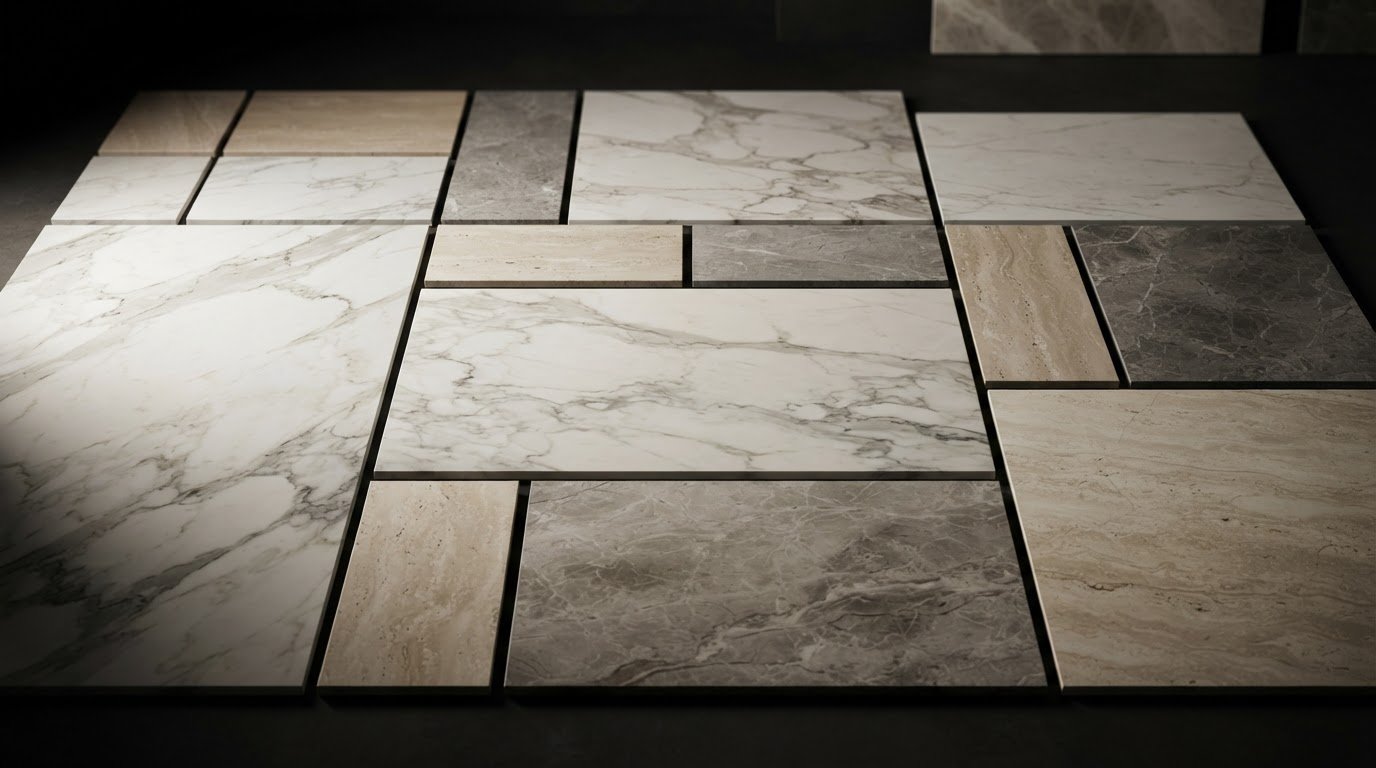
In marble, the chromatic background establishes the base of the composition; the veins define rhythm, depth, and movement. Subtle and widespread traits give a discreet reading, while wide and contrasted lines draw the eye and can transform the surface into a central element of interior design. The format of the slab and the finish also contribute to the overall effect.
Natural stone does not present a perfectly identical repetition: each slab can show variations in tone and design. For this reason, evaluation is not limited to a sample or a photograph. Consider the visible characteristics of the slabs that make up the supply and how they relate to each other.
From the atmosphere of the environment to the family of material: palette, light, and dimensions of the space help identify the background and the intensity of the design in a more coherent way. In an environment where visual brightness is sought, a white marble can dialogue with a light palette, but it is not a universal solution. A gray or dark background, instead, can introduce deeper contrasts and accompany furnishings with warm or metallic tones.
From the atmosphere of the environment, define whether the floor must blend with other elements or emerge as a distinctive sign. Then compare color, veins, finish, and format as complementary criteria: none, taken alone, fully describes the result.
Italian marbles for floors: comparing Carrara, Calacatta, and Arabescato
To compare these marbles, evaluate the effect of the background and veins with respect to the dimensions of the environment and the foreseen palette. There is no absolute best typology: the choice depends on how much the floor must accompany other elements or become a distinctive sign. Also, the degree of visual continuity desired guides the selection of slabs for Italian natural stones for floors.
Bianco Carrara, Calacatta, and Arabescato: visual differences
Bianco Carrara is appreciated for its luminous background and delicate veins. Calacatta features a light background with more marked veins, often wide and scenic. Arabescato is recognized for the dense network of dark veins that creates an articulated design on a white background. These are recurring characteristics, but each slab preserves its own natural variations.
The table summarizes the possible role of each marble in the composition. For a concrete selection, observe the slabs and compare their design, rather than relying solely on the typology.
- Bianco Carrara: Delicate and widespread veins / Luminous background and discrete presence
- Calacatta: Marked, often wide veins / Scenic accent
- Arabescato: Dense contrasted network / Articulated and dynamic design
A delicate design can harmonize with environments where furnishings and other materials already have a strong presence. Wide veins, instead, can stand out in a space that leaves the floor a central role. Explore the characteristics of Bianco Carrara marble and evaluate background and veins in relation to the project, without turning the comparison into a ranking.
Gray and dark marbles for more material palettes
Gray backgrounds can support measured palettes and material pairings, with a visual presence less luminous than white marbles. Black and brown varieties introduce more contrasts or warm tones. In any case, the result depends on the actual color of the slab, the vein design, and surrounding elements.
For a residential or professional project, comparing slabs in their entirety helps evaluate how they coordinate with the palette and the scale of the space. For information on supply based on project needs, share the characteristics of the desired material. For a reference on the Italian stone sector, it is also possible to consult Confindustria Marmomacchine.
Finishes, veins, and slab quality: the comparison that avoids purely aesthetic choices
A stone can appear balanced in a single store and produce a different effect when placed next to others. To evaluate a finish, therefore, observe each element both in relation to coherence. Color, veins, thickness, and visible imperfections are useful criteria for comparing slabs with project requirements.
How to read veins and design continuity
Observe direction, intensity, and distribution of veins across the surface. A regular and low-contrast design can support a discreet composition; wide or branched lines can become the visual fulcrum of the floor. Also consider the differences from one slab to the next. The sheet of the International Union of Geological Sciences on the marble province of Carrara offers a reference on the history and geological characteristics of this material.
On the single slab, chromatic background, design, thickness, and eventual visible imperfections are evaluated. On the entire supply, instead, tone variations and visual continuity between elements are compared. This check helps understand whether the overall result will be uniform, moved, or intentionally contrasted.
Finish and control of slabs before selection
Finish modifies the way the stone returns light. A matte polished surface, for example, reduces reflections and offers a softer reading than a glossy surface. Compare the finish on slabs and, when possible, the light of the foreseen environment: tone and design can be perceived differently according to surface treatment.
Before defining the floor design, examine edges and surfaces, note chromatic variations, and identify eventual visible imperfections. Then evaluate the placement of slabs according to the design layout: vein direction and meeting points influence perceived continuity.
If the project requires a specular effect, the mirror-like pairing of sequential slabs can valorize veins suitable for creating symmetry. Evaluate the actual design and the role it will have in the floor. To delve deeper into material characteristics, consult the selection of Bianco Carrara marble; for supply information, share the requirements of your project.
How to choose natural stone for the floor based on the project
An effective selection proceeds in stages: first the desired effect is defined, then the slabs are compared, and finally the supply is organized according to the details in the project. This method helps architects, interior designers, and clients evaluate Italian natural stones for floors as an integral part of the project, not as an isolated color choice.
Checklist for architects and clients
- Define the environment. Consider dimensions, light, wall palette, and furniture. Clarify whether the floor should appear luminous, discrete, or become a protagonist element.
- Determine the role of the veins. Decide which intensity of the design is compatible with the project setup and how much natural variation you want to see on the overall surface.
- Compare the slabs. Examine color, veins, and finish by looking at real surfaces, not just photographs or isolated images. In this way, you can better grasp the differences between individual elements.
- Verify visual coherence. Examine the slabs together to understand how they dialogue with each other and whether the color variations are compatible with the expected result.
- Plan the supply. Connect the selection and quantity of material to the drawings and the configuration foreseen for the floor.
Format, design, and quantity of material
The format contributes to the rhythm of the surface. A large-format flooring may be suitable for a project aiming for a more continuous reading and less evident joints. However, the result depends on the dimensions of the selected slabs, the foreseen layout, and the natural design of the stone. The layout scheme also influences the direction of the veins: aligning them in one direction can give order to the composition, while alternating them can create a more articulated movement. For this reason, it is useful to think about the combination before defining the final selection, especially when the design of the stone has a marked visual role. The quantity must be calculated starting from measurements and project drawings, without relying on generic estimates. Once the atmosphere, finish, and visual scheme are defined, MARMISAVAS supports slabs and tiles based on supply requirements. Share the project and the characteristics of the desired material.
Choosing and sourcing from MARMISAVAS: from slabs to the project
Once the desired atmosphere, finish, and design are identified, the subsequent transition translates the choices into a coherent supply. MARMISAVAS is specialized in the supply of marble and natural stone slabs and tiles for residential and professional projects. The range includes over 200 options and a large ready stock, also suitable for large-volume supplies.
A range of floor stones for different design visions
For those evaluating Italian natural stones for floors, the offer includes white marbles such as Calacatta, Bianco Carrara, and Arabescato, as well as black, gray, and brown varieties. This breadth makes it possible to compare different backgrounds and designs in relation to the palette and the character of the environment, without limiting the selection to a single chromatic family. Architects and interior designers can relate the material to the overall concept; stone contractors and professionals can evaluate supply continuity against project requirements. Residential customers can also start from concrete elements, such as the desired effect and the role of the floor, to navigate between slabs and tiles. Consult the complete guide to floor marble to review general selection criteria.
From material selection to project dialogue
To formulate a clear request, it is useful to share some essential data:
- Destination of the material: environment and context of the project.
- Aesthetic direction: palette, vein intensity, and desired finish.
- Supply requirement: foreseen quantity and indications derived from project drawings. This information helps frame the selection depending on the visual result and the volume required. The comparison on slabs can thus start from a defined brief, useful both for a residence and for a professional or contract project. MARMISAVAS supplies the lapidary material in dialogue with the needs of architects, designers, contractors, and clients. Share your project and request information to share supply features and receive material information.
Shaping the project with the right stone
The selection of Italian natural stones for floors starts from the atmosphere you want to create and is completed by evaluating the finish, veins, and characteristics of the slabs. Carrara, Calacatta, and Arabescato offer diverse visual identities; the most suitable solution depends on the palette, the scale of the environment, and the role assigned to the surface. Evaluating the slabs as a whole helps understand color variations and design continuity before defining the selection. Format and layout also contribute to the final reading of the floor and must be considered in terms of drawings and supply requirements. MARMISAVAS is specialized in the supply of natural stone slabs and tiles. With over 200 options and a large ready stock for large-volume supplies, it supports material selection in residential and professional projects. Share your project and request information to identify a stone coherent with the desired composition.
Frequently asked questions about natural stones for floors
Which Italian natural stones are suitable for floors?
The choice depends on the desired visual identity and project requirements. Among Italian marbles, Bianco Carrara, Calacatta, and Arabescato offer diverse designs and contrasts; gray, black, and brown marbles expand chromatic possibilities. To choose Italian natural stones for floors, evaluate finish, veins, slab format, and characteristics required by the environment together with the designer, without relying solely on color.
What is the difference between Carrara, Calacatta, and Arabescato marble for a floor?
Bianco Carrara generally features a gray-white background and delicate, widespread veins for a luminous and measured effect. Calacatta features a light background and more marked, often wide and scenic veins. Arabescato is distinguished by a dense and contrasted network resembling a lattice. The choice depends on how much you want the floor to accompany or define the composition of the environment.
How is the quality of a marble slab evaluated for a floor?
Observe a single slab and consider the color background, vein distribution, thickness, and visible imperfections. Then evaluate the entire supply: tone and design variations between slabs affect surface continuity. The check does not only concern the appearance of an isolated sample, but also the coherence of the material with the expected result and the foreseen project layout.
Which finish should be chosen for a marble floor?
The finish should be chosen in relation to the desired appearance, light, and character of the environment. A glossy surface reflects light more and makes the design brighter; a matte honed finish offers a softer and more discrete reading. Compare finishes on slabs, because color and veins can appear different depending on the surface. The final choice should accord with the overall project concept.
Is Italian marble suitable for contemporary flooring?
Yes, Italian marble can fit into a contemporary project thanks to the variety of backgrounds, veins, and finishes available. A delicate design can support essential lines and sober palettes; more evident veins can become a visual accent in an essential composition. To achieve coherence, evaluate the marble together with other materials and furnishings, also considering the slab format and desired continuity.
How to choose between white marble and gray marble for the floor?
White marble is indicated when the project seeks a luminous background and a light tone, but it is not a universal choice. Gray marble creates a more measured and material base, useful for compositions based on delicate contrasts or tonal pairings. Consider the light, the wall and furniture palette, and vein intensity. Observing adjacent slabs helps better foresee the overall chromatic balance.
What should be evaluated before purchasing natural stone slabs for floors?
Before selection, define the environment, visual effect, color, finish, and vein intensity. Examine slabs for color variations, thickness, and visible imperfections, then compare them with each other to evaluate continuity. Also consider the format, the foreseen layout, and the quantity indicated in project drawings. These elements help orient the supply toward a coherent result, both for a residential and a professional project.