Marble Cladding for External Facades: Technical and Architectural Guide (2026)
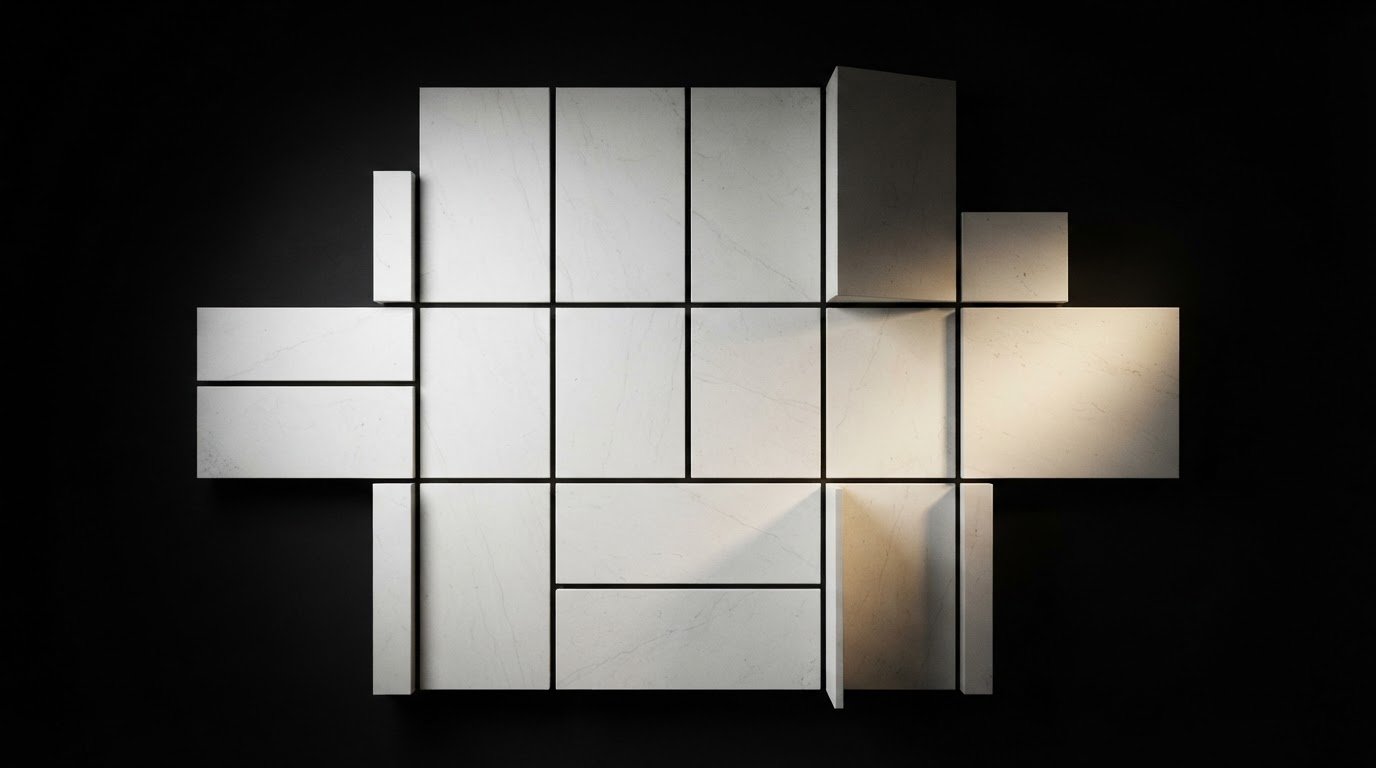
An exceptional stone facade does not succumb to the action of frost or pollution, but to a methodological error: considering natural stone as a mere decorative finish rather than the engineering core of the envelope. Defining a marble cladding for external facades indeed requires that the qualitative evaluation of the slabs precedes the structural calculation, overturning the usual construction site logic. If you consider the concern that atmospheric agents and acid rain can degrade the material or compromise the integrity of the panels over time, you are not alone. Sourcing uniform supplies over large areas, distinguishing the authenticity of the stone material from synthetic imitations, represents one of the most delicate challenges for architects and high-end builders. This technical guide will show you how to select the best marble slabs for external facades, combining performance rigor, durability, and timeless elegance. From mechanical resistance and absorption checks to the choice of the most suitable finishes for outdoor use, we will analyze every essential parameter to create a solid and impeccable monumental facade.
Key Points
- Understand the role of thermal inertia in building efficiency and why natural stone guarantees superior long-term protection.
- Discover the physical parameters essential for evaluating a marble cladding for external facades, from porosity and water absorption to wind resistance.
- Compare the stone varieties best suited for outdoor exposure, analyzing the compactness virtues of Bianco Carrara and other monumental stones.
- Evaluate the highest-performing surface finishes, discovering why the matte honed finish is preferable to mirror polishing outdoors.
- Learn how to manage batch procurement from quarry to construction site to ensure vein continuity and chromatic uniformity across large architectural volumes.
Table of Contents
- Marble for external facades: architectural value, longevity, and natural sustainability
- Technical criteria for slab selection: durability, absorption, and structural loads
- The best marble types for external cladding and monumental facades
- Surface finishes and protective treatments for externally exposed marble
- From quarry to construction site: supply of custom slabs with MARMISAVAS
Marble for External Facades: Architectural Value, Longevity, and Natural Sustainability
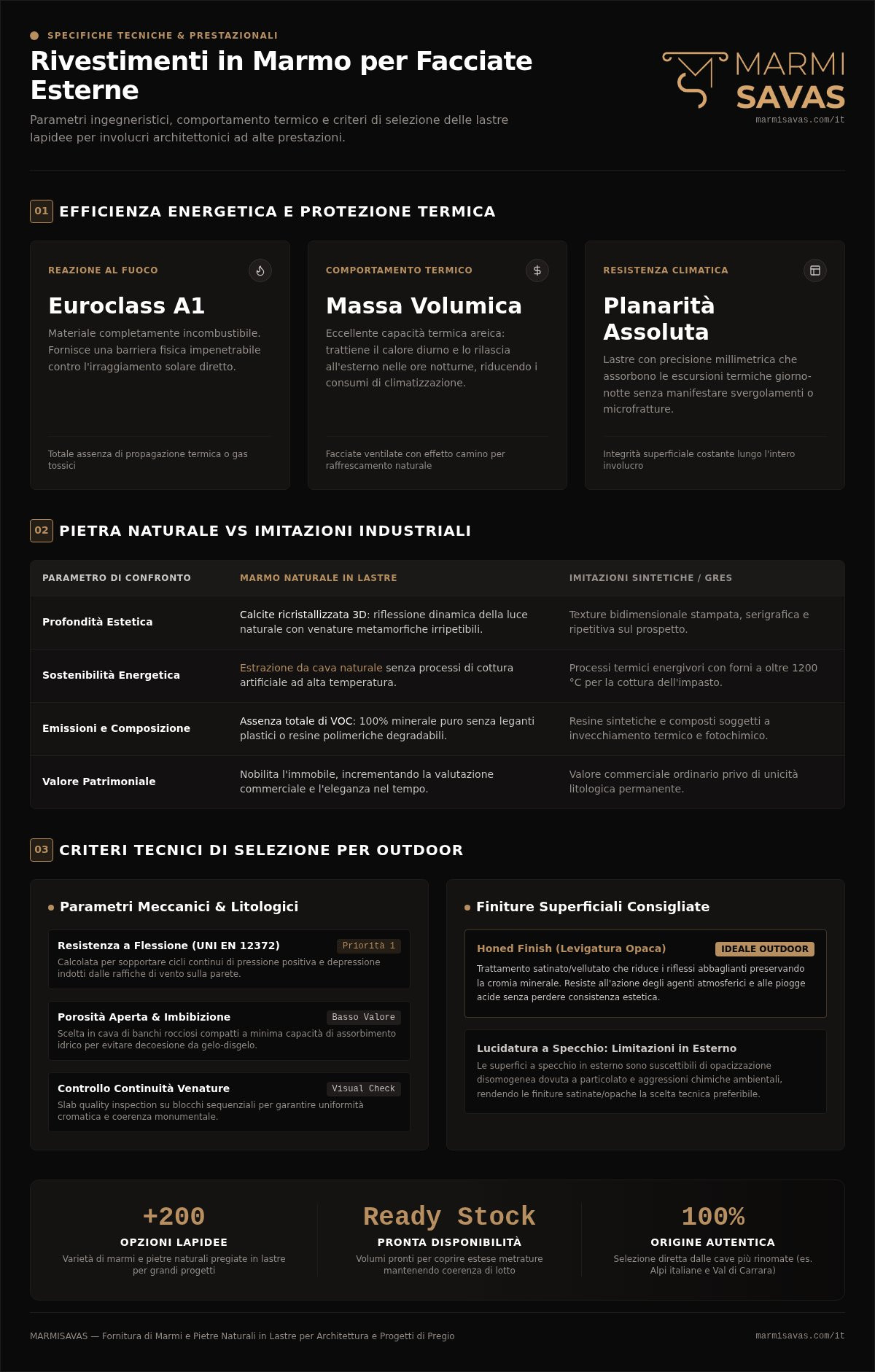
In contemporary architecture, the choice of the envelope defines the thermal and visual identity of the entire building. Designing a marble cladding for external facades does not simply mean installing a prestigious finish. It means equipping the building organism with a resistant protective membrane, capable of defying decades while maintaining its structural integrity unalterable. From the Roman Pantheon to modern business districts, marble represents the pinnacle of mineral expressiveness for ventilated facades and anchored wall systems. Unlike traditional lightweight claddings, natural stone guarantees a non-combustible Euroclass A1 fire reaction. It offers an impenetrable physical barrier to direct solar radiation. Historical typologies such as Carrara marble confirm how the lithological qualities of crystalline carbonates resist the action of atmospheric agents better than any synthetic surrogate.
Thermal Efficiency and Building Envelope Protection
The high volumetric mass of marble generates an excellent areal thermal capacity. This property maximizes thermal lag during the summer season; solar heat flow is retained by the stone mass and released towards the external environment during nighttime hours, drastically reducing energy requirements for air conditioning. In ventilated facades, the rear air cavity activates a natural chimney effect that lowers the building's surface temperature. Slabs processed with millimeter precision undergo continuous thermal excursions between day and night without warping or micro-fracturing, guaranteeing absolute flatness along the entire envelope surface.
Natural Stone Authenticity vs. Ceramic Imitations
While industrial products and porcelain stoneware reproduce a two-dimensional screen-printed and repetitive texture, natural stone authenticity lies in the three-dimensional depth of recrystallized calcite. Each block features unrepeatable vein directions, created by millennia of metamorphic pressure. This mineral three-dimensionality reflects natural light vividly, changing appearance as the hours of the day vary.
From an asset and ecological profile, stone cladding offers concrete advantages:
- Property enhancement: the use of white marble or colored extraction essences ennobles the facade, raising the building's commercial valuation in the global market.
- Extraction sustainability: marble is a natural raw material that does not require the energy-intensive thermal processes at over 1200 °C typical of synthetic mixtures.
- Absence of volatile organic compounds: pure natural stone contains no degradable polymeric resins or plastic binders subject to premature thermal aging.
The integration of a marble cladding for external facades confirms attention to construction excellence, transforming a simple perimeter wall into a permanent architectural work.
Technical Criteria for Slab Selection: Durability, Absorption, and Structural Loads
The success of a marble cladding for external facades depends on the preliminary analysis of the physical and mechanical properties of the lithotype. An external wall constantly interacts with driving rain, nighttime frost, and gusts of wind. Ignoring these parameters exposes the work to the risk of decohesion and cracking. Durability therefore begins in the quarry, identifying rock banks with a very low imbibition coefficient and minimized open porosity.
Slabs destined for exterior use must pass strict comparisons on four essential fronts:
- Flexural strength (UNI EN 12372): absorbs the pressure and force created by the wind against the facade.
- Water absorption (UNI EN 13755): prevents internal rising that triggers flaking phenomena.
- Frost resistance (UNI EN 12371): certifies that the crystalline matrix remains intact after dozens of freeze-thaw cycles.
- Anchorage strength (UNI EN 13384): quantifies the hold of the support mechanical pin hole.
Mechanical Resistance and Freeze-Thaw Cycle Behavior
Seasonal thermal cycles generate continuous micro-stresses. When water penetrates the pores and freezes, it increases in volume by about 9%, exerting a destructive internal hydrostatic pressure. Fine- and compact-grained marbles effectively counteract this dynamic. Equally crucial is considering the linear thermal expansion coefficient, calculating open elastic joints of adequate width between slabs to avoid rigid contacts.
For the long-term preservation of exposed surfaces, the National Park Service guidelines on protective treatments for marble and exteriors recommend breathable formulations, avoiding film-forming hydrophobic barriers that trap internal moisture.
Thicknesses, Tolerances, and Technical Criteria for Slab Inspection
In ventilated facades, the standard slab thickness typically ranges between 20 and 30 millimeters. A calibrated thickness of 30 millimeters offers a higher safety margin at the milling and kerf points for metal brackets. Slab inspection must exclude open veins or clay inclusions. The preventive application of a resin treatment with a fiberglass structural mesh on the back increases cohesion without altering the natural breathability of the visible front.
Before final cutting, a meticulous slab quality inspection process guarantees the geometric flatness and structural homogeneity of the batch. To evaluate technical data sheets or plan sampling for your marble cladding project for external facades, you can request specialized consultancy through our contact page.
The Best Marble Types for External Cladding and Monumental Facades
Mineralogical composition determines the longevity of the stone envelope. Selecting the right slabs for a marble cladding for external facades requires careful comparison between crystalline grain hardness and chromatic behavior under direct sunlight. Geological data and technical standards of dimension stone clearly demonstrate that not all carbonate varieties respond in the same way to continuous atmospheric exposure.
Blocks extracted from the best metamorphic basins offer guarantees of volumetric stability, but the choice between light, brecciated, or dark tones must balance performance rigor and architectural expressiveness.
Bianco Carrara Marble: Classical Excellence for Large Surfaces
Bianco Carrara Marble represents the absolute reference for large continuous fronts. Characterized by a uniform pearlescent background and a network of delicate gray inclusions, this lithotype possesses a very fine saccharoidal structure that boasts exceptional compactness against polluting agents. You can explore the most suitable treatments in the Carrara Marble Finishes Guide. High availability in the quarry of homogeneous batches allows maintaining tonal consistency across backgrounds of thousands of square meters.
Arabescato and Calacatta: Drama and Prestige for Scenographic Walls
When the project requires expressive monumentality for entrance portals or sculptural volumes, Arabescato Marble emerges for its ovate design surrounded by marked dark gray veins. Equally prestigious, Calacatta offers a warm white background crossed by decisive arabesques. Consult our Complete Calacatta Marble Guide to understand the vein differences between the various selections.
By installing consecutive mirrored slabs via the open-pore bookmatch technique, continuous geometries of extraordinary visual impact are generated. For facade projects requiring signature sampling, you can evaluate our premium white marble slabs ready for transformation on-site.
Gray and Dark Tones: Contemporary Rigor and Minimalist Elegance
Gray marbles like Bardiglio marble give severity and contemporary elegance to the facade, often acting as a base element or stringcourse bands. However, very dark-toned marbles absorb a significantly higher percentage of solar heat compared to white marbles. This difference induces internal thermal gradients that require expansion joints specifically recalibrated by structural designers.
Through careful technical expertise, architects and clients can select the ideal lithotype among gray marble varieties and dark stones, ensuring longevity and charm for any facade typology.
Surface Finishes and Protective Treatments for Marble Exposed Outdoors
The surface finish determines how the stone facade will age over time. While mirror polishing enhances the crystalline transparency of the material indoors, this processing is strongly discouraged outdoors. Sulfur dioxide and weakly acidic rains chemically attack calcium carbonate, dulling the polished surface unevenly and creating unsightly opaque patches after a few seasonal cycles. For a durable marble cladding for external facades, design practice prefers low-reflectance treatments capable of dialoguing with zenith sunlight without dazzling the observer.
Matte Honed Finishing and Exterior Textured Treatments
Honed finish (fine-grained matte smoothing) gives the slabs a soft and velvety consistency. This surface diffuses light evenly and masks wear and calcareous micro-deposits left by rainwater. When more marked sculptural effects are sought, relief processing offers excellent performance:
- Calibrated sandblasting: uniformly mattifies the front, giving a soft tone and eliminating artificial flatness residues.
- Light bush-hammering: creates a point-form micro-grooving that confers visual depth and three-dimensionality to the entire building volume.
- Water brushing: corrects the reliefs of the previously bush-hammered or sandblasted stone, producing a surface that is soft to the touch yet rich in natural light-shadow plays.
Water-Repellent Treatments and Anti-Pollution Protection
An outdoor slab must never be sealed with paints or film-forming resins that block breathability. The optimal solution lies in the use of water- and oil-repellent impregnating protectors based on neutral siloxane compounds. These molecules penetrate the first millimeters of the crystalline lattice without clogging the microscopic pores, allowing water vapor coming from the inside of the building to evaporate freely to the outside. This chemical shield hinders the capillary rise of soluble salts responsible for whitish efflorescence and counteracts the adhesion of carbonaceous particles or algal spores along north-facing facades. The facade still requires scheduled routine maintenance based on periodic washings with low-pressure demineralized water jets and neutral pH detergents. If you wish to determine the finishes and protective treatments ideal for your marble cladding specification for external facades, you can examine dedicated physical samples and coordinate supplies by contacting our technical team.
From Quarry to Construction Site: Supply of Custom Slabs with MARMISAVAS
The success of large architectural facades stems from strict control of the supply chain. When designing a marble cladding for external facades, material availability cannot be left to chance or fragmented batches. MARMISAVAS positions itself as a strategic partner for architects, builders, and facade specialists, offering a constantly refueled warehouse with over 200 options of fine marbles and natural stones ready for prompt delivery on a national scale. We exclusively supply raw material in the form of raw slabs or custom-processed, operating with traceability standards that meet the most demanding requirements and structural criteria for contemporary architecture.
Block Selection and Facade Slab Mapping
Chromatic continuity on large facades stems from extracting blocks in sequence from the same quarry bench. Our technicians analyze the marble vein orientation to coordinate the production of custom-calibrated slabs. This preliminary work includes:
- Precision cutting: slicing slabs to equal thicknesses to allow the perfect execution of perimeter milling and kerfs intended for mechanical anchorage.
- Laying schedule development: progressive numbering of each element to facilitate assembly by specialized companies on site.
- Photographic control: preliminary testing to verify grain homogeneity and exclude internal structural stresses prior to shipment.
The Excellence Partner for Architectural Studios and Developers
We support designers and General Contractors with technical competence gained by stone professionals in high-end stone procurement. We guide the studio in the lithological selection most adherent to load prescriptions and the work's spending constraints. To explore the economic factors that make up the investment, consult our examination on marble price per square meter. We regularly invite clients and directors from the site to our logistic warehouse to view the cut blocks live, validating the slabs in full transparency before the final production of the batch. To discuss the technical specifications of your next marble cladding for external facades and request dedicated sampling, visit the MARMISAVAS Contact section.
Enhance Your Architecture with Excellence Stone Slabs
Giving shape to a contemporary envelope requires a rigorous synthesis between engineering calculation and geological originality. As we have examined, the preventive verification of mechanical loads, the choice of low-reflectance honed finishes, and the coordination of the vein pattern are the pillars that transform a simple wall into a timeless architectural work. The success of a marble cladding for external facades rests on the certainty of supply. With over 200 stone varieties ready for prompt delivery and transparent traceability from origin extraction basins, MARMISAVAS supports architectural studios, General Contractors, and private clients in the selection of homogeneous batches of the highest range, subjected to rigid quality inspection protocols. Large projects deserve surfaces capable of defying decades while keeping their prestige intact. Request material consultation and reserve your slabs with MARMISAVAS to give shape to a solid, elegant, and memorable monumental facade.
Frequently Asked Questions on Marble Cladding for External Facades
Which marble is most resistant for an external facade cladding?
Calcific marbles with fine crystalline grain and compactness, like Bianco Carrara and Apuane varieties, guarantee maximum resistance to atmospheric agents. Their microcrystalline structure limits the penetration of rainwater and offers high flexural resistance. Homogeneous lithotypes free of clay inclusions or open veins withstand continuous solar radiation as well as wind and frost cracking without alterations.
Why is a matte honed finish recommended instead of polished for exteriors?
The honed finish is preferred because it resists the action of weakly acidic rains without showing uneven surface degradation. Mirror polishing, in contact with atmospheric pollutants and sulfur dioxide, rapidly loses brilliance, creating visible patches and matte halos. Fine-grained processing reduces glaring solar reflections, enhances stone consistency, and masks abrasive damage caused by wind-transported particles.
What is the minimum recommended thickness for marble slabs on a facade?
The ideal technical thickness for marble cladding for external facades is 30 millimeters, with a minimum limit allowed of 20 millimeters for contained format modules. This sizing ensures the necessary mechanical resistance at the incision and milling points for metal anchors. Lower thicknesses compromise structural integrity under wind push or suction, increasing the risk of accidental breakage.
Does Bianco Carrara marble yellow or stain when exposed to weathering?
Authentic Bianco Carrara marble does not yellow or stain if protected by non-film-forming breathable impregnating agents that prevent the rise of moisture or iron minerals. Any alterations almost always derive from inadequate glues, stagnant water infiltration, or non-breathable synthetic sealants that trap dirt and fine dusts. First-choice natural stone, supported by correct ventilation and periodic pH-neutral maintenance, preserves its color purity for generations.
What is the performance difference between a marble ventilated facade and glued cladding?
The ventilated facade completely outperforms glued cladding thanks to the air cavity and assembly on independent mechanical brackets. This configuration eliminates stresses caused by freeze-thaw cycles, prevents detachment caused by glue aging, and avoids the formation of saline efflorescences. Natural air circulation optimizes the building's summer thermal inertia, making the ventilated facade the number one choice for safety, insulation, and durability.
Does MARMISAVAS also perform on-site installation or setup?
MARMISAVAS operates exclusively as a supplier specialized in the selection and sale of raw or custom-cut natural stone slabs and tiles, excluding on-site installation services. We collaborate with architectural studios, General Contractors, and facade specialists by supplying certified material, quality control, and detailed laying schedules. The execution of structural assemblies is entrusted directly to qualified craftsmen and construction companies appointed by the client.
How is vein continuity guaranteed on large facade surfaces?
Vein continuity for a marble cladding for external facades is obtained by extracting blocks from the same quarry bench and slicing the slabs in sequential order. Through preliminary study of vein directions and open-pore processing, our technicians plan the geometric distribution of the panels. Each element is numbered and mapped to allow a harmonious and monumental composition throughout the facade envelope.