Marble extraction process in Italy: from quarry to block selection
The quality of a slab begins long before cutting in the laboratory: it is born from the careful reading of the quarry bed and the choice of the block. The marble extraction process in Italy includes distinct steps, often confused with the subsequent processing of the stone. Understanding where extraction ends and transformation begins helps comprehend why two blocks of the same variety can offer different results. The rock is identified, separated from the mountain, and selected taking its characteristics into account. Veins, fractures, and color variations are part of marble's identity, but they also affect visual continuity and application possibilities. Cutting techniques such as diamond wire allow bounding the blocks, which are evaluated prior to subsequent processing. In this journey, we will see how we move from observing the bed to detachment and block selection, distinguishing extraction from transformation. We will also consider waste management and how the natural structure of the stone guides the choice for an architectural project. Bianco Carrara, Calacatta, and Arabescato show how wide the variety of Italian marble is.
Key Points
- The marble extraction process in Italy leads from rock to block; cutting into slabs is a subsequent phase.
- Cutting, detachment, and handling are distinct operations with specific objectives.
- Equipment and working methods can vary from one quarry to another based on the characteristics of the bed.
- Veins, fractures, and color contribute to block selection and influence the appearance of the slabs.
- Evaluating format and visual continuity helps choose the stone best suited to the needs of the architectural project.
Table of Contents
- How the marble extraction process begins in Italy
- From rock to block: the operational phases of extraction in Italy
- Marble extraction techniques: what changes between cutting and handling
- Quality, safety, and environment in marble extraction in Italy
- From the extracted block to the selection of slabs for a project
How the Marble Extraction Process Begins in Italy
Extracting marble means isolating portions of natural rock to obtain blocks. This phase does not coincide with cutting into slabs: first, the stone is separated from the bed and handled; afterwards, at the processing facilities, the blocks are sawn and can receive further surface finishes. Distinguishing these steps allows following the material's journey from the quarry to selection for a project.
What is Meant by Marble Extraction
The deposit is the set of rock masses present underground or outcropping in an area. The bed is a portion of compact rock identified as a possible source of blocks; the block is the mass of marble obtained by separating it from the bed. Therefore, the marble extraction process in Italy includes the identification and detachment of the rock, not cutting into slabs nor polishing or honing, which belong to subsequent phases. The History of Carrara Marble offers a reference to delve into the connection between the material, the quarries, and the extraction and processing practices developed over time.
How a Bed is Evaluated Before Detachment
Before proceeding with extraction, the visible characteristics of the rock are observed. Color and the distribution of veins help describe the appearance of the material; discontinuities and natural fractures instead indicate separations or weak points in the mass. This reading is not only about aesthetics: it helps understand how the conformation of the bed can influence the orientation and dimensions of recoverable blocks. There is no identical scheme for every quarry. Geological structure, the course of fractures, and operational conditions contribute to defining the processing method. Evaluating the bed also helps interpret what is observed in the slabs: varieties like Bianco Carrara, Calacatta, and Arabescato express different aspects of natural stone, with possible variations in color and veins from one block to another. For designers and clients, knowing the origin of the material makes the choice more conscious. The selection of slabs can take into account not only the desired shade, but also the arrangement of veins and the visual continuity foreseen for the surfaces.
From Rock to Block: The Operational Phases of Extraction in Italy
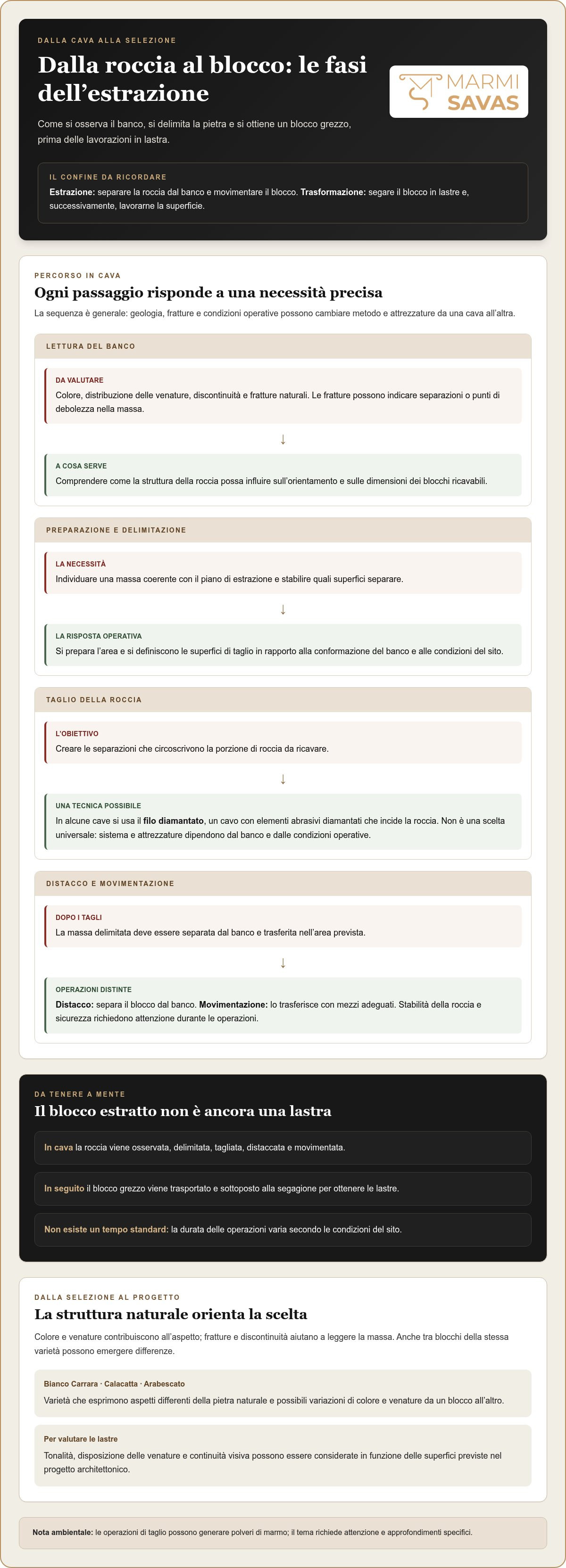
Once the portion of rock to be extracted is identified, work proceeds in coordinated steps: the area is prepared, the cutting surfaces are bounded, the block is separated, and it is handled. This is a general sequence, not an identical protocol for every quarry. The conformation of the bed, fractures, and operational conditions affect technical choices.
Preparation and Bounding of the Rock Portion
A mass consistent with the extraction plane is identified, and the surfaces along which to make cuts are defined. Preparation serves to bound the volume to be separated and set up the work in relation to the rock structure. Method and equipment vary by site: the configuration adopted depends on the conditions of the bed and the work area.
Cutting, Detachment, and Handling of Blocks
Mechanical cutting creates the separations that circumscribe the block. In some quarries, diamond wire is used, a cable with diamond abrasive elements that cuts the rock. This is one of the possible techniques, not a universal choice: other systems can be adopted based on the conformation of the bed and operational conditions. When the cuts have bounded the mass, the block is detached in a controlled manner and subsequently handled with appropriate means. The sequence requires attention to rock stability and the safety of operations. The extracted block remains a raw mass; to obtain slabs, it must be transported and subjected to sawing. The duration of operations varies based on site conditions and cannot be reduced to a standard time valid for every extraction. In summary, the rock is prepared and bounded, cut and detached, and then the block is handled for subsequent processing. This sequence describes the marble extraction process in Italy without confusing separation in the quarry with slab production. Cutting operations can generate marble dust, an environmental issue that requires attention and specific in-depth studies. SNPA presents research dedicated to the environmental impact of extraction and dust in the affected areas. After extraction, the selection of slabs allows evaluating color, veins, and visual continuity according to the project. To guide the choice between varieties like Bianco Carrara, Calacatta, and Arabescato, it is possible to consult on materials for the project.
Marble Extraction Techniques: What Changes Between Cutting and Handling
In quarry work, cutting the rock, detaching the block, and moving it are different operations, each with a precise objective. Cutting bounds the portion to be obtained; detachment separates it from the bed; handling transfers it to the intended area. Distinguishing these steps clarifies how a block is born and why it does not yet coincide with a slab ready for the project.
Diamond Wire and Other Cutting Systems
Diamond wire is one of the systems used to cut the rock mass and create cutting surfaces. However, it is not a universal choice: equipment and operating modes can change based on the structure of the bed and the organization of the quarry. For a broader overview of sector technologies, Confindustria Marmomacchine, the reference association for the Italian machinery and stone technology industry, can be consulted. The choice of technique depends on the conformation of the rock, the discontinuities present, and the portion intended to be isolated. Therefore, it is more accurate to describe the systems based on their function, without attributing absolute performance to a single one or assuming it is adopted in all Italian quarries.
Phase, Objective, and Expected Results
How the Method Affects Block Shape
The orientation of the cuts helps define the geometry of the obtained block. The arrangement of fractures and the continuity of the rock can condition the obtainable shape; the outcome must be evaluated on the real material, without expecting always uniform blocks or veins. Visual quality is considered together with mass integrity: color and natural design can vary within it. The extracted block is not yet a slab. Subsequent sawing subdivides it and makes veins and design continuity more readable. In summary, the marble extraction process in Italy adapts cutting, detachment, and handling to the characteristics of the bed; subsequent processing transforms the block into the format useful for project selection.
Quality, Safety, and Environment in Marble Extraction in Italy
The evaluation of a block is not only about color: the integrity of the rock, veins, and discontinuities contribute to the yield and the choice of subsequent processing. Safety and environment are also aspects to be considered with precision, distinguishing the natural characteristics of the material from the effects that can depend on the activities carried out in the quarry.
How the Integrity and Characteristics of Marble are Recognized
On a block, tones, vein distribution, visible cracks, and discontinuities are observed. These elements help understand the structure of the stone and evaluate how it might look once cut. A crack can affect the continuity ofワイト the mass; a vein can become a distinctive feature of the surface. Natural blocks are not perfectly identical: color and graphic variations are part of the material. The choice of slabs also depends on the desired effect. For a large surface, the vein array and consistency between slabs contribute to visual continuity; in a project that values the spontaneous character of the stone, variations can become part of the design. Bianco Carrara, Calacatta, and Arabescato offer examples of variety, but the reference is not just the name of the marble, but the actual slabs.
Environmental Considerations and Safety: Contextualizing Information
Mining activities can involve aspects to be evaluated on a case-by-case basis, including dust, processing residues, water used in processes, and landscape transformation. The presence of a possible impact does not demonstrate, on its own, what measures are adopted in a specific site. Rock stability, machinery use, and block handling also require attention in the organization of operations; procedures can vary from one quarry to another. Potential impacts describe aspects to monitor; adopted practices can only be affirmed when documented for the considered context. Authorizations, procedures, and applicable obligations require updated regulatory references and must be described without generalizations based on updated sources. Understanding this difference helps read the characteristics of the slabs and their consistency with the project with greater awareness. To evaluate natural materials based on color, veins, and visual continuity, consult with our team on materials for your project.
From the Extracted Block to the Selection of Slabs for a Project
Once extracted, the block is cut to obtain slabs that can be selected based on their intended use. At this stage, the internal structure of the stone shows with greater clarity: color and veins spread across the surface and help evaluate format, combinations, and visual continuity. The slab is therefore a material to be read in relation to the project, not just a portion of the block.
Why the Block Alone Does Not Determine the Final Appearance
The orientation of the cut influences how veins appear on the surface. Two slabs obtained from the same block can present variations. The choice must be made by observing the real material, without taking for granted a perfect correspondence between block, trade name, and appearance of each slab. For a cladding, for example, it is useful to evaluate the vein trend between slabs and the format necessary to compose the surface. In other projects, a tone variation or a more dynamic design can become distinctive elements. Extraction determines the availability of the natural block; cutting and selection then allow identifying the slabs most consistent with the desired architectural effect.
From Provenance to Material Selection
Calacatta, Bianco Carrara, and Arabescato are examples of Italian marbles appreciated for different visual identities. In Calacatta, the light background and marked veins can give the surface a scenic presence; the concrete choice still depends on the characteristics of the slabs. It is possible to explore Calacatta marble slabs and compare them with other white marble varieties based on color, design, and format. The marble extraction process in Italy explains the physical origin of the material, but the choice for a project is accomplished by observing the slabs: tones, vein distribution, and visual continuity that they can create together. MARMISAVAS specializes in the supply of slabs and natural stones for architectural and interior design projects. To identify materials consistent with the project vision, consult with our team on slab selection.
Choosing Marble with a Complete Vision
Following the marble extraction process in Italy means understanding how the reading of the bed, cutting, and detachment lead to the formation of blocks, while subsequent cutting reveals the slabs. Observing slabs in terms of format and visual continuity helps identify a solution consistent with the project. MARMISAVAS specializes in the supply of slabs and natural stones for high volumes. Calacatta, Bianco Carrara, and Arabescato offer different options to evaluate based on the desired effect and the characteristics of the slabs. To discuss the materials best suited to your idea, talk to MARMISAVAS about your project. Careful selection can shape spaces with a strong identity, enhancing the authentic beauty of natural stone.
Frequently Asked Questions
How Does the Marble Extraction Process Take Place in Italy?
The marble extraction process in Italy starts from the identification of a portion of rock suitable to be separated from the bed. Cutting surfaces are defined, cuts are made with equipment appropriate to the context, and the controlled detachment of the block is carried out. Once handled, the raw marble moves to subsequent processing phases that can transform it into slabs.
What are the Phases Leading from Rock to Marble Block?
Generally, a work area is identified, the portion of rock to be obtained is bounded, and cutting surfaces are prepared. Cuts circumscribe the volume, which is then separated from the bed and handled with appropriate means. It is a general sequence: modalities can vary according to the conformation of the rock, fractures, and the organization of the extraction site.
What Techniques are Used to Cut Marble in the Quarry?
Among the cutting techniques used in the quarry is the diamond wire, which cuts the rock to bound the portions to be extracted. Equipment and methods can differ from one site to another; the choice depends on the structure of the bed and operational conditions. Cutting, detachment, and handling have distinct functions, so there is no single technique valid for every quarry.
What is the Difference Between Marble Extraction and Slab Processing?
Extraction separates a portion of rock from the mountain and leads to the formation of a raw block. Processing happens afterwards: the block is sawn to obtain slabs, which can then be selected and subjected to surface finishes. Quarry cutting does not produce direct finished slabs. This distinction clarifies at which stage format and surface appearance are evaluated.
How is the Quality of a Marble Block Evaluated?
Mass integrity, color, vein pattern, and the presence of cracks or other visible discontinuities are observed. These elements can influence the dimensions and selection of the block as well as the appearance of the slabs obtained subsequently. Marble is a natural stone and can present variations even within the same material; the evaluation is therefore referred to the block and the actual slabs.
Can Marble Extraction Have an Impact on the Environment?
Yes, mining activities can involve aspects to be evaluated in the specific context, such as dust, residues, and water management. The presence and relevance of these aspects are not equal in every site, and adopted practices must be described only when documented. Authorizations and obligations also require updated regulatory references: it is important not to confuse a potential impact with an effectively applied measure.
How Do You Move from the Extracted Block to the Selected Slab for a Project?
The block is cut to obtain slabs, then color, veins, format, and visual continuity are evaluated according to the desired effect. The orientation of the cut makes different portions of the natural design visible, so slabs of the same material can vary. Comparing available surfaces helps choose between marbles like Calacatta, Bianco Carrara, and Arabescato in a way consistent with the architectural needs of the project.