Marble Slab Thickness: A Technical and Design Guide for Professionals
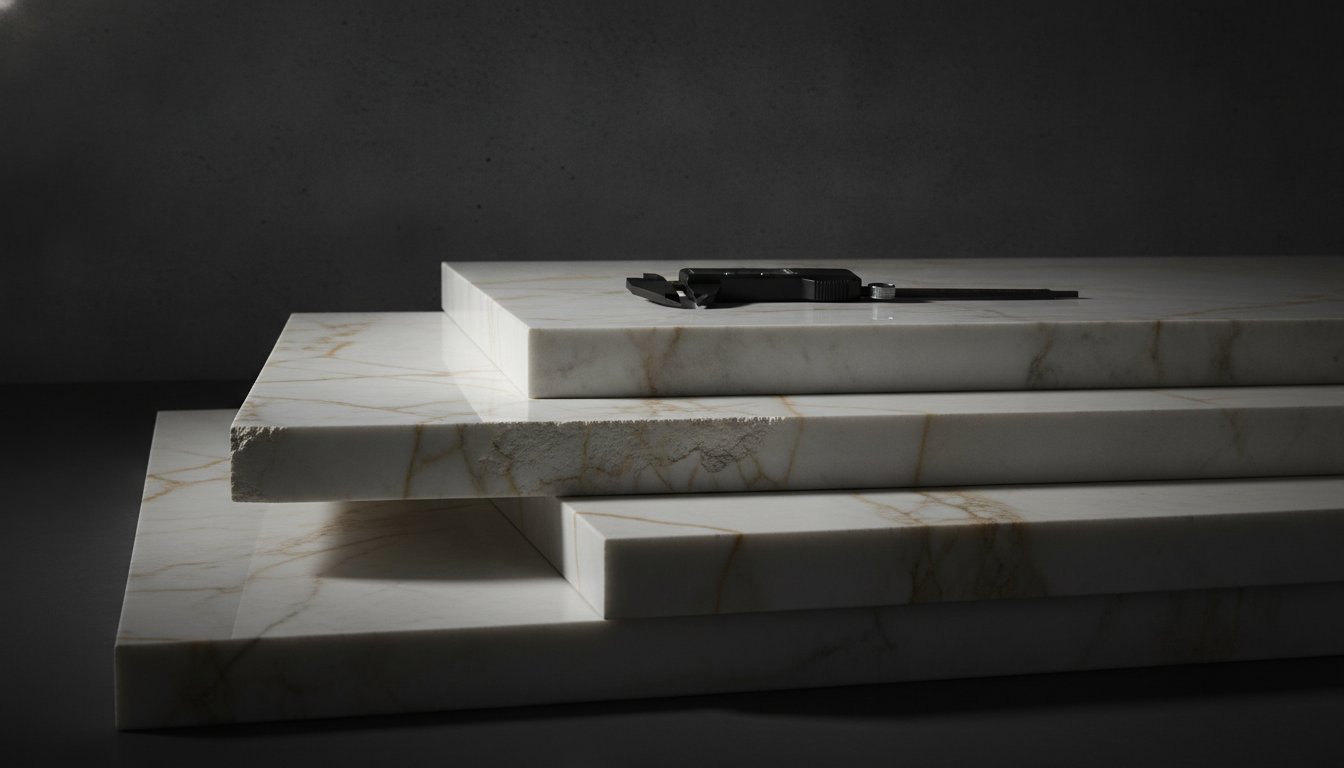
Can a single millimeter determine the success or failure of an architectural vision? When working with premium materials, marble slab thickness is not just a technical detail but the cornerstone of structural safety and the final aesthetic result. We know that choosing the right thickness often requires a delicate balance between the desire for lightness and the need for strength, especially when addressing the risks of breakage during installation or the load limitations of vertical cladding systems.
This guide has been created to provide you with a comprehensive understanding of how slab thickness influences the success of your projects, turning a technical requirement into a strategic advantage. We will explore the differences between the 2 cm and 3 cm standards, the potential of lightweight marble, and custom solutions for the most ambitious designs. By combining technical expertise with a passion for natural stone, you will discover how to optimize the strength-to-weight ratio, achieve flawless visual continuity, and preserve the timeless beauty of natural veining in your most prestigious creations.
Key Takeaways
- Discover why the 20 mm and 30 mm standards dominate the natural stone industry and how to select the ideal thickness to ensure the stability of every project.
- Learn about the aesthetic impact of edge profiles and how to determine the appropriate marble slab thickness to create bold or minimalist designs that reflect your creative vision.
- Explore the innovation of lightweight marble featuring honeycomb technology, capable of reducing structural weight by up to 70% without compromising the beauty of the natural material.
- Understand the relationship between the stone's petrographic characteristics and the need for structural reinforcements, such as resin treatment, to preserve the integrity of thinner slabs.
- Evaluate the advantages of sourcing directly from Italian quarries to obtain custom-cut slabs and carefully selected blocks tailored to the requirements of complex construction projects.
Table of Contents
- The Importance of Marble Slab Thickness: Standards and Variables
- Choosing the Right Thickness Based on Design Applications
- Lightweight Marble vs. Solid Slabs: Innovation and Tradition
- Technical Factors Affecting Slab Stability and Quality
- MARMISAVAS Sourcing and Consulting: Custom Thickness Solutions for Global Projects
The Importance of Marble Slab Thickness: Standards and Variables
The thickness of marble slabs is far more than a simple numerical specification. It forms the foundation upon which the entire technical feasibility of an architectural project depends. When we refer to nominal thickness, we mean the target measurement established during the cutting of the stone block at the processing facility. However, the most critical stage is the initial calibration process. This procedure evens out the slab surface by eliminating millimeter-level irregularities that could compromise installation. As a dimension stone, marble requires exceptional precision to ensure that every element fits perfectly within the overall design.
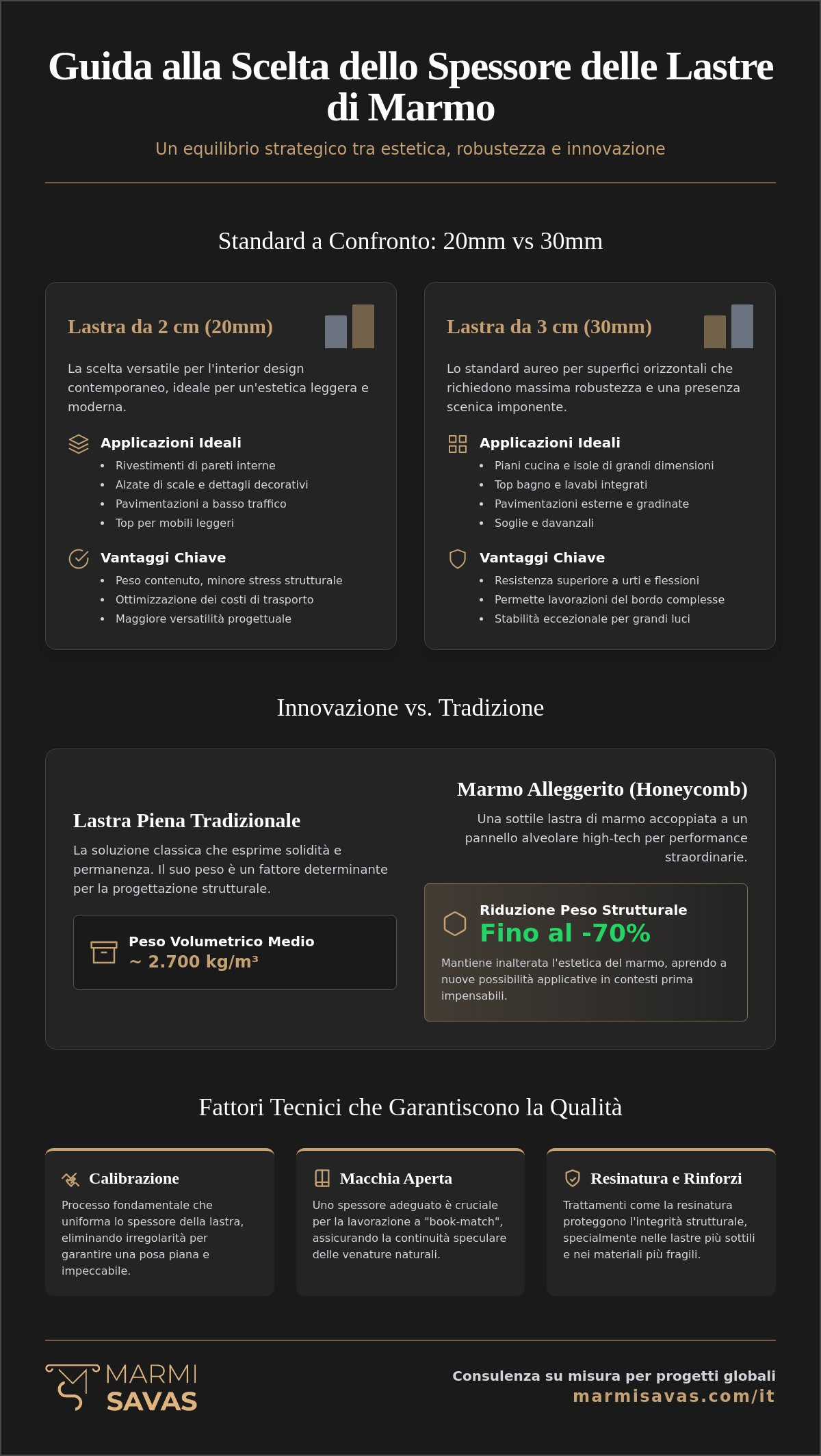
Over the years, the Italian natural stone industry has established 20 mm and 30 mm as the standard thicknesses for both historical and functional reasons. These dimensions maximize the yield from each extracted block while ensuring proven structural performance. Selecting the correct marble slab thickness directly influences the perception of luxury. Greater thickness conveys a sense of permanence and unmatched visual solidity, while thinner slabs express modernity and lightness. Load calculations should never be overlooked: with an average density of approximately 2,700 kg/m³, every additional centimeter requires careful assessment of the load-bearing capacity of the supporting structure.
2 cm Marble Slabs: Versatility and Common Applications
2 cm marble slabs represent the most versatile solution for contemporary interiors. They are the preferred choice for wall cladding, where minimizing weight is essential to avoid placing excessive stress on anchoring systems. Varieties such as Bianco Carrara, in this thickness, make it possible to create elegant stair risers and intricate decorative details. From a logistical perspective, 2 cm slabs optimize international shipping by allowing a greater number of square meters to be loaded into each container. However, one limitation remains: in environments subject to significant mechanical stress or constant vibration, 2 cm slabs may require additional structural support to prevent cracking.
3 cm Marble Slabs: Strength for Horizontal Surfaces
For projects that demand a strong visual presence and superior durability, the 3 cm slab is the gold standard. It is the ideal choice for Calacatta or Arabescato kitchen countertops and bathroom vanities, where the natural mass provides exceptional resistance to impacts and bending. The greater material density absorbs everyday stresses more effectively while allowing for deeper and more sophisticated edge profiles. In outdoor environments, 3 cm slabs are essential for flooring and staircases exposed to weather conditions and heavy foot traffic, ensuring that the installation maintains its structural integrity for decades to come.
Choosing the Right Thickness Based on Design Applications
Selecting the appropriate marble slab thickness is never a random decision. Every millimeter added or removed significantly changes the material's response to stress and its interaction with the surrounding space. Before determining the slab format, it is essential to conduct a thorough analysis of the supporting structure. A concrete substructure for flooring requires different tolerances than a metal frame used for ventilated façade cladding. To navigate these technical parameters, designers frequently rely on industry standards and tolerances, which are essential for ensuring that installation meets the safety and durability requirements expected in high-end architectural projects.
One aspect that is often overlooked is how slab thickness affects the visual appearance of natural veining, particularly in book-matched designs. In these applications, the seamless continuity of the natural pattern between adjacent slabs is the ultimate objective. An appropriate slab thickness allows for greater precision during cutting and subsequent polishing, ensuring that the marble's veining flows uninterrupted across corners and joints. In large-scale contract projects, such as luxury hotels or high-end fashion boutiques, slab thickness becomes a defining design element. Bold profiles communicate a sense of opulence and solidity that only natural stone can deliver.
Flooring and Wall Cladding
To achieve a flawless "total stone" effect, it is essential to coordinate the slab thickness across different surfaces. Using thinner slabs for wall cladding helps minimize joints while reducing the structural load, enhancing the overall brightness of the space. If you are planning a walkable surface, we recommend consulting our guide, Marble Flooring: A Guide to Choosing the Right Solution, to achieve the perfect balance between aesthetics and mechanical performance.
Countertops and Horizontal Surfaces
For kitchen countertops and bathroom vanities, slab thickness plays a crucial role in ensuring the secure installation of sinks and cooktops. While a 3 cm slab provides superior thermal and mechanical resistance, many designers prefer the appearance of a solid, thick slab. This effect is achieved by joining 2 cm slabs with a 45-degree mitered edge, creating the illusion of a much thicker slab without placing excessive weight on the cabinetry below. This technique requires millimeter-level precision in edge fabrication.
Every unique project deserves a dedicated evaluation to balance structural requirements with creative vision. If you are defining the technical specifications of your next project, you can request a personalized consultation to identify the most suitable solution.
Lightweight Marble vs. Solid Slabs: Innovation and Tradition
The debate between using solid marble slabs and modern composite solutions continues to divide interior design professionals. On one side stands the centuries-old tradition of solid natural stone; on the other, cutting-edge engineering that pushes the limits of structural weight. Honeycomb technology, for example, bonds an ultra-thin layer of marble—typically between 3 and 5 mm thick—to an aluminum honeycomb backing. This innovation makes it possible to achieve the visual impact of a substantial marble slab while reducing its structural weight by up to 70% compared to a traditional solid slab of the same overall thickness.
However, it is essential to distinguish between nominal thickness and actual thickness, a technical detail that is often overlooked during the early stages of a project. A solid slab with a nominal thickness of 20 mm may measure approximately 18 mm after final polishing on site. This tolerance is crucial for correcting minor surface irregularities during installation. Composite materials, by contrast, feature such a thin layer of natural stone that extensive post-installation polishing is virtually impossible. Removing too much material may expose the resin layer or the metal backing, permanently compromising the appearance of premium marbles such as Bianco Carrara or Calacatta.
Special Applications: Marine and Aerospace Industries
In industries where every kilogram affects performance, such as luxury yacht construction and private aviation, lightweight marble slabs are often the only practical solution. They make it possible to incorporate natural marble even into ceilings and cabin partition walls. Lightweight backing systems not only reduce weight but must also comply with strict fire safety and certification standards. This represents the perfect fusion of the timeless beauty of natural stone and advanced aerospace engineering, bringing the elegance of Arabescato marble to applications where excessive weight once made its use impossible.
The Value of Solid Marble Slabs in Restoration Projects
Despite technological advances, solid marble slabs remain the preferred choice for architectural projects designed to stand the test of time. A solid slab is a long-term investment that retains its value for generations. Its ability to be honed, polished, and restored repeatedly allows the stone to regain its original beauty even after decades of heavy use. This exceptional durability is one of the primary reasons why many architects continue to favor the authenticity and substance of solid natural stone. To explore these concepts in greater depth and separate marketing claims from technical reality, we invite you to read our editorial, Natural Stone: Truths and Common Myths, where we examine the balance between performance and timeless elegance.
Technical Factors That Influence Slab Stability and Quality
The stability of an architectural project depends not only on its design but also on a thorough understanding of the material itself. Petrography, the study of rock composition, plays a crucial role in determining the appropriate marble slab thickness. Not all types of marble respond the same way during the cutting process. Crystalline varieties, which are denser and more compact, allow for precise cutting even at reduced thicknesses. In contrast, marbles with pronounced veining or brecciated structures require greater thickness to withstand the internal stresses released during block cutting.
To ensure the integrity of every slab, modern technology relies on resin treatment and the application of fiberglass mesh reinforcement on the back of the slab. These solutions are particularly important for thinner slabs, as they help distribute loads evenly and reduce the risk of accidental breakage. However, the final quality ultimately depends on professional calibration. A slab with inconsistent thickness can irreversibly compromise installation flatness, creating noticeable lippage between adjacent pieces. This risk becomes even more significant with large-format slabs, where a variation of just one millimeter can make perfect surface alignment impossible.
Mechanical Strength and Marble Type
Each marble variety has its own structural characteristics. Calacatta Marble, for example, is renowned for its dramatic veining, which also represents naturally weaker structural areas. For this reason, it often requires a minimum thickness of 20 mm or additional reinforcement compared to the more uniform Bianco Carrara. Mineral inclusions and color variations are not merely aesthetic features; they are technical indicators that reveal how the material will respond to mechanical stress over time. Selecting an inadequate slab thickness for a more delicate marble variety can compromise the long-term durability of the entire project.
Professional Slab Thickness Inspection
Quality assurance begins with a rigorous inspection of millimeter-level thickness tolerances across the entire perimeter of every slab. At MARMISAVAS, we use advanced digital sensors to detect any deviations in manufacturing precision before shipment. This inspection process allows us to identify internal stresses that are invisible to the naked eye but could lead to cracks after cutting or during installation. Only precise calibration ensures that the marble maintains both its beauty and structural stability once installed.
If you want to ensure that your selected material meets the highest technical standards for your project, you can request a dedicated technical consultation from our team of experts.
MARMISAVAS Sourcing and Consulting: Custom Thickness Solutions for Global Projects
MARMISAVAS has established itself as a strategic partner for professionals who refuse to compromise on the quality of natural stone. Our strength lies in serving as a direct link between Italy's historic quarries and some of the world's most prestigious construction projects. When a project requires marble slab thicknesses beyond standard industry specifications, we carefully select blocks directly at the quarry according to rigorous quality criteria. This approach ensures that the stone retains its structural integrity from the moment it is extracted, preventing the microfractures that often result from unsuitable mass-production processes. We do more than simply supply stone—we carefully oversee the selection process to ensure that every slab fulfills both the aesthetic and functional expectations of your design.
Transparency is at the core of our international consulting services. We provide an advanced remote inspection service that includes detailed technical reports for every selected slab. Every parameter—from millimeter-accurate calibration to the flawless continuity of natural veining—is documented through high-resolution images and objective technical data. Monitoring marble slab thickness throughout every stage of the sourcing process is essential for the success of complex projects, particularly where installation tolerances are extremely tight. We also understand that transporting slabs with critical thickness specifications requires exceptional care. For this reason, we use reinforced packaging and certified wooden crates specifically designed to protect the material during long-distance sea and land transportation, ensuring that every slab arrives ready for installation without unexpected issues.
Technical Consulting for Architects and Designers
Our team supports architects and designers from the earliest stages of project planning, helping them determine the ideal slab thickness based on both technical performance requirements and the project's aesthetic vision. Whether for a luxury residential development or a large-scale contract project, we carefully select matching slabs to ensure a harmonious visual result. We always encourage our partners to evaluate the material's consistency, weight, and interaction with light. To facilitate this process, we offer a rapid sampling service that allows clients to experience the quality of Italian marble firsthand before confirming large-volume orders.
From Quarry to Design Studio: A Process Without Compromise
Every slab that leaves our facilities undergoes a rigorous quality control process with no exceptions. We provide complete transparency regarding the geological origin of every stone, enabling professionals to work with confidence and complete peace of mind. Our goal is to eliminate uncertainty throughout the construction process by transforming natural stone into a reliable architectural material with predictable performance characteristics. Contact us for a technical consultation on your next project and discover how our sourcing expertise can elevate the quality standards of your most ambitious architectural achievements.
Shape the Future with the Excellence of Natural Stone
Choosing marble with expertise transforms an idea into a timeless masterpiece. We have explored how marble slab thickness influences every aspect of a project, from structural stability to the seamless continuity of natural veining. Balancing the strength of a solid slab with the load requirements of modern cladding systems demands a deep understanding of the material and its unique characteristics. MARMISAVAS stands alongside international architectural firms, helping them navigate these technical complexities with expertise and passion.
Through our direct sourcing from the finest Italian quarries, we provide access to premium-quality blocks in prestigious varieties such as Calacatta and Arabescato. Our dedicated technical support ensures that every detail aligns with your creative vision, delivering outstanding results for projects around the world. Contact MARMISAVAS to select the perfect marble slabs for your next project. We are ready to become your trusted partner in creating luxurious spaces that celebrate the timeless beauty of Italian natural stone.
Frequently Asked Questions
What is the standard marble slab thickness for a kitchen countertop?
The ideal thickness for a marble kitchen countertop is 3 cm. This thickness provides the strength needed to support appliances and accommodate undermount sinks while offering the natural mass that better withstands everyday impacts. Although a 2 cm slab can be used with appropriate reinforcement, 3 cm remains the industry standard for structural stability and premium aesthetics.
Can 2 cm marble slabs be used for high-traffic flooring?
Yes. 2 cm marble slabs are widely used for both interior and exterior flooring, provided the substrate is perfectly level and structurally sound. However, for commercial environments subjected to heavy loads or intense foot traffic, we recommend considering 3 cm slabs. Selecting the appropriate marble slab thickness ensures long-term structural integrity and minimizes the risk of cracking.
What is a "calibrated" slab thickness, and why is it important?
Calibrated thickness refers to a slab that has undergone precision machining to achieve a perfectly uniform thickness across its entire surface. This process is particularly important for large-format slabs because it eliminates millimeter-level variations that could otherwise create uneven surfaces or lippage during installation. Accurate calibration reduces installation time while ensuring a flawless visual result, especially in projects featuring minimal joints.
Is lightweight marble as durable as traditional solid marble?
Lightweight marble provides excellent structural performance thanks to its honeycomb backing system, but it differs from solid marble in several respects. Since the natural stone layer is typically only a few millimeters thick, it is more susceptible to deep scratches and cannot be repeatedly honed or polished over time. It is an outstanding solution for applications such as luxury yachts, private aircraft, and ceilings, where weight reduction is the primary concern, but it requires more careful maintenance.
How does slab thickness affect the final price?
Slab thickness directly influences cost in proportion to the volume of stone extracted and the associated transportation expenses. In general, a 3 cm slab costs approximately 40–50% more than a 2 cm slab of the same marble variety. The additional weight also increases international shipping costs and requires more robust handling equipment during installation.
Is it possible to request custom slab thicknesses greater than 3 cm?
Absolutely. Custom thicknesses can be produced directly from carefully selected quarry blocks. Thicknesses exceeding 3 cm are commonly requested for monolithic architectural elements such as carved stone sinks, massive stair treads, and monumental entrances. These custom orders require advance planning to ensure the selection of blocks with the size and structural integrity necessary to support greater thicknesses.
What are the risks of choosing a slab that is too thin for exterior cladding?
Selecting a marble slab thickness that is too thin for exterior applications increases the risk of breakage caused by thermal expansion, temperature fluctuations, and wind loads. Thinner slabs have a lower capacity to absorb structural stresses and are more vulnerable to impact damage. For ventilated façades and exterior cladding exposed to the elements, the recommended minimum thickness is generally 2 cm.
Does MARMISAVAS provide support for calculating slab weight for export?
Yes. We provide comprehensive technical reports that include precise volumetric weight calculations for every international shipment. Since marble has an average density of approximately 2,700 kg/m³, we assist our clients in optimizing container loads and selecting the most suitable reinforced packaging solutions. This support is essential for ensuring safe transportation and efficient global logistics management.