Marble Slab Thickness Options: A Technical and Aesthetic Guide for Luxury Projects
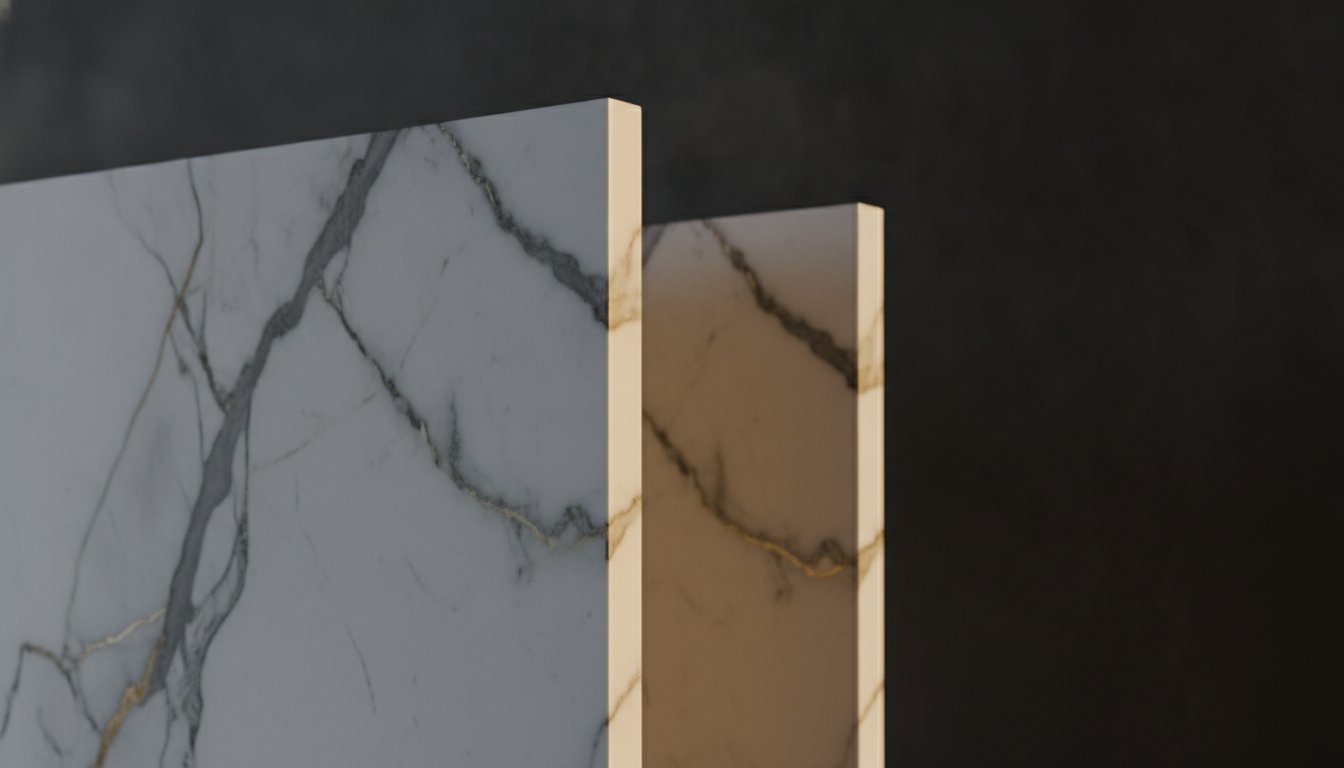
Choosing the thickness of a marble slab is not a simple technical decision, but an act that defines the architectural soul of a luxury project. Many professionals evaluate the various marble slab thickness options with extreme care to understand how they influence not only structural strength, but also the perception of prestige within a space. It is the subtle boundary between a surface that appears fragile and one that conveys a sense of eternity, transforming natural material into a monumental design element.
We know how complex it can be to balance the aesthetic desire for an imposing profile with structural load limits or the fear of accidental breakage during the delicate installation stages. This guide will provide you with the tools needed to select the perfect thickness for each specific application, ensuring that your creative vision achieves the right balance between functionality and beauty without any compromise in quality.
We will examine the performance differences between the 2 cm and 3 cm standards, analyzing how these choices affect the durability of kitchen countertops and the lightness of vertical cladding. You will discover how to optimize the project budget without sacrificing the integrity of the material, ensuring a final result that is safe, majestic and technically flawless in every detail.
Key Points
- Discover how the different marble slab thickness options influence not only aesthetics, but also the structural integrity and longevity of your luxury projects.
- Compare the technical and economic advantages of the 2 cm and 3 cm standards to optimize the budget while maintaining the highest quality standards.
- Identify the ideal thickness for each application, from high-strength kitchen countertops to ultra-lightweight panels for the nautical and aeronautical sectors.
- Learn how to correctly calculate weight and load-bearing requirements to ensure safe installation and a flawless aesthetic rendering of the natural veining.
- Understand the importance of sourcing directly from Italian quarries to ensure uniformity and technical precision in large-scale contract supplies.
Contents
- The Importance of Thickness in the Selection of Premium Marble
- Industry Standards: Comparison Between 2 cm and 3 cm Slabs
- Ideal Applications Based on Natural Stone Thickness
- Technical Considerations for Architects and Designers
- Excellence in Sourcing: Custom Slabs with MARMISAVAS
The Importance of Thickness in the Selection of Premium Marble
Choosing among the different marble slab thickness options is not a simple technical detail relegated to the final stage of a construction project. It is a fundamental decision that affects the very feasibility of an architectural work. In the natural stone industry, it is essential to distinguish between nominal thickness, meaning the thickness requested at the ordering stage, and actual thickness. The latter may vary slightly due to cutting tolerances and surface finishing processes. Understanding these nuances is vital for anyone working with complex natural materials. For an overview of the categories of stone used in architecture, it is useful to consult a Dimension Stone Overview, which clarifies how marble fits into the context of building materials.
Premium varieties such as Calacatta marble require specific design sensitivity. The crystalline structure and arrangement of the natural veining may suggest minimum recommended thicknesses to prevent the slab from becoming too fragile during processing. The critical mass of the material directly influences our tactile and visual perception; greater volume conveys a strength that only authentic stone can offer.
Beyond Functionality: The Visual Impact of Volume
Thickness defines the aesthetic character of a furnishing or structural element. A 3 cm slab immediately conveys a sense of solidity and timeless luxury. It is the preferred choice for kitchen islands that must dominate the space with an imposing presence. In contrast, contemporary minimalist design often favors reduced thicknesses to achieve an ethereal lightness. In these cases, marble becomes a thin skin that covers pure geometric volumes, preserving the elegance of the veining while reducing the overall volumetric impact. Correctly evaluating the marble slab thickness options makes it possible to calibrate the visual weight of marble in harmony with the rest of the interior.
Structural Integrity and Long-Term Durability
Resistance to bending and impact loads is closely linked to the millimeters of the slab. Choosing the correct thickness is the first step in preventing cracks and fractures caused by mechanical stress or minor settlement of the supporting structure. While thinner slabs require continuous supports and specific installation techniques, greater thickness provides superior inherent stability, which is particularly valuable in high-traffic environments. The longevity of a natural stone work is inseparably linked to the ability of the selected thickness to withstand the challenges of time and daily wear.
Industry Standards: Comparison Between 2 cm and 3 cm Slabs
In the dimension stone market, the distinction between 20 mm and 30 mm lies at the heart of technical planning. The different marble slab thickness options are not interchangeable; every additional millimeter radically transforms the physical properties and visual appearance of the slab. Following the Natural Stone Institute Standards is essential to ensure that the selected thickness complies with the safety and durability criteria required by European regulations.
The cost factor is directly proportional to the volume of material extracted. A 3 cm slab uses 50% more raw marble than a 2 cm slab. This affects the price per square meter, but it often reduces secondary processing costs, such as the application of structural reinforcements. Classic varieties such as Bianco Carrara Marble are usually available in both standard thicknesses, allowing designers to maintain color consistency while varying the material substance between flooring and worktops.
The Versatility of 20 mm Slabs
The 2 cm slabs, with an approximate weight of 55 kg/m², represent the ideal solution for vertical cladding and indoor flooring. Their lightness greatly facilitates logistics and handling on site, especially in historic buildings or on upper floors. This thickness is perfect for complex cuts and decorative inlays, where precision of detail takes precedence over structural mass. It is the preferred choice when the goal is to minimize the permanent load on floor structures without sacrificing the elegance of natural marble.
The Solidity and Prestige of 30 mm
For kitchen countertops and surfaces subject to heavy stress, 3 cm is considered the standard of excellence. Weighing approximately 80 kg/m², these slabs provide inherent stability that allows overhangs and self-supporting areas to be managed more safely. Greater thickness also makes it possible to create more elaborate edge profiles, such as an owl’s-beak profile or shaped waterfall edges, which enhance the depth of the veining. If your project requires a monumental visual presence, you can request a technical consultation to evaluate the use of customized thicknesses exceeding 4 cm, ideal for massive staircases or monolithic architectural elements.
Ideal Applications Based on Natural Stone Thickness
The intended use of a slab determines its ideal technical configuration. Choosing among the different marble slab thickness options means understanding how the marble will interact with the surrounding space over the long term. In renovation projects, for example, it is essential to balance the desired aesthetics with the existing structural load. This prevents excessive stress on original floor structures, which were often not designed to support monumental weights. For cutting-edge applications, such as aeronautical or nautical design, ultra-thin thicknesses reinforced with honeycomb are often used; here, every kilogram saved is vital to the performance of the vessel or aircraft without sacrificing the prestige of authentic stone.
When working with dynamic varieties such as Arabescato Marble in large formats, thickness becomes an ally of visual continuity. The oval veining and bold contrasts of this material require a stability that only the correct thickness can ensure during handling. This is especially true when the aim is to create spectacular open-book effects, where millimeter-precise cutting is the only way to achieve perfect symmetry.
Wall Cladding and Lightweight Solutions
For vertical cladding, the primary objective is to minimize suspended mass without losing rigidity. The 2 cm slabs offer the perfect compromise. They are strong enough to be processed safely, yet light enough not to overload load-bearing walls. This choice is ideal for contemporary wood paneling or elegant fireplace surrounds. In the case of translucent marbles or onyx, reduced and calibrated thicknesses allow the integration of LED backlighting systems. The stone is thus transformed into a natural light source. Strictly following the Natural Stone Institute standards ensures that every panel adheres perfectly to the selected support, eliminating any risk of accidental detachment.
Kitchen Countertops, Bathrooms and High-Traffic Surfaces
Intensively used horizontal surfaces require superior mechanical strength. A kitchen countertop must withstand impacts, localized weights and daily thermal shocks; the 3 cm standard remains the most reliable choice for ensuring the longevity of the investment. In bathrooms, selecting the thickness for shower trays and vanities must allow the correct slope for water drainage without weakening the stone structure. For flooring, an adequate thickness ensures that the marble does not develop microcracks caused by minor movements in the underlying screed. The result is a level, stable and safe surface that lasts for decades.
Technical Considerations for Architects and Designers
Designing with natural stone requires millimeter precision that goes far beyond pure aesthetics. A carefully considered choice among the different marble slab thickness options directly affects the structural behavior of the building and the successful execution of the tender specifications. An architect must know how to translate a creative vision into rigorous technical specifications, anticipating how the weight and strength of the marble will influence every stage, from on-site handling to final installation.
A crucial technical aspect, often overlooked in general guides, concerns the relationship between thickness and “open-book” techniques (book-matching). In slabs cut consecutively from the same block, thickness determines the accuracy of the symmetry. Standard 2 cm thicknesses allow the veining to “close” with extreme precision, making them ideal for dramatic walls where the natural pattern must flow without visible interruptions. To evaluate the economic impact of these choices on your budget, consult our guide to marble prices per square meter.
Specific Weight and Support Requirements
Calculating the structural load is the starting point for every safe installation. A 2 cm slab weighs an average of 55 kg/m², while a 3 cm slab weighs approximately 80 kg/m². For a quick estimate, multiply the thickness in meters by the slab area and the density of the marble, which is usually around 2,700 kg/m³. Large kitchen islands or cantilevered installations often require structural steel reinforcements or reinforced supports to manage the mass of the 30 mm slabs, especially during the delicate manual handling stage.
Edge Profiles and Finishing Processes
The physical thickness of the slab defines the geometric limits of edge processing. While an eagle’s-beak profile or a full bullnose necessarily requires 3 cm to express its roundness, contemporary design often makes use of the illusion of thickness. By using a 45-degree edge, 2 cm slabs can be joined to create the appearance of very massive volumes without weighing down the structure. The choice of profile must harmonize with the selected Carrara marble finishes, ensuring that every joint is invisible and every corner is finished to the highest professional standard. To define the technical details of your next contract project, we invite you to contact our expert consultants.
Excellence in Sourcing: Custom Slabs with MARMISAVAS
Working with MARMISAVAS means choosing a partner that approaches marble as an aesthetic and technical mission. We are not mere distributors; we act as expert consultants who select the finest blocks directly from Italian quarries. Our in-depth knowledge of the material enables us to guide you through the different marble slab thickness options, ensuring that every slab meets the parameters required for your project. We guarantee rigorous thickness uniformity even in large-scale contract supplies, eliminating uneven levels that could compromise installation quality. We invite you to discover our selection of White Marble, where the variety of veining meets the precision of industrial cutting.
Our ability to select material at the quarry is a competitive advantage for architects and designers. Choosing the right slabs for book-matching requires an expert eye capable of anticipating how thickness will affect the continuity of the natural pattern. We ensure that every batch maintains millimeter-level consistency, facilitating the work of fabricators and guaranteeing a final result that faithfully reflects your original vision.
Customized Thickness for Unique Projects
Every high-end architectural project presents challenges that require customized solutions. Our custom-cutting service responds precisely to this need, offering non-standard thicknesses that go beyond the classic 20 or 30 mm. This level of customization is essential for monolithic furnishings or ventilated façades that require specific weights calculated to the millimeter. We constantly monitor slab flatness, ensuring minimal tolerances that facilitate the work of fabricators. Whether your search is focused on the brilliance of Calacatta or the magnetic contrast of Black Marble, you will receive dedicated consultation to balance mass, strength and color rendering.
From Italy to the World: Guaranteed Logistics and Quality
The excellence of Italian sourcing must be preserved until final installation. Our logistics system is structured to manage the inherent fragility of natural slabs, regardless of their thickness. We use certified wooden crates and fastening systems that prevent any microcracking during long sea or land journeys. We know that adherence to the project schedule is vital to the success of a large construction site; for this reason, we coordinate every shipment with maximum operational efficiency. We bring the timeless beauty of Italian quarries to the world’s most ambitious projects, ensuring that every piece arrives at its destination in flawless condition. For a detailed technical assessment or to receive specific samples, you can Request Information through our technical office.
Defining Excellence Through Material Precision
Choosing the correct thickness transforms a simple stone slab into a lasting architectural masterpiece. We have explored how the different marble slab thickness options influence not only the stability of large kitchen islands, but also the ethereal lightness of wall cladding. Millimeter precision in cutting is the only way to ensure that the natural beauty of Italian marble remains intact over time. This approach eliminates structural risks and optimizes every stage of installation.
MARMISAVAS stands by your side as a specialized supplier of premium Italian marble, offering dedicated technical support to architects and designers seeking perfection in every detail. We have a wide range of slabs available for immediate delivery, carefully selected to ensure uniformity and superior quality in every batch. Our experience in sourcing directly from quarries enables us to provide customized solutions that meet the most ambitious architectural challenges of contemporary design.
Contact MARMISAVAS for technical advice on thickness options for your project. We are ready to collaborate with you to elevate the standard of your creations, bringing the authentic prestige of natural stone into every space.
Frequently Asked Questions
What is the standard thickness of a marble slab?
The industry standards for marble slabs are 2 cm (20 mm) and 3 cm (30 mm). These formats cover the vast majority of residential and commercial architectural applications. The 2 cm thickness is the most common choice for flooring and vertical cladding. The 3 cm thickness is preferred for horizontal surfaces that require greater inherent structural solidity.
Is it better to use 2 cm or 3 cm for a marble kitchen countertop?
A thickness of 3 cm is the best solution for a kitchen countertop due to its superior mechanical strength. This measurement makes it possible to manage the cutouts required for sinks and cooktops more safely, reducing the risk of cracking. Although 2 cm slabs can be used with reinforcing supports, 30 mm offers superior stability and a more monumental aesthetic.
How does slab thickness affect the final price per square meter?
Thickness affects the cost because a 3 cm slab requires 50% more raw material than a 2 cm slab. The increase in logistics costs associated with the greater weight during transportation must also be considered. However, choosing 3 cm can sometimes simplify processing stages, eliminating the need for complex bonding to create edges with a massive appearance.
Can I request marble slabs thicker than 3 cm?
Yes, it is possible to request thicknesses greater than 3 cm for special projects such as massive staircases or monolithic architectural elements. These variants are made to order from blocks selected directly at the quarry. MARMISAVAS offers technical consultation to assess the feasibility of these special marble slab thickness options, ensuring that every piece meets the load-bearing requirements of your specific project.
What is the minimum recommended thickness for wall cladding?
The minimum recommended thickness for wall cladding is usually 2 cm. This measurement provides the rigidity needed for safe installation using adhesives or mechanical anchoring systems. In specific contexts, such as nautical design, reduced thicknesses reinforced with technical supports can be used, but 20 mm remains the benchmark standard for ensuring flatness and long-term durability.
Does thickness affect the visibility of the veining in Calacatta marble?
Thickness does not alter the beauty of the surface veining, but it affects the precision of open-book techniques. In Calacatta marble, consecutive slabs cut to 2 cm allow an almost perfect symmetry of the natural pattern. Greater thickness, however, enables deeper and more elaborate edge processing, enhancing the three-dimensional quality of the stone and the visual depth of its distinctive gray and gold veining.
Is thicker marble always more resistant to stains?
No, thickness does not affect the porosity of the material or its chemical resistance to stains. Absorption capacity depends exclusively on the geological variety and the quality of the applied protective treatment. Both a thin slab and a massive one require the same periodic maintenance and the use of specific sealants to preserve the original appearance of the natural stone against acidic substances or liquids.
What is the approximate weight of a 2 cm marble slab?
A 2 cm marble slab weighs an average of 55 kg per square meter. This figure is essential for calculating the permanent load on supporting structures and safely organizing on-site logistics. Correctly evaluating the different marble slab thickness options makes it possible to plan the necessary structural reinforcements, ensuring that the final installation is stable and complies with all safety regulations in force in Italy.