Marmo Verde Alpi: The Timeless Elegance of Italian Stone
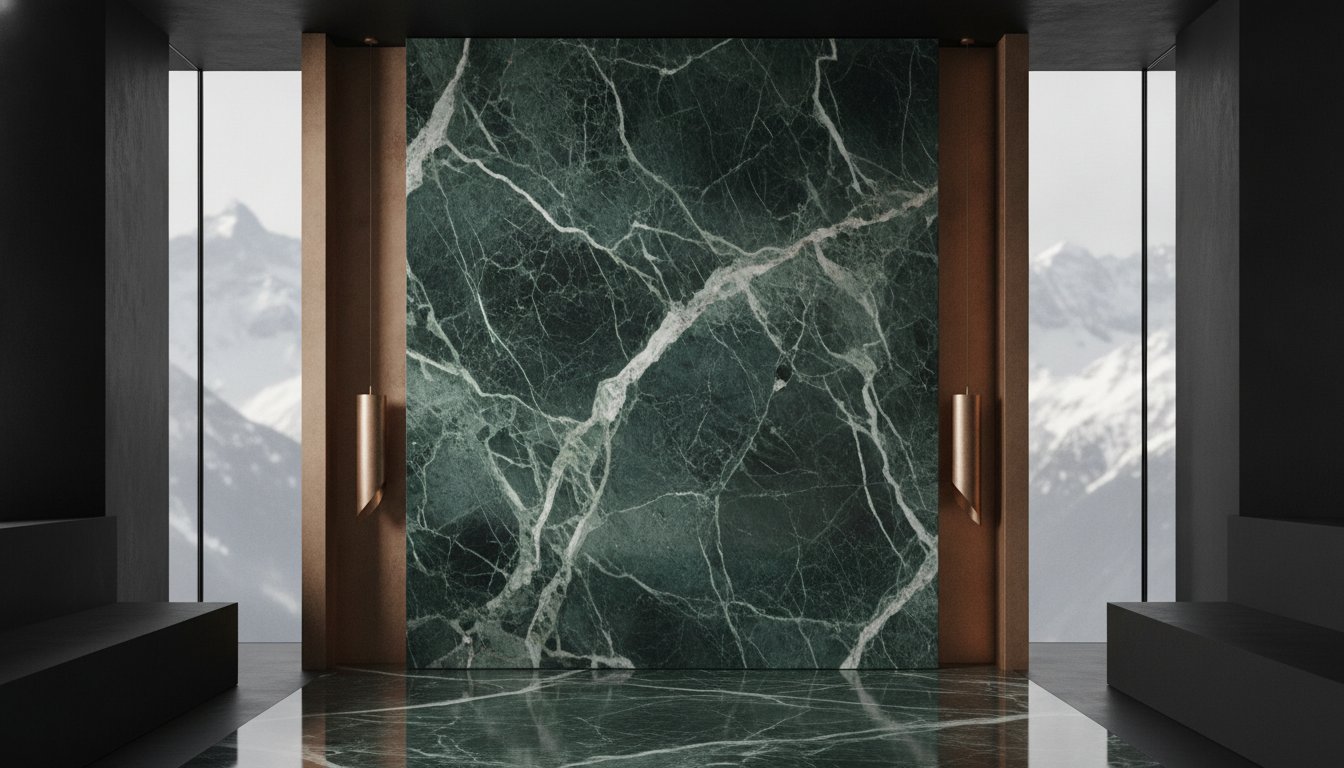
What if the secret to transforming a luxury interior into an oasis of well-being didn't lie in the minimalism of white, but in the chromatic depths of a stone that breathes geological history? Many designers fear that such intense shades might weigh spaces down or present critical issues in humid environments like bathrooms. This is a legitimate doubt for those seeking aesthetic excellence but requiring, at the same time, impeccable functionality and simple maintenance.
In this in-depth analysis, you will discover the distinctive characteristics, the most sophisticated design applications, and the technical secrets of Verde Alpi marble for your prestigious projects in 2026. We will guide you through the origin of this unique material, extracted in the heart of the Aosta Valley, explaining how recent Italian regulations on the management of processing residues are making the supply chain more circular and sustainable. We will see together how to select the best slabs and how to enhance natural veins to create contemporary environments that celebrate the eternal beauty of Italian nature, guaranteeing an investment of absolute value for every client.
Key Points
- Understand the geological identity of Verde Alpi marble as an ophicalcite and its exclusive origin in the quarries of the Aosta Valley.
- Discover how to integrate this stone into contemporary design through chromatic combinations with warm metals and light materials.
- Identify ideal architectural applications, from vertical claddings for luxury lobbies to flooring with refined inlays.
- Learn technical secrets to preserve the stone's luster, managing acid sensitivity with the most effective protective treatments.
- Learn fundamental criteria for slab selection, evaluating vein continuity and chromatic homogeneity for large surfaces.
Table of Contents
- What is Verde Alpi Marble: Origin and Geological Characteristics
- Aesthetics and Design: The Return of Green Marble in Prestigious Interiors
- Architectural Applications: Where to Use Verde Alpi
- Technical Properties and Stone Maintenance
- Sourcing and Selection: Choosing the Perfect Verde Alpi Slab
What is Verde Alpi Marble: Origin and Geological Characteristics
The magnetic charm of Verde Alpi marble lies in its hybrid nature. Technically, we are not talking about a traditional marble, but an ophicalcite. This metamorphic rock was formed millions of years ago during the Alpine orogeny, when tectonic movements fused magmatic and sedimentary rocks. The result is a material of extraordinary compactness, extracted exclusively in the Italian Western Alps, with the heart of production located in the historic quarries of the Aosta Valley.
In 2026, this stone has become a symbol of aesthetic sustainability for architecture of excellence. A recent measure by the Budget Committee of the Italian Senate, approved in January 2026, classified stone processing residues as by-products rather than waste. This regulatory evolution promotes the circular economy, allowing designers to choose Verde Alpi marble with the awareness of supporting a supply chain that minimizes environmental impact and values every fragment of natural matter.
The Geology of Luxury: Why It Is Not a Common Marble
Unlike classic calcareous marbles, the structure of Verde Alpi is dominated by serpentine. It is this mineral that gives it its typical forest green coloration and a higher-than-average hardness. With a density ranging between 2680 and 2710 kg/m³, this stone offers remarkable compressive resistance, reaching peaks of 194 MPa. The presence of crystalline calcite within the dark matrix acts as a natural binder, ensuring a mirror-like polish that few other materials can match. Every extracted block is a unique piece; variations between different Alpine quarries determine the prevalence of emerald tones or darker shades, close to deep black marble.
Chromatic Varieties and Natural Textures
The visual impact of this stone is defined by a sharp and vibrant chromatic contrast. The dark green background, almost black in some variants, is crossed by a dense network of white veins. These lines are not simple marks, but calcite crystals that capture and reflect natural light, creating a sense of three-dimensional depth. When light hits a polished slab, the surface seems to come alive, revealing shades ranging from malachite green to deep forest.
"Verde Alpi captures the chromatic essence of coniferous forests, bringing the force of nature inside urban architecture."
This quote perfectly summarizes why designers and architects choose this material for their most ambitious projects. Its ability to dialogue with the surrounding space makes it ideal for those who desire an elegance that does not follow passing trends, but roots itself in the geological history of the territory.
- Water absorption: Extremely reduced, between 0.0095% and 0.38%.
- Flexural strength: Approximately 33.2 MPa, ideal for large formats.
- Reference standard: Compliant with European regulations EN 14617 for technical quality.
Aesthetics and Design: The Return of Green Marble in Prestigious Interiors
Contemporary design is strongly rediscovering the chromatic power of natural stone, moving away from flat grays to embrace more organic and vibrant shades. Verde Alpi marble fits perfectly into this evolution, becoming the undisputed protagonist of biophilic design. This design approach aims to bring nature back inside living spaces, using materials that evoke the outside world. The Alpine stone, with its shades reminiscent of coniferous forests, creates an immediate visual bridge with the mountain landscape, giving a sense of calm and stability to indoor environments.
The use of this material is not a novelty, but a confirmation of class. An iconic example of its masterly application is the Barcelona Pavilion designed by Mies van der Rohe. In this fundamental work of modern architecture, green stone is used to create walls that are true natural works of art. Today, just as then, inserting a surface in this marble means creating a "statement" element, a focal point that captures attention and defines the character of an entire room, be it a lobby of a luxury hotel or the living room of a private residence.
Material Contrasts: Pairing Verde Alpi with White Marble
The secret to enhancing such a dark and intense stone lies in the game of contrasts. The dialogue between deep green and the luminosity of Bianco Carrara Marble represents the pinnacle of sophisticated elegance. In palettes for high-level contract projects, the use of White Marble as a neutral base allows the veins of Verde Alpi to emerge with visual power. This combination not only serves to balance light but creates a dynamic rhythm in the space. The integration of warm metals, such as satin brass or rose gold, completes the work by adding a touch of warmth that softens the natural coldness of the stone.
Finishes and Visual Rendering: From Polished to Leather
The choice of finish radically transforms the perception of color and texture. Each process responds to a specific aesthetic need:
- Polished finish: The classic choice for those who desire maximum chromatic depth. The reflective surface accentuates the contrast between the dark background and crystalline veins, making the color appear almost liquid.
- Honed finish: Gives a more sober and velvety appearance. It is perfect for minimalist environments where you want to avoid direct light reflection while keeping the material's elegance intact.
- Leather (brushed) finish: This process follows the natural irregularities of the rock. To the touch, it restores the feeling of live stone, adding a precious sensory dimension for vertical claddings or furniture accessories.
Architectural Applications: Where to Use Verde Alpi
The applications of Verde Alpi marble range from large contract projects to the most exclusive private residences, confirming it as a choice of election for those seeking a monumental visual impact. Thanks to its high density, this material lends itself to uses that require both aesthetic excellence and structural resistance. In luxury hotel lobbies, it is often employed for full-height vertical claddings, where the deep color creates an atmosphere of sophisticated and timeless welcome. There is no shortage of prestigious flooring, where large fields allow appreciation of the natural variability of the veins, transforming a simple walking plane into a mineral carpet of rare beauty.
The Art of Book-Matching
To obtain the most spectacular visual impact, many designers choose the book-matching technique. Arranging marble slabs symmetrically allows the creation of natural geometric patterns that recall organic symmetries or abstract landscapes. Verde Alpi is particularly suitable for this type of installation thanks to its distinct white veins that contrast sharply with the dark background. We advise designers to select blocks with extreme care, evaluating the frequency and direction of crystalline veins to ensure that design continuity is maintained across the entire surface of the feature wall, especially if integrated with backlighting systems that enhance its depth.
Verde Alpi in Bathroom and Kitchen: Practical Advice
Understanding the geological nature of this stone is fundamental for its correct application in technical environments. Being an ophicalcite, Verde Alpi features a mixed composition of serpentine and calcite. This peculiarity makes it technically harder and less porous compared to classic pure calcitic marbles, offering excellent resistance in humid environments. It is an excellent choice for creating a natural spa effect, cladding shower walls and vanity tops with a stone that recalls the freshness of water and mountain vegetation.
For those who manage these spaces dedicated to personal care, adopting beauty tech solutions like panema.it represents the ideal complement to guarantee a fluid organization aligned with the surrounding design.
It is important to consider that the presence of calcite veins requires specific precautions. Although it represents a sought-after alternative to classic black marble, the calcitic component remains sensitive to acid substances. For use as kitchen tops or in areas with high contact with aggressive detergents, it is indispensable to provide an adequate protective treatment and expert installation. Beyond flat surfaces, the versatility of this material expresses itself with elegance in custom architectural elements, such as monolithic fireplaces, portals, and stairs, where the solidity of Alpine stone meets the vision of modern design.
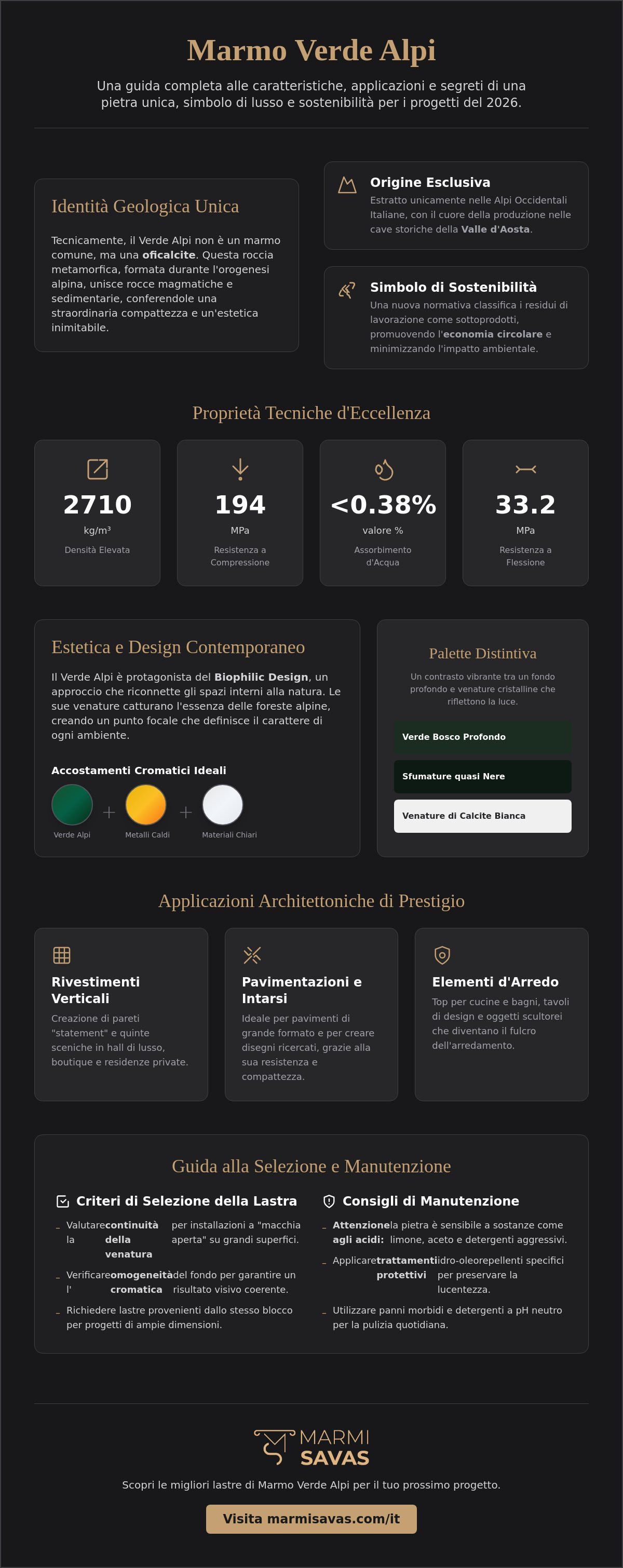
The choice of Verde Alpi marble for an architectural project is not based solely on its aesthetic impact, but also on its excellent mechanical performance. This rock presents a remarkable compressive strength, ranging between 184.0 and 194.5 MPa, making it one of the most robust natural stones available on the market. This solidity guarantees a superior durability over time compared to many purely calcitic marbles, allowing installation in areas subject to frequent foot traffic or moderate structural loads without compromising the surface integrity.
However, the longevity of this stone strictly depends on understanding its chemical nature. Despite its hardness, the calcite component present in the white veins makes the material sensitive to acids. Common substances such as lemon, vinegar, or aggressive detergents can corrode the surface, dulling the polished finish. It is therefore essential to provide a water- and oil-repellent protective treatment immediately after installation. This invisible shield does not alter the color, but prevents liquids from penetrating the micro-pores, facilitating the removal of any substances before they can cause permanent damage.
Understanding Hardness and Porosity
One of the main technical advantages of Verde Alpi is its extremely dense structure. With a very low water absorption coefficient, between 0.0095% and 0.38% by weight, this stone is much less porous than traditional white marbles. This characteristic makes it inherently more resistant to organic stains, but does not exempt it from the need for professional sealing. A masterfully executed installation must always include the sealing of joints and the surface to ensure that the depth of the green remains unaltered over the decades, protecting the stone from rising damp or external agents.
Cleaning Guide for Professionals and Clients
Daily maintenance is surprisingly simple if a few precise rules are followed. To preserve the natural luster, it is sufficient to use lukewarm water and pH-neutral detergents specific for natural stones. Here are some essential precautions:
- Absolutely avoid: anti-limescale products, bleach, or abrasive sponges that could scratch the finish.
- Prevent deposits: in bathroom environments, dry the surfaces after use to prevent water limescale residues from fixing onto the stone.
- Scratch management: small superficial marks on the polished finish can be treated with specific polishing powders, but for deep scratches, it is advisable to request a professional re-polishing intervention.
Extraordinary maintenance, such as periodic honing, restores the original splendor to the stone, eliminating the signs of time and wear.
Sourcing and Selection: Choosing the Perfect Verde Alpi Slab
The material selection phase represents the crucial moment where architectural vision meets the natural reality of the stone. Choosing the ideal slab of Verde Alpi marble requires an expert eye and a deep knowledge of the material, as each block extracted in the quarries of the Aosta Valley tells a different geological story. For high-profile projects, it is indispensable to view the whole slabs before cutting. Only through an overview is it possible to evaluate the homogeneity of the color and the distribution of the veins, ensuring that the final result reflects the client's aesthetic expectations.
The slabs of this marble often present generous dimensions, on average between 250x170 cm and 320x200 cm, with standard thicknesses of 1.8 or 2 cm. MARMISAVAS acts as a global curator, selecting only the block portions that show the best chromatic continuity. Our integrated logistics allow us to manage the supply on a national and international scale, ensuring that the quality of the stone remains intact from the moment of extraction in the quarry until delivery to the site or workshop.
Selection Criteria for Large Projects
In ophicalcites, the presence of natural micro-fissures, often called "peli" (hairs), is an intrinsic characteristic of the rock's brecciated structure. During selection for large surfaces, our experts verify that these features have been correctly treated with high-quality transparent resins, which guarantee structural stability without altering its beauty. Another fundamental aspect is the evaluation of the dominant "tone":
- Emerald Green: Ideal for environments seeking brightness and a strong link to lush nature.
- Forest Green: The classic, balanced, and deep shade, perfect for timeless interior design.
- Almost Black: Extremely dark variants that offer a rigorous elegance, often preferred in combination with precious metals.
Why Choose MARMISAVAS for Marble Supply
MARMISAVAS does not limit itself to simple supply, but operates as a dedicated consultant for architecture firms and luxury showrooms. Our experience in selecting high-end Italian natural stones allows us to identify the lots that best adapt to the technical and aesthetic specifications of each single project. We focus exclusively on the supply of superior quality slabs and tiles, guaranteeing professionals a material that is synonymous with prestige and reliability.
Elevating Interior Design with the Power of Italian Green
Choosing Verde Alpi marble means integrating an authentic fragment of Italian geological history into your projects. Discover our selection of Verde Alpi Marble and request a quote to start designing your luxury spaces in 2026.
Frequently Asked Questions about Verde Alpi Marble
What is the difference between Verde Alpi Marble and Verde Guatemala?
Verde Alpi marble differs from Verde Guatemala mainly in geographical origin and geological structure. While the Italian variety is an ophicalcite extracted in the Aosta Valley, Verde Guatemala is usually a serpentinite of Indian origin with a more uniform coloration. The Alpine stone offers a sharper and deeper chromatic contrast between the dark green background and the dense crystalline white veins, making it a much more prestigious choice for luxury interior design.
Is Verde Alpi Marble suitable for a heated floor?
Yes, Verde Alpi marble is an excellent material for underfloor heating systems due to its high natural thermal conductivity. The stone absorbs heat efficiently and releases it gradually, ensuring constant and uniform thermal comfort throughout the room. During installation, it is crucial to use high-quality elastic adhesives and grouts to accommodate the minimal thermal expansions of the material without causing cracks.
How can I prevent green marble from dulling over time?
To preserve the surface luster, it is essential to use exclusively pH-neutral detergents, categorically avoiding acidic products, anti-limescale, or bleach. The periodic application of a professional sealing treatment creates a protective barrier that prevents liquid absorption and delays the wear of the polished finish. Regular cleaning with soft cloths and lukewarm water is usually sufficient to maintain the stone's chromatic depth unaltered.
Can Verde Alpi be used for outdoor applications?
The use of Verde Alpi outdoors is generally not recommended in climates subject to severe temperature fluctuations or frequent acid rain. The calcite component present in the white veins can react with atmospheric agents and pollution, leading to a progressive loss of color and luster. For outdoor projects, we advise limiting its use to protected areas or consulting our technicians to evaluate specific surface treatments.
What is the average cost of Verde Alpi Marble per square meter?
The value of this material depends strictly on the quality selection of the block, the dimensions of the slabs, and the required surface finish. As a natural stone extracted in limited quantities, the price reflects its exclusivity and certified Italian origin. To receive an accurate and updated quote based on the technical specifications of your architectural project, we invite you to contact our sales office.
What are the standard dimensions of available Verde Alpi slabs?
Slab dimensions usually vary between 250x170 cm and 320x200 cm, with a standard thickness of 2 cm for floors and claddings. This width allows designers to work on large fields, minimizing the number of visible joints.
Is it possible to request Verde Alpi samples for my architecture firm?
Certainly, we provide physical samples of Verde Alpi to professionals and design firms to support the material selection phase. You can request your set of samples by contacting us directly, specifying the finishes required.