Natural Stone for Luxury Interiors: 2026 Trends Guide
Overview & Key Points
In 2026, natural stone in luxury interiors focuses on visual continuity and investment value. Before ordering marble or granite slabs, compare aesthetic yields, technical resistance, and budget on the Italian market: on this comparison depends whether the material supports your residential or contract project. Marmisavas offers over 200 slab options for diverse design needs.
Key Points: Natural stone for luxury interiors requires dense marbles or granites for floors and translucent varieties like onyx for vertical backlit scenography.
- Avoid use in environments with strong acids or continuous impacts without professional water-repellent treatments.
- Choose the matte finish for high-traffic floors to mask scratches and direct reflections.
- The bookmatch technique with Arabescato marble enhances dark reticles while reducing the visual impact of joints.
Index
- Selection Guide: 3 Profiles for Premium Surfaces
- Durability and Combinations That Protect the Slab Over Time
- Three Finishes and Backlighting That Change the Light in the Room
- Real Costs and Installation Times on the Italian Market
- Where Natural Stone Is Not Suitable in Interiors
- Four Phases to Select Slabs Consistent with the Project
- Frequently Asked Questions
Selection Guide: 3 Profiles for Premium Surfaces
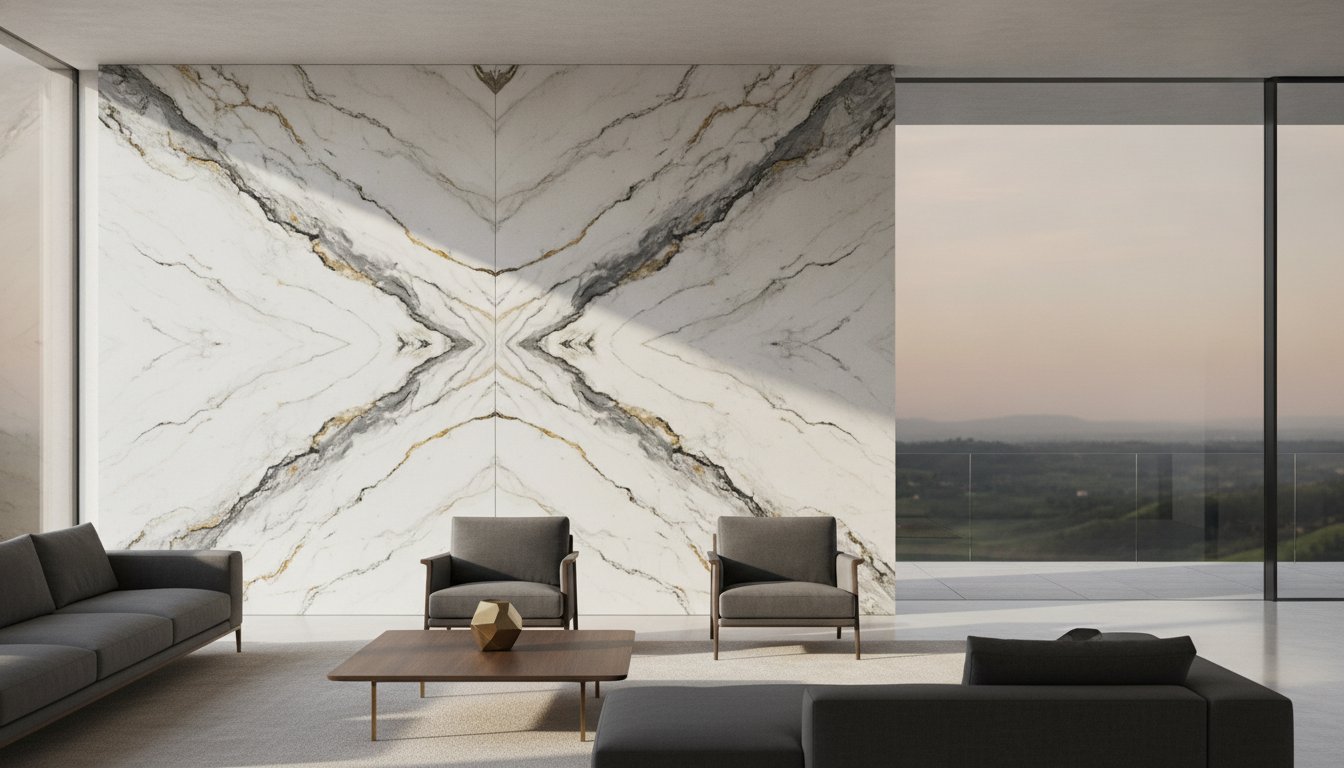
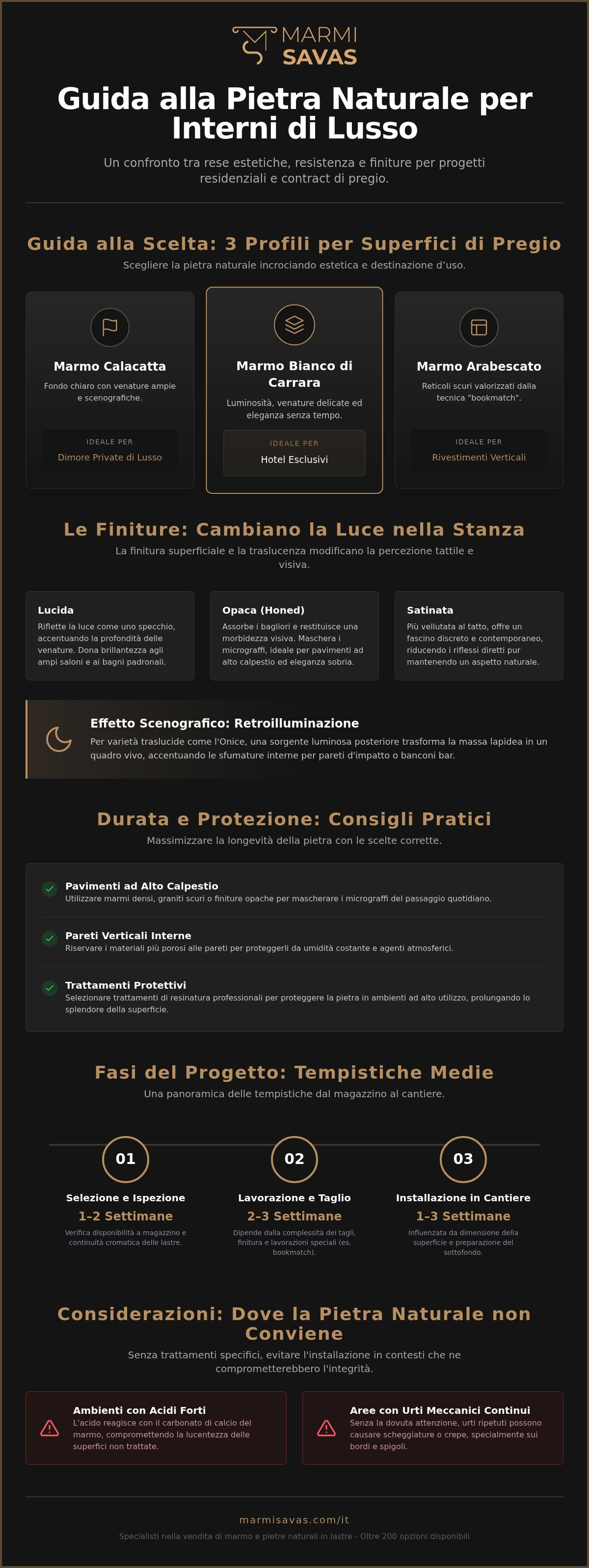
Choosing the right natural stone for your construction site requires weaving together aesthetic appearance and intended use. Three typical situations guide the decision with indications already tested in the project: in a luxury private residence, if you want a light background and broad veins, lean towards Calacatta marble; in an exclusive hotel asking for brightness and delicate veins, Carrara white marble remains the consistent choice; on a representative vertical cladding, the mirror design (bookmatch) enhances the dark reticles of Arabescato marble and reduces the joint effect.
With clients we often see architects aiming for the visual continuation of the veins in large square footage, precisely to lighten the impact of joints with a large-format slab floor. In open living rooms, that continuity makes the surface a design element readable from multiple points of view. The correct decision depends on the daily stresses expected for the top: if you prefer a velvety finish that reduces reflections, order a matte marble (honed finish).
To view the veins in the slab, explore the selection of white marble available in stock. Marmisavas guarantees the authenticity of materials and offers over 200 options for diverse architectural needs. Deep dive: White Marble Slabs.
Durability and Combinations That Protect the Slab Over Time
Dense marbles and dark granites hold up well outdoors; more delicate chromatic varieties give their most readable effect in indoor environments. From construction site practice, it is advisable to reserve porous materials for vertical walls, sheltered from atmospheric agents: thus you limit stains linked to constant humidity.
For indoor high-traffic floors, a matte marble helps mask the micro-scratches of daily passage. The combination of natural stone and metal elements creates a scenographic and refined contrast. As highlighted in the Salvatori brand collections in 2024, the union between dark marble, golden brasses, and fine woods enhances the matter's veins.
The matte finish suits elegant living areas; the glossy one transforms master bathrooms. For a sweeping large-format slab floor, select structurally sound slabs. The mirror design allows continuous and harmonious geometries. Combining black marble with light tones balances the visual field. Treating the stone prolongs the surface's splendor: the quality of the raw material remains the factor that weighs most on the result. Deep dive: Black Marble Slabs.
Tip: Professional Resin Treatments
Recommendation
Select professional resin treatments to protect the stone in high-traffic environments.
Three Finishes and Backlighting That Change the Light in the Room
The surface finish and translucency of the stone change the tactile perception of luxury design. Imagine entering your living room at the end of the day and touching the wall: a matte marble absorbs the glows and returns a quiet visual softness. The glossy finish reflects light like a pool of water and pushes deep into the golden or gray veins. The satin surface, more velvety, gives a discreet and contemporary charm.
Brown marble slabs with mineral veins instantly add personality when you apply backlighting to translucent varieties. The material works like stained glass: the rear light source transforms the stone mass into a living painting. Backlit stone accentuates internal shades and builds scenographies for impact walls or bar counters. Deep dive: Brown Marble Slabs.
Real Costs and Installation Times on the Italian Market
Installation times and final costs depend on cutting complexity and the structural characteristics of natural stone. In operational site visits, it often emerges how surface preparation impacts the calendar: a non-level subfloor with precision compromises the planarity of large-format slabs. Key cost factors include the rarity of the extracted block, the required thickness, and the type of surface finish. Working with matte marble requires specific sanding passes for a soft-to-the-touch surface. For scenographic walls, the use of translucent green stone transforms the environment and extends backlit installation. The mirror design requires preliminary workshop work to align the veins: the process raises the overall aesthetic value. Deep dive: Translucent Green Stone for Luxury.
Project PhaseEstimated TimingKey VariablesSlab selection and inspection1–2 weeksStock availability, chromatic continuityProcessing and custom cutting2–3 weeksCutting complexity, finish typeOn-site installation1–3 weeksSurface dimension, mirror design
For complex residential projects, direct supply of slabs from Marmisavas simplifies coordination. To limit delays, request a customized quote and plan shaping well in advance.
Where Natural Stone Is Not Suitable in Interiors
Without targeted maintenance, avoid stone material where acids are used or mechanical impacts are continuous. In daily practice, installation in areas with heavy chemical use compromises the luster of untreated surfaces in a short time: acid reacts with calcium carbonate and alters the visible plane. Industrial laboratory zones or kitchens with operational traffic require caution. Compared to mirror surfaces, matte finishes better conceal scratches; however, even vinegar or lemon can etch porosity. For high-impact walls in representative environments, vertical cladding with a mirror design remains a consistent choice.
Specific surface treatments reduce absorption. In places with a constant presence of liquid corrosive substances, different materials are needed. If you fear irreversible stains on work surfaces, an appropriate water-repellent finish protects the stone without altering its aesthetics.
Four Phases to Select Slabs Consistent with the Project
To choose the natural stone best suited to your space, examine structural quality and visual continuity of each surface. In the field, live evaluation remains irreplaceable to grasp the authentic depth of the material: shades vary among extracted blocks. Volakas marble, from the quarries of Greece, stands out for a white background with gray, beige, and taupe veins. Careful selection requires a rigorous method:
- Visual inspection: evaluates the surface quality of the slab.
- Technical criteria: checks thickness and absence of hidden defects, technical criteria for slab inspection.
- Pattern analysis: examines the development of marble veins.
- Final approval: confirms the chromatic homogeneity of the lot.
The orientation of the vein relative to sunlight changes the perception of final color in the environment: a detail few care about in the ordering phase. For walls, favor scenographic slabs; for wide floors, seek uniformity. This methodical selection supports a result consistent with the project.
Tip: Bookmatch Continuity
Recommendation
Always verify vein continuity with the bookmatch technique before final cutting.
Details and Request: MARMISAVAS
Frequently Asked Questions
Why is natural stone appreciated in luxury design?
Natural stone remains central in luxury design for visual authenticity and resistance. Each surface presents a non-repeatable mineral pattern that transforms a wall into a dynamic work of art. To enhance these motifs, many architects adopt the mirror layout, placing two adjacent slabs in symmetrical compositions. The finish elevates the perception of space and makes residential or contract projects more recognizable over time.
Which stones are suitable for indoor versus outdoor use?
Material selection depends on chemical resistance and water absorption. Dense stones like granites or some quartzites handle external thermal shocks well. Volakas marble, from Greek quarries, offers a white background with gray or beige veins, suitable for elegant floors inside prestigious residences. For refined vertical claddings oriented towards a light background, Calacatta marble and Carrara white marble remain established project references.
How does stone texture affect design uniqueness?
Mineral microstructure defines how light interacts with the surface. The satin finish gives a soft-to-the-touch texture and distributes light with delicacy, reducing direct reflections and accentuating vein depth. Choosing the right finish transforms a mineral surface into a complete sensory experience and distinguishes high-end spaces from ordinary projects.
How does backlighting enhance onyx?
Backlighting exploits the translucency of selected stone to allow hidden veins to emerge. Onyx allows light to pass through the slab thickness and transforms the wall into a scenographic luminous source. Chromatic details and internal veins become three-dimensional when artificial light passes through the rear. The application sustains the atmosphere in hotels, wellness spaces, or prestigious living zones.
What advantages does natural stone offer in interior design?
Natural stone offers secular durability, manageable maintenance, and solid aesthetic value over time. Installing a large-format slab floor reduces visual interruptions and amplifies spatial continuity. Marmisavas offers a wide selection for these design needs. Beyond visual impact, the thermal inertia of stone stabilizes the surface temperature of air-conditioned environments.
Your Next Design Project
Carefully planning slab selection produces refined and durable environments. The use of natural stone for luxury interiors gives stable elegance to floors, walls, and custom countertops. In 2026, Marmisavas experts highlight the certified origin of materials, such as the provenance of Volakas marble, for first-choice blocks. Visual continuity stems from careful slab selection and vein alignment before cutting. To view the catalog and evaluate stones suitable for your home, request a specialized consultation.