Practical Tips on How to Choose the Perfect Marble Slab
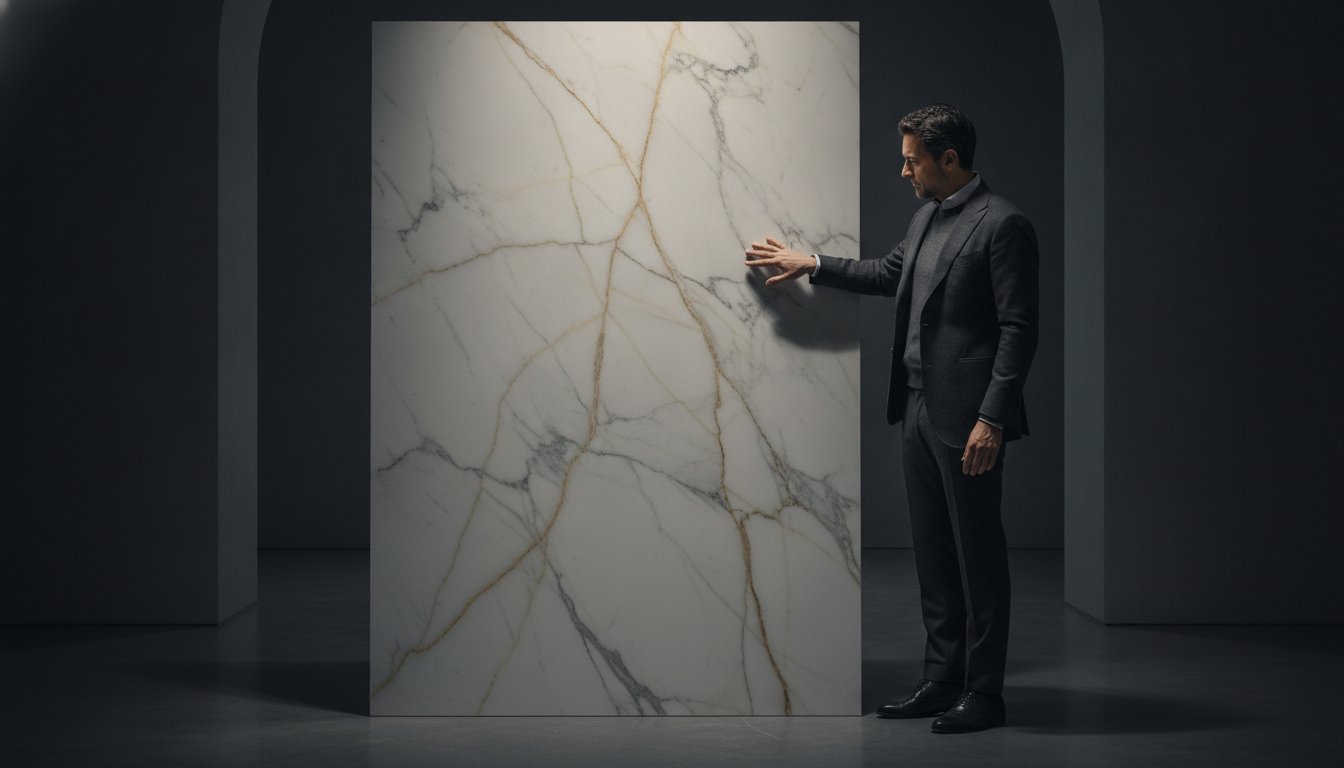
Choosing a marble slab requires careful analysis of veins, thickness, and stone origin to avoid surprises during installation. Two questions guide the work: which pattern and which finish suit the intended use, and how much of the budget should be allocated to visual continuity, waste, and long-term protection. If you wish to enhance your home with high-value natural stones, evaluate the surface both aesthetically and structurally. An expert marble worker helps you connect material, cutting, and installation to your needs.
Key Points & Overview
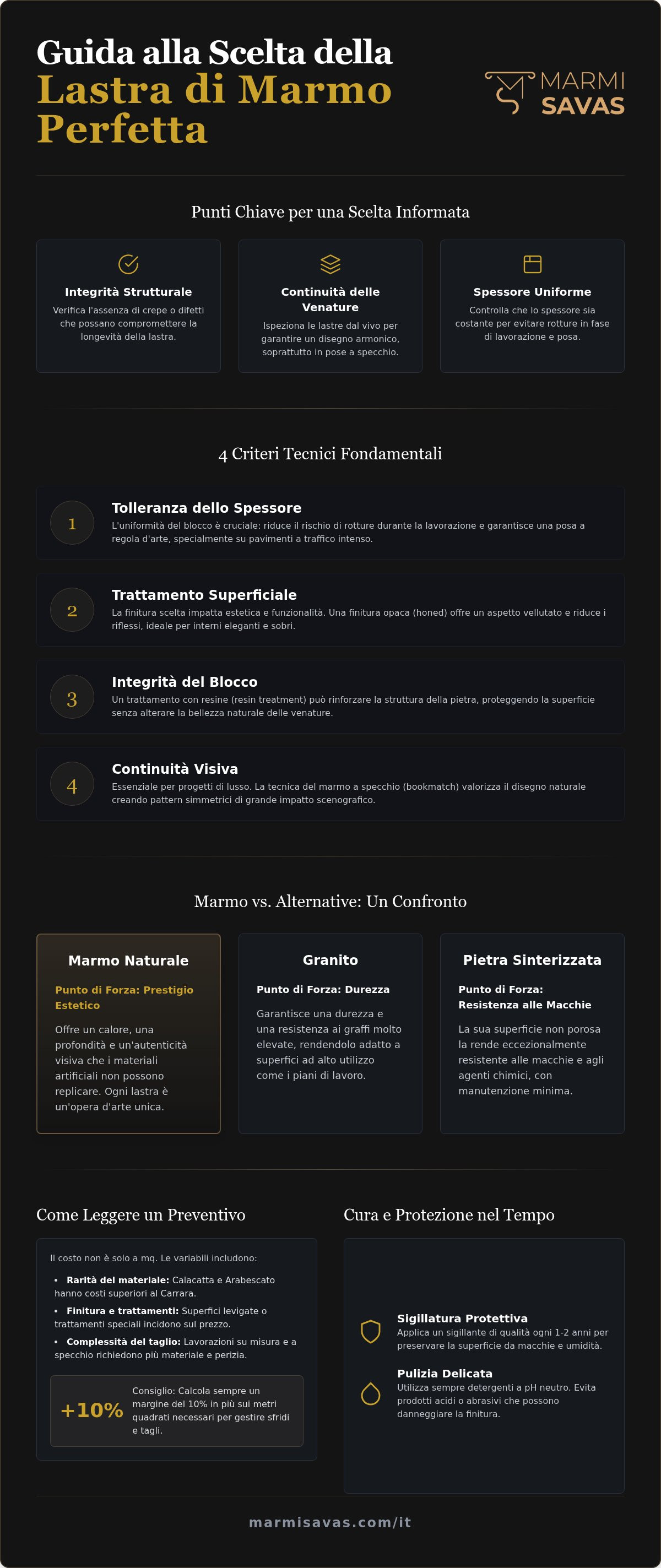
- Choose the perfect marble slab by verifying structural and vein integrity and a uniform thickness suitable for your project's static load.
- Avoid natural marble in industrial or acid-exposed contexts without constant maintenance.
- Apply a protective sealer every one to two years to preserve saturated surfaces.
- Always calculate an extra 10% margin on square meters to manage waste.
Table of Contents
- Pattern continuity: the ideal slab for your project
- Four technical criteria separating a solid slab from a weak choice
- Cost per sqm: how to read slab budgets and quotes
- Marble, granite, or sintered stone: which material serves your space
- Five steps to inspect and order the slab without installation errors
- Sealing and care: how long protection lasts over time
- Where natural stone is not suitable and what to evaluate first
Pattern Continuity: The Ideal Slab for Your Project
Practical Applications & Selection Factors
Three recurring situations guide selection in a concrete way. For residential indoor flooring, a honed marble finish reduces reflections and better withstands foot traffic marks. For an accent wall, the bookmatch technique and marble veining continuity control prevent chromatic breaks after cutting. For a Calacatta marble kitchen countertop, already factor in the sealing cycle during selection (re-application of the protector every one or two years) and the use of neutral pH detergents.
Visual and Structural Evaluation
Choosing stone to clad a surface requires both visual and structural evaluation. Verifying visual continuity live, before cutting, prevents chromatic disharmonies among stone elements, especially when comparing materials like Carrara white marble, Calacatta, and Arabescato.
The marble pattern drives the final effect. Calacatta marble brings scenographic veins on a light background, suitable for luxury projects. Book-matched marble unites two mirrored slabs with sequential precision. In high-traffic environments, honed marble offers sober elegance without aggressive specular reflections. Marmisavas selects slabs for high-level residential, commercial, and architectural uses.
The stone surface conveys an immediate tactile response: selection demands technical competence, not just taste. Careful visual inspection identifies the purity and authenticity of natural stone and protects the aesthetic yield over the years.
Four Technical Criteria Separating a Solid Slab from a Weak Choice
Methods of Inspection
Rigorous inspection distinguishes a reliable material from a slab that disappoints upon installation. Physical characteristics must be read methodically before purchase: structural verification, in our opinion, precedes aesthetic selection.
The structural qualities define the longevity of the prized material extracted from the Apuan basin, a tradition tied to Carrara Marble.
Operational Criteria
- Thickness tolerance: block uniformity reduces the risk of breakage during processing and installation.
- Surface treatment: honed marble yields a velvety, reflection-free finish suitable for elegant interiors.
- Block integrity: a resin treatment protects the surface without altering the marble pattern.
- Visual continuity: in complex installations, the book-matched marble technique enhances chromatic networks.
Calacatta Luna slabs, extracted from high-value quarries in Italy, feature a round and soft structure on a white background with gray veins. For dark shades, you can orient yourself toward gray slabs in natural stone of a similar selection, evaluating the vein and background on the actual piece. In-depth guide: Marmo Grigio Slabs.
Thickness must be calibrated to static load and stress: vertical cladding prefers slabs that do not weigh down the structure more than necessary; high-traffic flooring requires thickness and, if specified, reinforcements consistent with use. A thin slab requires careful handling and support, without improvising on site.
- Tip: Verify the visual continuity of the pattern before cutting to guarantee the harmony of the finished work.
Cost per SQM: How to Read Slab Budgets and Quotes
Financial and Technical Breakdown
Understanding quotes means breaking down technical specifications and finishes. Transparency here means evaluating geographical rarity, thickness, and surface treatments one by one, not just the sqm price printed on the price list.
Visual continuity affects installation waste: slabs with a well-defined marble pattern require careful selection right from the estimation phase. Book-matched marble processing raises the scenographic impact in luxury interiors, but requires dedicated sequential blocks. Honed marble surfaces offer a velvety aesthetic and reduce direct reflections, with a cost profile tied to finishing and cutting waste.
Material Cost Comparison Table
Material TypeCost VariablesIntended UseCarrara White MarbleVein section, background purityFlooring, claddingCalacatta and ArabescatoVein dramatic effect, rarityAccent walls, custom elements
For precise estimates on white marble slabs, it is best to base the quote on the exact measurements of the project. Cutting complexity weighs on the final price; calculating the total surface area, including margins, keeps the budget under control. The right stone combines aesthetic value and durability in exclusive residences. In-depth guide: White Marble Slabs.
Request a custom quote with your room dimensions and desired finish.
Marble, Granite, or Sintered Stone: Which Material Does Your Space Need?
Natural stone brings an aesthetic charm that is difficult to replicate in interior coverings. In site selections, it clearly emerges how this raw material surpasses granite and sintered stone for warmth and visual prestige: the organic depth of the surface transforms the environment into a living visual field, rather than a flat background. For exclusive projects, compare performance. Granite guarantees high hardness; sintered surfaces resist stains well. Natural stone bridges the gap between those seeking an authentic look and a unique marble design for flooring and scenographic walls. Among natural stones featuring chromies and origins, Volakas marble, extracted from Greek quarries, stands out for a white background with gray, beige, and taupe veins. To map origins and stone families, you can consult a list of marble types grouping notable deposits and denominations. Application and finishing close the result. Honed marble offers a tactile velvety surface; for scenographic layouts, book-matched marble creates continuous mirrored motifs. In the selection of Carrara, Calacatta, and Arabescato, you can compare suitable slabs for your home. Choice follows project priorities: marble suits high-level residences where aesthetics guide decisions; granite and sintered remain effective in very high-traffic areas or external surfaces exposed to atmospheric agents.
Five Steps to Inspect and Order the Slab Without Installation Errors
Adapt the slab to space without errors from millimetric dimensioning of shapes. Inaccurate dimensions produce wrong drawings and misalignments of the marble design: measuring the real room equals tracing a tailored map for the stone.
Detailed Inspection Process
1. Measurement of real dimensions
Measure height, width, and diagonals of walls or spaces destined for the slabs.
2. Safety stock
Calculate an extra 10% margin on m² to manage perimeter cuts.
3. Planarity check
Check that the support surface has no depressions greater than 2 mm.
4. Structural inspection
Examine the slab to exclude unconsolidated micro-fractures prior to transport.
5. Chromatic check
Compare adjacent blocks to verify the continuity of the light background of Calacatta marble or the veins of Arabescato.
Custom cutting reduces waste of prized stone and preserves the impact of large-format slabs. In vertical wall coverings, define the numerical sequence before cutting: this avoids aesthetic surprises on site and keeps the design aligned along the entire wall.
Sealing and Care: How Long Does Protection Last Over Time
Sealing frequency depends on intensity of use and how exposed the natural stone is to staining agents. A typical site case clarifies this in three steps: Situation: a Calacatta marble kitchen countertop accumulates contact with oils, weak acids, and detergents. Action: reapplication of the protector is programmed every one or two years, and aggressive products are excluded. Outcome: the veins remain readable and the surface does not open to premature pores. On vertical surfaces and cladding, protection can last up to four years. Honed marble has higher surface porosity than polished finishes and requires more frequent treatments to stay neat to the view.
Maintenance Guidelines
Daily cleaning with aggressive detergents removes the protective layer ahead of schedule. For veining layouts, the safe route is neutral pH soaps. In master bathrooms, a biennial treatment cycle makes sense, thus limiting water spots and scale or cosmetic stains. In high-traffic environments with large-format slabs, annual inspection identifies worn points: when water stops forming droplets on the surface, it is time to renew the protective resin and prolong the useful life of the material.
Where Natural Stone Is Not Advisable and What to Evaluate First
Authentic lapidary materials are not the suitable answer for every structural or chemical context. Spaces exposed to aggressive acids suffer the use of marble: this metamorphic rock undergoes continuous chemical corrosion and loses luster.
Material Limitations & Suitability
Bianco di Carrara marble offers great elegance, but a countertop subject to stubborn stains demands constant attention. Sensitivity to acidic substances alters the polished surface; in these cases, natural stone holds up only with periodic maintenance or structured protective treatments, otherwise, it is advisable to evaluate less reactive alternatives.
Intense foot-traffic surfaces push toward different materials. In exclusive homes, on impact walls, and in classy bathrooms, marble remains a solid solution. In heavy-use commercial projects, constant care becomes the factor that preserves the original marble design. Evaluate the destination of use before purchase, because aesthetic stability does not imply an exception. Details and request: MARMISAVAS.
Frequently Asked Questions
How to Choose the Marble Slab?
Inspect chromatic continuity and marble design across the entire surface, in full light. Technical criteria look at thickness, structural integrity, and absence of open defects. Honed marble highlights delicate tones. If you are looking for a scenographic stone for luxury residences, Calacatta marble offers a light background with wide and marked veins; for large and luminous environments, Bianco di Carrara brings sober elegance and readable endurance over time.
What Factors Influence Slab Pricing?
Material rarity, quarry provenance, and vein continuity determine economic value. Calacatta Luna marble arrives from prized Italian quarries and shows a fibrous texture on a white base. Volakas marble is extracted from Greek quarries and features a white background with gray and beige tones. Surface treatments and thickness impact final cost. For precise figures on your project, ask for a dedicated quote with measurements and finish.
How to Calculate the Necessary Size?
Measure the total surface of the environment, including perimeter cuts and technical waste. In large-format flooring, spatial continuity reduces the number of visible joints. On impact walls, the book-matched marble technique is applied, juxtaposing sequential slabs. Keep a safety margin for installation and have a professional support you on exact measurements.
How to Get the Best Quality-Price Ratio?
Select thicknesses consistent with destination of use and verify structural quality on the piece. The global market offers different selection phases for different budgets. Buying with direct control over design and aesthetic yield limits waste at cutting. Accurate inspection before order avoids slabs that do not align background and veins on site.
How to Clean Sintered Stone Slabs?
Clean with lukewarm water and non-abrasive neutral detergents, without aggressive acids. This material resists stains well and does not require complex sealing nor periodic resin cycles. Wipe with a soft microfiber cloth to avoid streaks and keep the surface free of dust to preserve luster.
Your Project with Premium Natural Stone Slabs
Knowing how to choose the right marble slab requires technical competence and knowledge of lapidary material: the two starting questions return (design and thickness for use, budget for continuity and protection) and close only with live-seen pieces, real measurements, and a realistic maintenance plan.
Professional Consultation and Support
MARMISAVAS consultants guide you on the visual continuity of the marble design and the provenance of stones, including the renowned Volakas marble. You can consult the catalog for available finishes on your surface and write for a quote with project quotes, thus defining the space with measured elegance and durability.