Quality certifications for marble: how to read documents and verify slabs

A certificate can describe a company's organization, but it does not tell every detail of the slab you have chosen on its own. For this reason, quality certifications for marble must be read together with technical documentation and a direct examination of the material. This is an important distinction when selecting a natural stone for a project where aesthetics, intended use, and slab characteristics must dialogue with precision.
It is natural to look in documents for simple and definitive confirmation of quality. In reality, a company system certification, a product data sheet, and a test report have different functions: knowing what they attest helps avoid misleading interpretations and focus on the data relevant to the intended application.
In this article, we will see how to distinguish these types of documents, what technical characteristics to consider, and how to combine the reading of papers with a visual inspection of the slab and verification of its origin. Marbles like Bianco Carrara, Calacatta, and Arabescato show how much color and veining can vary: a conscious evaluation starts from the available information, but is completed by observing the selected material.
Key Points
- Quality and marble certifications may concern the company system, while tests and technical data sheets describe different aspects of the product.
- Evaluate rules and documents in relation to the stone's format and intended application, without automatically considering them pertinent to every project.
- Compare declared origin, technical documentation, and test results: each element offers useful information, but has interpretive limits.
- During inspection, observe the color, veining, thickness, and visible defects of the selected slab, recording the checks performed.
- Define the selection by considering together the design, required characteristics, format, and natural appearance of the marble.
Table of Contents
- Quality certifications for marble: what they really certify
- Technical documents of marble: standards, tests, and declarations to understand
- How to compare marble quality certifications and documents
- Inspection of marble slabs: technical criteria and visual control
- Choosing certified marble for a project: decisions and next steps
Quality certifications for marble: what they really certify
A certification attests conformity to defined requirements; a technical test measures one or more characteristics according to a declared method; visual control allows observing the slab and evaluating its appearance. These are complementary checks, not synonyms. To understand the material, it can be useful to start from the definition of marble: its geological origin helps contextualize the natural variations in color and veining that make each slab distinct. No single document describes every aspect of a natural slab on its own. Quality certifications for marble must therefore be interpreted based on what they actually attest, without attributing information to them that they do not contain.
Company certification and material quality: the essential differences
ISO 9001 concerns an organization's quality management system: it describes an approach to business processes, does not assign a quality class to marble, and does not automatically certify every marketed slab. Similarly, an environmental or occupational safety certification concerns aspects of company management, not the aesthetic characteristics or specific performance of the stone. In practice, a company certification can offer information on how an organization manages its activities, but it never establishes whether a slab of Calacatta, Bianco Carrara, or Arabescato is suitable for a given application. It does not describe, for example, the pattern of the veining, nor does it replace the evaluation of the selected material.
Origin, technical data sheet, and certificate: what each document communicates
A provenance attestation indicates the declared origin of the material. It is useful information to reconstruct its traceability, but on its own it does not demonstrate resistance values or other technical performance. The technical data sheet, on the other hand, collects data referring to the material and can help compare them with the project's requirements; however, it is necessary to verify which product, format, and use it refers to.
A test report documents the result of a specific measurement, together with the method used. Its informative value therefore depends on the parameter examined and the correspondence between the sample tested and the slab to be evaluated. A test on one characteristic does not automatically certify all others.
- Provenance: informs about the origin.
- Technical data sheet: summarizes characteristics pertinent to the material and use.
- Test report: documents a parameter measured with a specific method.
CE marking and performance declaration: when they are relevant
CE marking and the performance declaration should not be considered identical requirements for every marble product. Their applicability depends on product characteristics, intended use, and current technical and regulatory provisions. For this reason, the correct reference must be verified on the specific product, avoiding deducing the obligation or exemption from the word "marble" alone. When relevant, the performance declaration reports performances referring to defined characteristics. It does not attribute an absolute aesthetic quality and does not establish whether the shade, background, or veins are those desired in the project. The choice of quality certifications for marble therefore requires linking documents and performances to actual design requirements.
Technical documents of marble: standards, tests, and declarations to understand
A technical standard establishes criteria or test methods, while a report documents the results obtained on a sample. To correctly read documents, one must first identify the product: a raw slab, a processed element, and a material intended for a specific application may require different references. The destination, for example a cladding or flooring, also guides which characteristics are useful to evaluate. EN 12058 and EN 1469 can be references to examine in relation to the product type and intended use. However, they should not be cited as automatically pertinent to every single slab: before basing a design choice on a standard, it is appropriate to verify the title, scope of application, and current edition. The UNI catalog on natural stone standards is a starting point for identifying applicable technical references.
Which tests can describe the characteristics of marble
Physical and mechanical tests can concern, for example, water absorption, density, or mechanical resistance. Each result answers a circumscribed question: absorption data alone does not describe resistance, just as a mechanical test does not define color or vein pattern. The reported number must be read together with the test method, sample identification, and conditions considered. Before comparing results or applying them to a project, verify that the document indicates the standard used and that this, in its current edition, is pertinent to the intended use. If the sample is not clearly traceable to the selected material, the data may not describe that specific slab.
How to compare marble quality certifications and documents
A useful comparison does not consist in counting documents, but in understanding which object each one refers to and what information it offers for the project. Comparing documents means comparing equivalent parameters and destinations.
Inspection of marble slabs: technical criteria and visual control
Observe the single slab and consider the color background, vein distribution, thickness, and visible imperfections. Then evaluate the entire supply: tone and design variations between slabs affect surface continuity. The check does not only concern the appearance of an isolated sample, but also the coherence of the material with the expected result and the foreseen project layout.
Choosing certified marble for a project: decisions and next steps
When reading a data sheet or report, check the material description and, when it appears, verify data matching against the concrete requirements of the intended application. A result attributed to a parameter or a different sample does not allow direct comparison with the selected slab. The selection and evaluation of natural stone slabs require, beyond technical documentation, a direct visual inspection.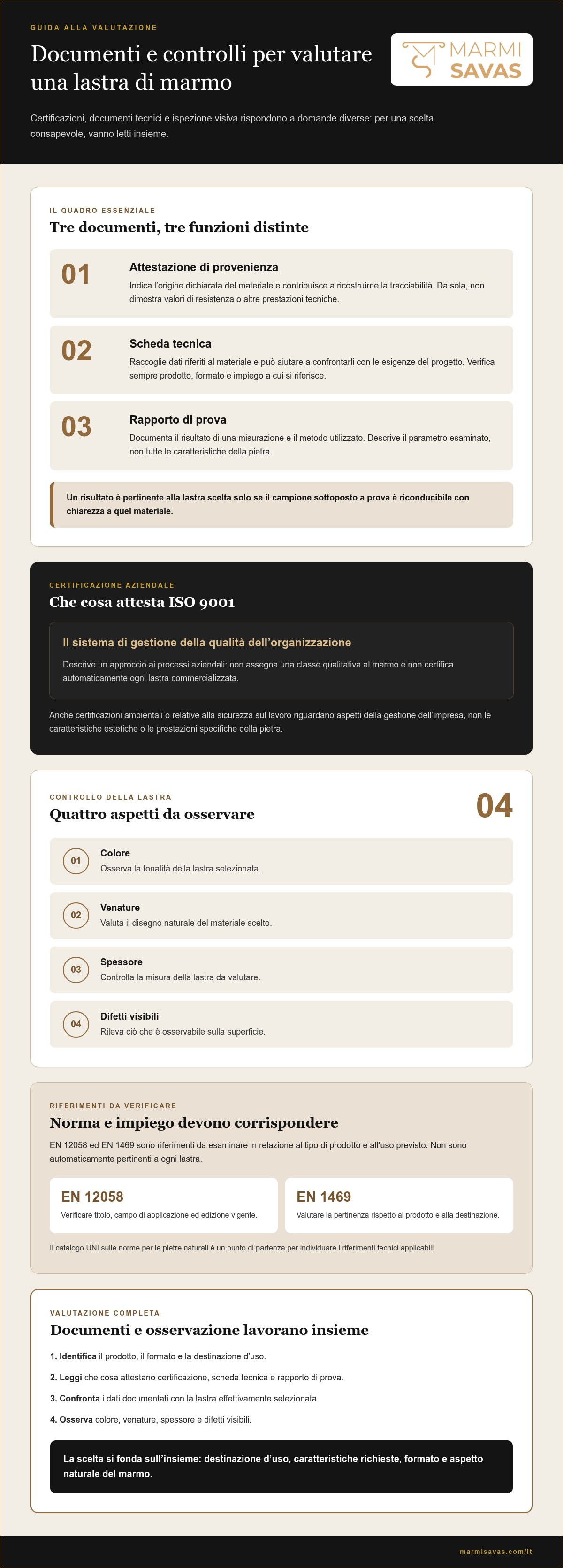
Inspection of marble slabs: technical criteria and visual control
An effective verification starts from the project, not from a generic control. First, the intended application is identified; then the relevant documents are examined, the selected slab is observed, and verifications are recorded. This sequence helps to connect visible characteristics and available data to real needs, without confusing natural appearance with technical performance.
Visual control of color, veins, and integrity
Observe the slab in its entirety under adequate light and from a distance that allows grasping the whole. Evaluate the background tone, color distribution, rhythm of the veins, and their continuity. In Bianco Carrara, for example, gray shades and veined marks can vary from one slab to another; in Calacatta, the contrast and width of the veins contribute to a more pronounced visual presence. Also check the edges and surface to identify any chipping, cracks, or visible repairs. Noticing them is an observation, not a structural diagnosis: their relevance is evaluated in relation to position, intended use, and available technical information. Color variations and irregular veins are also natural features and do not automatically mean defects. If the project requires graphic continuity or a continuous-vein composition, evaluate the slabs in their entirety and mutual relationship. Frontal photographs, identifying references of the selection, and notes on verifications make it simpler to connect what has been observed to the consulted documents.
From slab selection to verification for the project
Compare required dimensions, thickness, and finishes with the data reported in the available documentation. If the information refers to a sample or a different selection, note the discrepancy instead of assuming they describe the observed slab. Samples and images help guide the choice, but natural marble presents variations: aesthetic correspondence does not need to be necessarily perfect.
- Destination: clarify where and how the material will be used.
- Documents: verify that the data is pertinent to the product and use.
- Slab: observe color, veins, thickness, and visible defects.
- Traceability of selection: keep photographs and identifying references together with notes. The finish modifies reflections and surface perception. To deepen options related to Bianco Carrara marble, evaluate the finish in relation to light and project language. Quality certifications for marble acquire value when documentation, visual inspection, and destination are evaluated together. Share your project requirements and the selection of slabs to evaluate.
Choosing certified marble for a project: decisions and next steps
The choice of a slab does not reduce to the presence of a certificate. It must relate destination of use, pertinent performances, format, appearance, and available documentation. Natural marble does not correspond to a uniform aesthetic class: background, tone, and veins vary, therefore every selection is evaluated in the context of the project and referred to the material actually chosen.
What information to prepare before selecting slabs
A brief clear helps to narrow down the choice and evaluate both documents and the appearance of the stone consistently. Before comparing slabs, gather the essential information.
- Application and format: indicate the environment or surface foreseen and the indicative dimensions required.
- Finish and render: define the desired effect, for example an opaque or more luminous surface.
- Aesthetic objectives: share visual references to clarify background tone, intensity of veins, and possible graphic continuity.
- Technical requirements: indicate which performances are relevant based on use, to concentrate reading on pertinent data. These elements do not make the natural slabs identical, but allow comparing them with greater precision. For example, Calacatta can present a light background crossed by wide and scenographic veins: the selection of Calacatta marble allows exploring different interpretations of this visual character.
A project comparison with an expert supplier
A dialogue with natural stone professionals helps connect the design vision to the characteristics of the slabs and available documents. With over 200 options of natural stones, MARMISAVAS offers a wide choice to explore, from white marbles like Bianco Carrara and Arabescato to dark and colored varieties. The selection can thus start from concrete needs, without confusing company information with those referring to the material. Along this path, quality certifications for marble are a reading tool, not a universal answer: the most conscious decision is born from the encounter of project requirements, pertinent documentation, and slab observation. Consult with MARMISAVAS on the marble best suited to your project, sharing application, format, and desired aesthetic result.
Turn selection criteria into a conscious project
A careful choice linking the destination of use with pertinent documents does not confuse company certifications, technical data sheets, and test results. Verification is completed by observing the selected slab: color, veins, thickness, and visible defects contribute to evaluating coherence with the project. Quality certifications for marble are therefore a useful tool to be interpreted together with the characteristics of the natural material. Bianco Carrara, Calacatta, and Arabescato offer different expressions in terms of tone and design. MARMISAVAS specializes in supplying slabs for architectural and interior design projects, with over 200 natural stone options and a wide ready stock even for high volumes. To start a targeted comparison, share the destination of use, format, and desired aesthetic result: consult with MARMISAVAS on the marble best suited to your project. With documents read with criteria and a conscious visual selection, you can give shape to a natural stone choice in tune with your vision.
Frequently asked questions about marble certifications
What does a quality certification for marble certify?
It depends on the object indicated in the document. A certification can refer to a company's management system, while a technical data sheet summarizes the characteristics of the material, and a test report documents specific parameters measured. To interpret them, verify which product they refer to and consider the destination of use. No certificate, on its own, describes every technical and aesthetic aspect of a single natural slab.
Do ISO certifications guarantee the quality of a marble slab?
No. A corporate ISO certification concerns processes or management systems according to the indicated standard, it does not automatically certify every slab supplied. It does not establish on its own the color, vein design, integrity, or performance of the selected marble. To evaluate a specific slab, combine visual control with pertinent documentation, considering any pertinent technical tests and always the intended application.
Which documents should be consulted to evaluate the quality of marble?
Documents depend on the product and intended use. You can examine a technical data sheet, provenance information, and any test reports relating to specific parameters. Check that the material described, the method used, and, when indicated, the sample analyzed are clear. Quality certifications for marble and technical documentation help guide the evaluation, but do not replace the inspection of the selected slab.
Is CE marking always necessary for marble slabs?
It cannot be assumed that the same requirements apply to every stone product. The applicability of CE marking depends on the product, intended use, and current provisions. Even references like EN 12058 and EN 1469 must be verified in relation to use and the updated edition of the standard. Before drawing normative conclusions, it is appropriate to identify which reference concerns the specific material and its shape.
How is a marble slab checked before selection?
First define the application and requirements of the project, then compare them with pertinent documents. Observe the slab in its entirety and note color, veins, thickness, and visible defects, verifying that the result responds to aesthetic goals. Photographs and identifying references help connect inspection with documentation. The natural variations of marble in context do not automatically indicate a defect.
Is a slab with irregular veins of lower quality?
Not necessarily. Veins are part of the natural identity of marble and can vary in intensity, direction, and continuity. Aesthetic evaluation depends on the desired composition and the role of the slab in the project. It is useful to distinguish these variations from eventual physical criticalities, observing the material and consulting pertinent technical data. An irregular pattern alone does not determine the suitability or overall quality of the stone.
What is the difference between marble provenance and a quality certification?
Provenance indicates the declared origin of the material and can contribute to its traceability. A certification, a technical data sheet, or a test report instead concerns the object and specific aspects described in the document, such as a company system or specific parameters. Provenance alone does not prove the performance or integrity of the slab. For a comprehensive evaluation, compare provenance with available technical information and visual inspection of the material.